
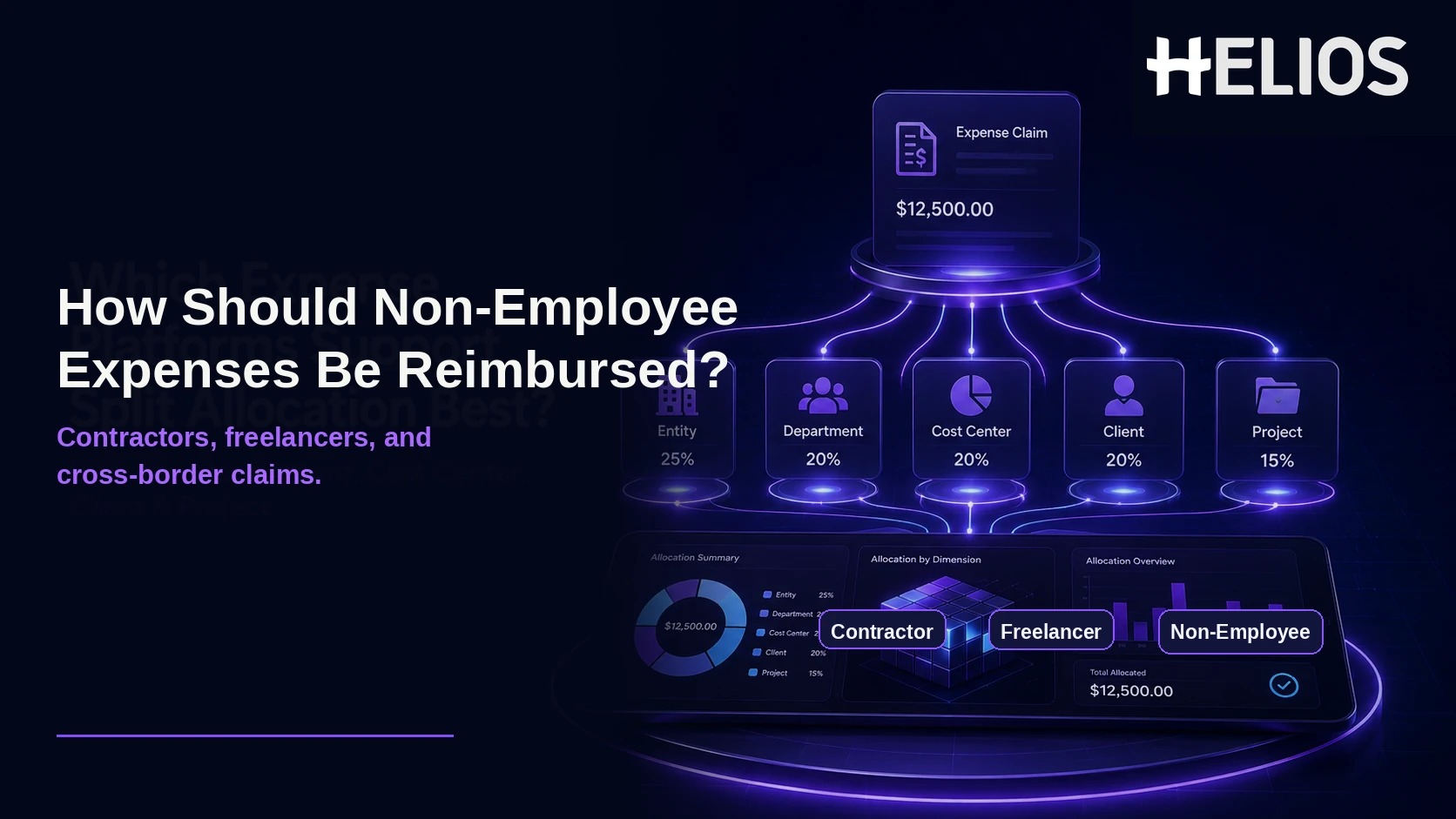
Contractors, freelancers, consultants, guest experts, and other non-employees often incur legitimate costs while delivering work for a company. The mistake is to treat those costs exactly like employee reimbursements. A non-employee may be a vendor, an individual service provider, a worker engaged through an intermediary, or a non-resident professional—and each status can change the invoicing, withholding, VAT/GST, payment, and reporting requirements.
For global finance teams, the safest design is to classify the payee and engagement first, agree the expense treatment in the contract, collect the right evidence, then route the payment through the appropriate vendor, AP, payout, or expense workflow. Country rules should determine the tax treatment; the software should preserve the business purpose, approvals, documents, payment status, and accounting trail.
Start With Worker Status and the Commercial Relationship
The label “freelancer” is not enough. Before accepting expense claims, finance and procurement should know who is legally supplying the service and who is being paid. Worker-status mistakes can turn an apparent vendor reimbursement into an employment-tax or reporting issue.
| Payee / Engagement | Typical Expense Route | What Finance Should Confirm |
| Individual contractor or freelancer | Approved expense claim linked to the engagement, or expenses included on the contractor invoice. | Contract/SOW, worker status, tax ID, reimbursable categories, invoice requirement, and payment destination. |
| Contractor company / personal service company | Vendor invoice through AP; expense lines may be separate or included in the service invoice. | Correct vendor entity, VAT/GST status, withholding rules, and whether pass-through costs are principal expenses or true disbursements. |
| Agency or intermediary worker | Usually paid through the agency/intermediary arrangement rather than direct employee reimbursement. | Who is the fee-payer, whether off-payroll rules apply, and which party owns travel/expense obligations. |
| Guest expert or non-resident professional | Engagement-specific reimbursement or payment, often with extra withholding review. | Country of service, residency, tax treaty/withholding requirements, reimbursed benefits, and required documentation. |
The reimbursement process should never be used to bypass status determination, vendor onboarding, tax forms, or contractual payment terms. If a person is actually an employee for local tax or labor purposes, the organization should correct the classification rather than preserve a contractor workflow for convenience.
Choose the Right Expense Model Before Work Starts
Most companies use one of three models. The correct choice depends on tax, VAT/GST recovery, administrative effort, and how much control the company wants over travel and other spend.
- Contractor-paid, reimbursed separately. The contractor pays an approved business cost and submits evidence for reimbursement. This can work well for occasional travel or small out-of-pocket costs, but the contract should say what is reimbursable, what evidence is required, and whether any tax applies to the reimbursement.
- Expense included on the contractor or vendor invoice. The service provider invoices fees plus approved pass-through expenses. This keeps payment in AP, but finance must understand whether the expense becomes part of the taxable supply or is treated as a true disbursement under local indirect-tax rules.
- Company pays the travel or supplier directly. For high-value airfare, hotels, events, or regulated locations, direct booking can reduce contractor cash-flow burden and improve evidence quality. It may also make VAT/GST recovery cleaner when the company is correctly named as the customer.
A fourth model—paying the non-employee through payroll simply because the person is an individual—should not be the default. Payroll may be appropriate if local law or worker classification requires employment treatment, but otherwise non-employees are normally better managed through a vendor or controlled non-employee payment process.
Minimum Evidence for a Non-Employee Expense Claim
The organization should capture enough information to prove both the business purpose and the tax/accounting treatment. A practical minimum data set includes:
- Engagement reference. Contract, purchase order, statement of work, project, cost center, or event that explains why the expense was incurred.
- Payee identity. Contractor/vendor legal name, country, tax ID or registration data required by the local process, and approved payment destination.
- Expense evidence. Itemized receipt or invoice, date, supplier, amount, currency, tax details where relevant, and proof of payment when policy requires it.
- Business purpose. Who or what the expense supported, why it was necessary for the engagement, and any client/project or travel context.
- Approval and exception history. Pre-approval where required, policy exception reason, approver, and any local tax or procurement review.
If the contractor is expected to invoice the expense, the expense claim should not create a second independent payment. The system needs a rule that links supporting expense evidence to the vendor invoice or otherwise prevents duplicate reimbursement.
Country Differences Can Change the Payment Treatment
Global policies should define a common control framework, but local overlays must handle worker classification, withholding tax, invoice rules, and indirect tax. The examples below illustrate why one global “contractor reimbursement” rule is risky.
| Country / Region | What Can Change the Expense Treatment | Practical Control |
| United States | Independent-contractor status matters. Certain reimbursed contractor travel and related costs require substantiation; unsubstantiated amounts can become income to the contractor. Nonemployee service payments may also have information-reporting obligations. | Keep the engagement, business purpose, receipts, tax form/vendor record, and reimbursement terms linked to the payment. |
| United Kingdom | IR35/off-payroll rules may apply contract by contract. Workers through intermediaries can face employee-like tax treatment, and travel/subsistence restrictions may apply to ordinary commuting for an engagement. | Complete status determination before building the expense route; do not assume a personal-service-company invoice makes all travel reimbursable tax-free. |
| Australia | Contractor payments can involve ABN, GST and PAYG-withholding considerations. A supplier that does not quote an ABN can trigger withholding, and contractor reporting rules may apply in some industries. | Validate vendor/ABN and GST data before payment and ensure invoice evidence matches the legal supplier. |
| Singapore | For non-resident professionals performing services in Singapore, reimbursed airfare, accommodation, per diem, transport and meals can form part of the withholding-tax base depending on the tax method. GST treatment also differs between reimbursement and disbursement. | Route the claim to tax review before payment and identify whether the contractor acted as principal or agent for the underlying cost. |
| European Union | B2B supplies generally require VAT invoices, and a valid VAT invoice is normally the core evidence for input-VAT deduction. National rules still vary. | Require correct supplier/customer VAT details and avoid treating a card receipt as sufficient VAT evidence when a full invoice is required. |
These examples are policy-design signals, not substitutes for local tax advice. The same contractor can also have different outcomes in different countries depending on where services are performed, who contracts with the worker, and which legal entity pays the expense.
A 6-Step Global Non-Employee Expense Workflow
- Onboard and classify. Confirm the legal payee, engagement type, worker-status outcome, tax forms/registrations, payment destination, and whether expenses should flow through AP, an expense tool, or direct company booking.
- Define reimbursable terms. Put eligible categories, limits, pre-approval rules, receipt/invoice standards, tax handling, FX method, and payment timing in the contract or SOW. Avoid verbal exceptions.
- Capture the expense with engagement context. Require the contractor to submit the document, business purpose, project/client, currency, and payment evidence. If the expense will be invoiced, link the claim to that invoice path instead of creating a second payable.
- Review policy, tax, and invoice requirements. Operational approvers check business purpose and limits; finance/tax review special cases such as non-resident professionals, VAT/GST, withholding, mixed personal use, or missing evidence.
- Pay through the correct rail. Use AP/vendor payment, approved bank transfer, payout platform, or another permitted method. Keep service fees, reimbursed costs, withholding tax, and any recoverable indirect tax clearly distinguishable in the record.
- Reconcile and retain the audit trail. Match the expense to the engagement, invoice/payment, tax record, and ledger posting. Track failed/returned payments and keep evidence for the required local retention period.
Accounting, VAT/GST, and Withholding: Keep the Components Separate
Finance should avoid posting every payment to a single “contractor expense” account. A cleaner design distinguishes service fees, reimbursable travel or other costs, withholding tax, input VAT/GST where recoverable, and settlement differences such as FX or bank charges. That separation supports reporting and makes it easier to explain the payment during an audit.
Indirect tax can be especially sensitive. If the contractor incurred the cost as principal and then re-bills it to the client, the recovery may form part of the contractor’s taxable supply. If the contractor acted as agent and made a genuine disbursement on the client’s behalf, the treatment can differ. The contract, invoice wording, and original supplier document should support the position rather than relying on the word “reimbursement” alone.
How Helios Supports Non-Employee Expense Control
Contractor spend creates a specific control problem: the same claim can be a business reimbursement, a taxable payment, or a duplicate if it also lands on a vendor invoice. Helios's public product pages do not describe a dedicated contractor module, so vendor-master integration, tax-form collection, and non-employee payout coverage still need to be confirmed for the organization's countries before rollout. Three parts of the platform matter most for closing the gap between source evidence and payment:
- Capture and policy at the point of submission. OCR can extract receipt and invoice details, and automated policy rules can flag missing evidence or out-of-limit amounts before a claim reaches finance. For non-employees, the submission should also carry the engagement, project, and legal payee, plus a flag for whether the cost will be reimbursed separately or is already sitting on a vendor invoice - the detail that prevents the duplicate-payment risk described above.
- Approval routing to the right owner. Configurable flows by department, role, or cost center can route contractor and project expenses to the budget owner first, then to finance or tax reviewers when the country, amount, or exception calls for extra scrutiny - useful given how often non-resident or intermediary arrangements need a second look.
- A structured handoff into accounting. Helios states its accounting engine can generate journal entries from expense reports. For contractor scenarios, that mapping needs to keep service fees, reimbursable costs, withholding tax, and recoverable VAT/GST separate rather than posting everything to one generic account - otherwise the accounting record loses exactly the distinction this article argues for.
Multi-dimensional reporting can tag spend by worker type once the classification above is done correctly, which helps identify where direct booking or vendor consolidation would cut reimbursement volume - but that reporting value only holds if the upstream classification work is right.
Related Helios guides: VAT/GST receipt and invoice evidence · taxable reimbursement vs business expense · international reimbursement payment methods · global expense policy with local exceptions
FAQs About Contractor and Freelancer Expense Reimbursement
1. Can reimbursed contractor travel create withholding-tax issues?
Yes. Some countries include reimbursed travel, accommodation, allowances, or other benefits in the withholding-tax base for certain non-resident professionals or service arrangements.
2. What happens if a contractor is later found to be misclassified as an employee?
The reimbursement workflow itself doesn't fix this. If a worker is actually an employee under local tax or labor rules, the organization needs to correct the classification and move the person onto payroll rather than continuing to route their costs through a contractor expense process.
3. Can a contractor expense platform replace vendor onboarding or tax review?
No. Expense automation can capture and control the claim, but worker classification, vendor setup, withholding, VAT/GST, and payment eligibility still need the appropriate finance, procurement, tax, or legal process.
Build One Controlled Non-Employee Expense Process
Global companies should not solve contractor expenses with dozens of local email processes, but they also should not force every non-employee into an employee reimbursement model — the classification decided at the start is what the rest of this process hangs on. In a Helios evaluation, test non-employee expense scenarios in a demo alongside employee claims, AP handoffs, and local compliance workflows.