
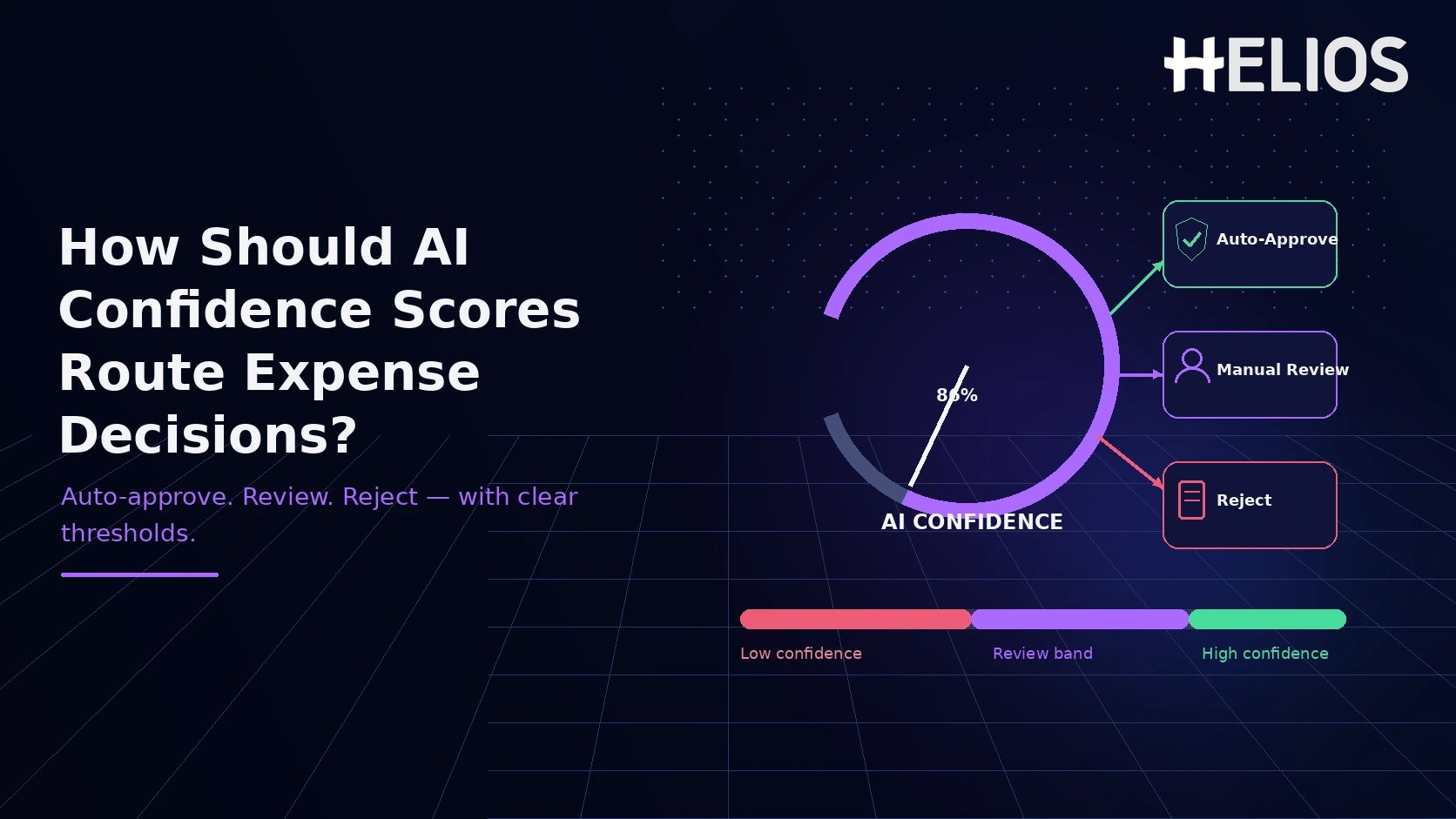
AI confidence scores are useful for routing expense decisions, but they should never become a single magic cutoff. A score estimates how certain a model is about its output; it does not tell finance whether a claim is low risk, policy-compliant, complete, or appropriate to reject. The safest design combines confidence with deterministic policy rules, amount and fraud risk, evidence quality, and human oversight.
For most expense programs, the best pattern is a three-zone decision model: auto-approve only a tightly defined low-risk population; send uncertain or material cases to review; and reserve automatic rejection for objective hard-stop conditions that are independently verified. Low confidence by itself should usually trigger review or a request for correction—not denial.
Why Confidence Alone Should Not Decide the Outcome
A confidence score is model-specific. Two models can attach different scores to the same prediction, and a 0.95 score is not the same as a measured 95% accuracy rate. Microsoft, AWS, Google, and NIST guidance all point to the same implementation principle: thresholds must be calibrated on representative data and adjusted to the risk of the business decision.
- A high-confidence answer can still be wrong if the policy is ambiguous, the evidence is incomplete, or the model is confidently misreading a novel case.
- A low-confidence answer can still be valid; sending it to a reviewer protects control quality without unnecessarily denying the employee.
- The cost of a false approval is different from the cost of a false review. Finance should tune thresholds around that asymmetry.
- Confidence should be monitored alongside override rate, false-approval rate, exception rate, decision latency, and post-payment corrections.
A Three-Zone Decision Model for Expense AI
The ranges below are practical pilot starting points, not universal standards. Each organization should calibrate them against historical claims, human decisions, policy complexity, transaction value, and local control requirements.
| Decision zone | Illustrative starting point | What else must be true |
|---|---|---|
| Auto-approve | High model confidence, often 0.95+ for the relevant decision or critical fields. | Low-value/low-risk claim; complete evidence; no duplicate/anomaly; policy checks pass; valid entity/cost center/GL/tax context. |
| Manual review | Middle-confidence band, for example 0.70–0.95, or any conflicting signal. | Reviewer sees the evidence, model rationale, policy rule, and exact reason for escalation. Material/high-risk claims should route here even with high confidence. |
| Reject / return | Do not use "low confidence" alone as the trigger. | Use objective hard stops: confirmed duplicate, prohibited category, invalid employee/entity, missing mandatory evidence after correction, or an unambiguous rule violation. Ambiguous cases stay with a human. |
Microsoft's AI approval guidance explicitly frames automated approvals as suitable for routine decisions with well-defined criteria and recommends keeping humans in control of important or exceptional cases. NIST likewise stresses that precise metrics and thresholds require human judgment and should reflect the consequences of failure.
Auto-Approval Requires More Than a High Score
A claim should enter auto-approval only after both AI and deterministic controls agree that it is safe. A strong architecture treats confidence as one gate in a sequence rather than the final answer.
- Evidence gate. Required receipt or invoice is present, readable, and linked to the claim; key fields such as amount, currency, date, and merchant are reliable.
- Policy gate. Category, spend limit, business purpose, receipt threshold, travel rule, and local/entity policy all pass without unresolved exception.
- Risk gate. No duplicate signal, unusual merchant, split-pattern anomaly, high-value threshold, suspicious timing, or conflicting source data is present.
- Accounting gate. Entity, department/cost center, project/client, GL, tax code, and currency treatment are valid and postable.
- Confidence gate. The model output itself clears the calibrated threshold for this exact decision type and cohort—not a generic enterprise-wide average.
When Manual Review Is the Correct Outcome
Manual review is not a failure of automation. It is the control path for cases where the expected cost of a wrong automated decision is higher than the cost of human attention. The goal is to make the review queue smaller and more informative.
- Confidence is below the auto-approval threshold or different model signals disagree.
- The amount is above a finance-defined materiality threshold, even if the AI is confident.
- The expense requires interpretation: client entertainment, unusual travel, mixed personal/business spend, tax-sensitive items, or a local policy exception.
- The employee changed a critical field after AI extraction or after a prior approval step.
- The model detects a policy violation but the policy itself contains discretion or an exception process.
- The claim is a new/rare pattern that has not been adequately represented in validation data.
Rejection Should Be Rule-Governed, Not Confidence-Governed
The safest expense design separates "the AI is uncertain" from "the claim is invalid." Uncertainty should normally create a review or correction request. Automatic rejection is more defensible when a hard-stop rule can be independently proven.
| Scenario | Recommended route | Why |
|---|---|---|
| Low confidence, evidence otherwise complete | Manual review | Uncertainty is not proof of non-compliance. |
| Receipt missing but policy allows an exception declaration | Review / request correction | The system needs the permitted exception path. |
| Confirmed duplicate of an already-paid claim | Reject or block payment | Objective duplicate evidence creates a clear hard stop. |
| Prohibited category with no exception allowed | Reject / return | Deterministic policy rule, not model opinion, controls the result. |
| High-confidence AI says "policy violation," but policy is ambiguous | Manual review | The material decision still requires interpretation and accountability. |
| Employee/entity/master data invalid | Block until corrected | Do not post or pay against invalid reference data. |
Calibrate Thresholds with Historical Decisions
Before go-live, replay a representative set of prior claims through the decision logic. Compare the model recommendation with the final, documented finance outcome—then measure not only accuracy but the business cost of mistakes.
| Metric | What it tells finance | How to use it |
|---|---|---|
| False auto-approval rate | Claims auto-approved that should have been stopped or reviewed. | Primary safety metric; tighten threshold or add deterministic gates when it rises. |
| False review rate | Compliant claims unnecessarily routed to humans. | Operational-efficiency metric; reduce once safety is stable. |
| Override rate | How often reviewers change the AI recommendation. | Analyze by policy, entity, category, amount, and reviewer. |
| Coverage / auto-approval rate | Share of claims eligible for automation. | Do not maximize it at the expense of control quality. |
| Post-payment correction rate | Errors discovered after reimbursement or posting. | Strong lagging indicator of unsafe automation. |
| Decision latency | Time from submit to final route/approval. | Ensures review thresholds do not create a new bottleneck. |
Google's Document AI guidance illustrates the same precision-versus-recall tradeoff: raising a confidence threshold usually improves precision while reducing recall. In expense approvals, that means fewer risky auto-decisions but more human review. Finance should choose the operating point that matches its risk appetite.
Related reading: multilingual OCR accuracy before straight-through processing
Use Different Thresholds for Different Decisions
One enterprise-wide confidence threshold is usually too crude. The same claim can be low risk for receipt extraction but high risk for final approval. Thresholds should vary by decision type and control consequence.
| Decision | Why risk differs | Suggested design |
|---|---|---|
| Receipt field extraction | Wrong amount/currency can corrupt downstream controls. | High field-level thresholds plus arithmetic and source-document validation. |
| Category prediction | Usually affects policy and GL mapping but can be corrected before posting. | Moderate-to-high threshold; review when category changes tax or policy outcome. |
| Policy interpretation | Can involve ambiguity and local exceptions. | High threshold plus deterministic rules; human review for discretionary language. |
| Duplicate / fraud signal | False negatives cause cash leakage; false positives frustrate employees. | Use multiple signals and risk scoring; confirm high-impact blocks. |
| Final auto-approval | Creates reimbursement/accounting consequences. | Highest governance bar: high confidence + all controls pass + low-risk population. |
How Helios Can Support a Risk-Based Approval Model
Three Helios capabilities map onto the zones this article describes. Exact confidence-score exposure and threshold configuration are not published in detail and should be validated during implementation.
- AI pre-check plus a deterministic policy floor. Spark AI states that it audits expenses against company policies and flags risks and violations, and Approval Copilot checks every claim against policy to speed review—but Automated Policy Control is the separate, deterministic layer that should catch a hard-limit or mandatory-evidence violation even if a model score alone would have let it through.
- Configurable escalation for medium-confidence and material cases. Approval workflows can route by department, role, and cost center, giving finance a structured path to the right reviewer instead of a single generic review queue—this is the piece that operationalizes the "manual review" zone rather than just defining it on paper.
- Monitoring decision quality over time. Dashboards and reporting can support the override-rate, false-approval-rate, and post-payment-correction tracking this article recommends; confirm that AI recommendation, confidence, override, exception reason, and final outcome are all available as reportable fields, not just the final decision.
Once a claim clears these gates, it still has to post correctly—Helios states its accounting engine generates journal entries from expense reports—so the entity, GL, and tax mappings validated during the pilot should carry through automatically rather than being re-verified at posting time.
What to Verify in a Helios Pilot
- Are confidence scores exposed at the field, claim, or decision level—and are they calibrated enough to use operationally?
- Can thresholds vary by decision type, amount, entity, country, category, or risk cohort?
- Can medium-confidence cases route to the right reviewer with the evidence, policy clause, and AI rationale attached?
- Can low-confidence cases be returned for correction without being falsely classified as policy violations?
- Are AI recommendation, human override, final decision, and downstream posting retained in the audit trail?
- Can finance suspend auto-approval for a cohort when model quality or business conditions change?
Related reading: audit-trail evidence for internal and external audits
FAQs About AI Confidence Scores in Expense Approval
Can high-confidence AI automatically reject an out-of-policy expense? Only when the rule is objective, unambiguous, and governance permits automatic rejection. Discretionary or material cases should remain human-reviewed even when the model is confident about the violation.
How often should confidence thresholds be reviewed? Continuously in the background, and formally recalibrated whenever override rates, post-payment corrections, new countries, new policies, or a model change signal drift—not on a fixed annual schedule.
Who should own the decision to change a threshold? Finance and whoever manages the model, jointly. Finance owns the risk tolerance—the tradeoff between false approvals and false reviews—while the model owner handles the calibration mechanics. Neither side should adjust a threshold unilaterally, since what looks like a technical tuning change is really a risk-appetite decision.
Final Takeaway
AI confidence should route decisions, not replace control design. Auto-approve only when confidence is high, the business risk is low, and every deterministic rule passes. Use manual review for uncertainty, materiality, policy ambiguity, or conflicting evidence. Reserve rejection for objective hard stops or human-confirmed violations. That three-zone model gives finance a practical way to increase automation without turning confidence scores into an ungoverned approval policy.
Explore Helios expense management and Spark AI: Helios | Spark AI