
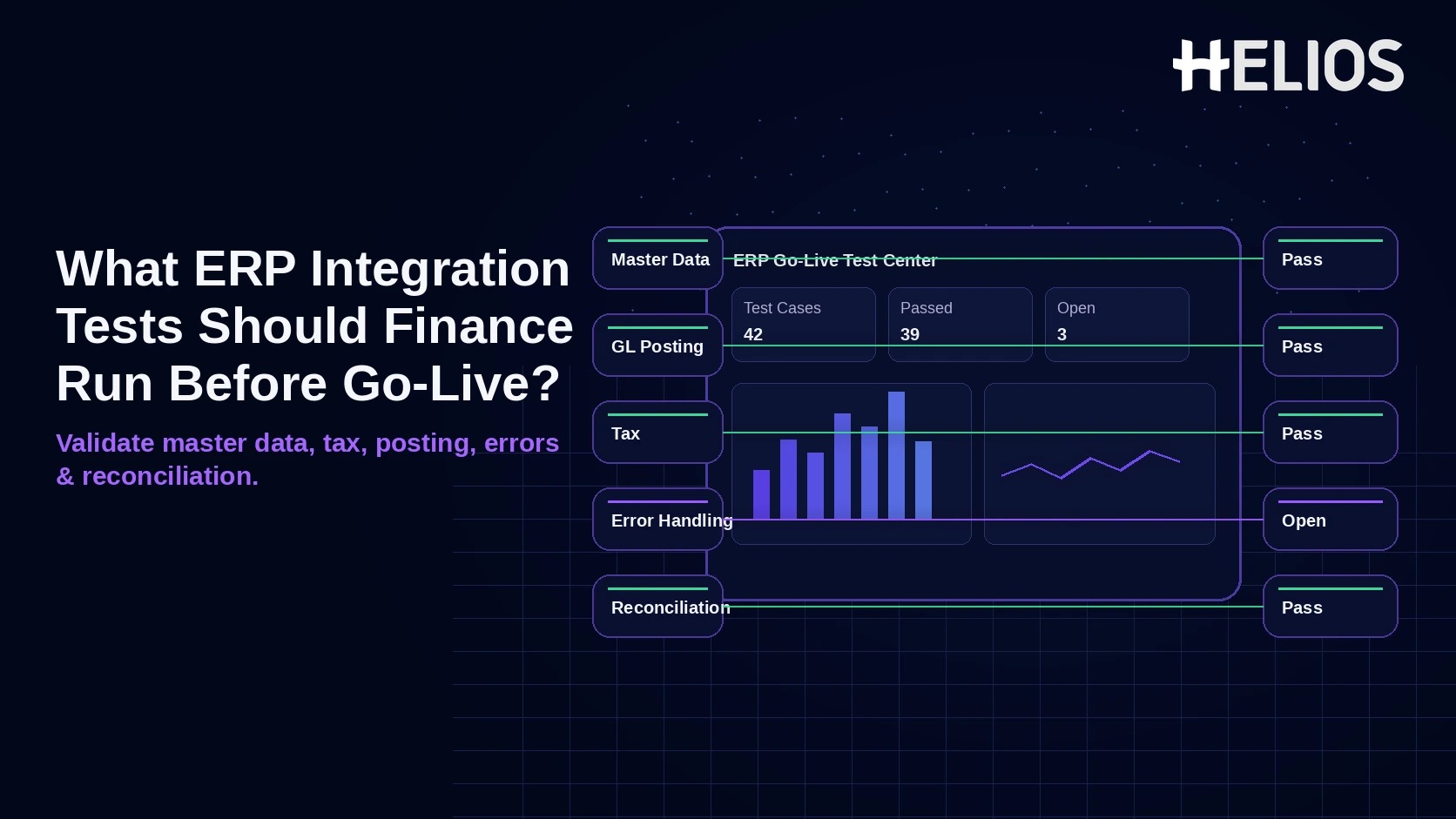
An expense-system integration can look healthy in a technical dashboard and still create bad accounting. A cost center may sync but be assigned to the wrong entity. A journal may post but use the wrong tax code. A rejected ERP document may be retried twice and become a duplicate. A reimbursement may be released before the expense has successfully reached the ledger.
That is why finance should own the business acceptance criteria for ERP integration testing. IT and the implementation partner can validate connectivity, authentication, payloads, and jobs; finance must prove that the resulting transactions are complete, accurate, correctly classified, recoverable after failure, and reconcilable from the source expense to the ERP document.
Related reading: master data ownership between an expense platform and ERP
What Finance Is Actually Testing Before Go-Live
The test objective is not “the interface ran successfully.” The objective is that a valid business event produces the expected accounting result—and an invalid event is blocked, explained, and recoverable. A practical finance test pack should therefore cover five test types:
- Happy path: valid expenses flow from approval through posting and reconciliation with no manual repair.
- Negative tests: invalid GLs, closed cost centers, missing tax codes, unauthorized users, or malformed records fail safely with actionable errors.
- Boundary tests: period-end dates, FX rounding, split allocations, high-value transactions, entity changes, and maximum field lengths behave correctly.
- Reprocessing tests: failures can be corrected and retried without creating duplicate journals or losing audit history.
- Reconciliation tests: source totals, ERP totals, payment totals, and exception queues can be matched and explained.
ERP Integration Test Matrix at a Glance
| Test area | Minimum finance test cases | Pass condition |
| Master data inbound | Employees/approvers; legal entities; cost centers; projects; GL accounts; tax codes; currencies; active/inactive dates. | Correct records, hierarchy, status, entity ownership, and effective dates appear in the expense system. |
| Expense → ERP posting | Simple expense; split allocation; multi-line report; multi-currency; prepaid/card item; cash advance; refund/reversal. | Journal/document posts to the expected entity, accounts, dimensions, tax treatment, amount, currency, and period. |
| Errors & retries | Invalid GL; closed cost center; missing tax; ERP outage; timeout; duplicate submission; partial batch failure. | Transaction is not silently lost or duplicated; clear status, error, correction path, and safe retry are available. |
| Payments & status | Employee reimbursement; AP payment; payout status; return/failure where applicable. | Payment is linked to the approved liability and, where integrated, status returns without breaking accounting traceability. |
| Reconciliation | Expense subledger to GL; payment to bank/provider; card clearing; intercompany; reversals. | Totals and unique IDs match or exceptions are explainable and owned. |
| Reporting & audit | Audit trail; posting status; exception report; tax report; dimensional analytics. | Finance can drill from a report to source expense, approval, ERP document, and correction history. |
1. Start With Master Data and Reference Data
Most posting defects begin before a journal is created. Finance should test the reference data that drives coding, approval, tax, and reporting—not only confirm that a file or API loaded successfully.
- Create, change, deactivate, and reactivate an employee; confirm manager/approver, entity, department, and effective dates update correctly.
- Move an employee between entities or cost centers and test expenses both before and after the effective date.
- Create and close GL accounts, cost centers, projects, and tax codes; inactive values should not remain selectable for new expenses.
- Test duplicate codes that exist in different entities and verify the integration preserves entity context instead of treating the code as globally unique.
- Confirm field lengths, special characters, leading zeros, currencies, and local-language names survive the round trip.
This is also where finance should confirm the system-of-record design. The ERP or HRIS may own reference data, while the expense platform consumes it for policy and workflow. Re-keying the same master data in both systems should be the exception, not the operating model.
2. Prove the Expense-to-ERP Posting, Not Just the Export
Every common expense pattern should be posted into the ERP test environment and inspected at document or journal-line level. Validate both the values and the accounting structure.
| Scenario | What finance should inspect in ERP |
| Simple reimbursable expense | Entity/ledger, expense GL, employee payable, cost center, tax code, transaction/accounting currency, posting date, document ID. |
| Split allocation | Each allocation line, percentages/amounts, department/project/client dimensions, rounding, and total = original expense. |
| Multi-currency expense | Transaction currency, approved FX source/rate, functional amount, rounding, and any separate FX difference treatment. |
| Corporate card expense | Expense account, card clearing/liability account, employee/cardholder reference, settlement linkage where applicable. |
| Refund or reversal | Original transaction link, reversal/credit amount, tax reversal, period treatment, and net-zero result when fully reversed. |
| Cross-entity allocation | Correct legal entity/ledger and, if required by the ERP architecture, intercompany/balancing entries. |
Related reading: mapping expense categories to GL accounts and tax codes
3. Test Tax, FX, Allocation, and Period Cut-Off as Finance Rules
Integration defects often hide in the “edge” fields that determine tax and statutory reporting. Test the combinations that actually occur in the business, not a single domestic meal receipt.
- Taxable, non-taxable, recoverable, partially recoverable, and zero-rated scenarios where relevant to the entity.
- Missing or invalid tax evidence: the system should apply the configured policy rather than invent a recoverable tax amount.
- Transaction date versus posting date around month-end and year-end; confirm the intended accounting period and cut-off behavior.
- FX rates on weekends/holidays, card-settlement differences, and reimbursement currency different from ledger currency.
- Allocation rounding across multiple lines and dimensions; the ERP document must remain balanced and the source total must remain unchanged.
- Entity-specific GL/tax mapping where the same user-facing expense category maps differently by legal entity.
4. Deliberately Break the Integration
A go-live test is incomplete until finance has seen the failure path. The production environment will eventually face unavailable ERPs, stale master data, bad mappings, timeouts, and partial batch failures. The question is whether the system fails visibly and recoverably.
| Negative test | Expected behavior |
| Invalid or closed GL account | Posting rejected; report remains in an exception state with a clear error; no payment or final closure if posting is a prerequisite. |
| Closed cost center/project | Validation blocks the expense or ERP rejection is returned with enough detail to correct the source data. |
| ERP unavailable / timeout | Retry is controlled and idempotent; the same source expense cannot create two ERP documents. |
| Partial batch failure | Successful items remain identifiable; failed items are isolated and reprocessed without replaying successful records. |
| Duplicate interface submission | Duplicate key/document ID is detected or the integration behaves idempotently. |
| Corrected/reopened report | System produces the intended delta/reversal/repost treatment rather than silently overwriting the original posting. |
SAP Concur’s current Financial Integration Service is a useful benchmark for this principle: it expects ERP posting status to be returned to the expense platform and can keep an expense report from advancing when ERP posting fails. SAP also documents test-user configuration that routes test transactions to a test financial system. The important lesson is not to copy one product’s design, but to require explicit posting feedback, failure visibility, and safe reprocessing in your own implementation.
External reference: SAP Concur Financial Integration Service
5. Reconcile the Integration End to End
A technically successful interface is not enough if finance cannot reconcile it. For each test population, preserve unique identifiers and prove four links: expense report to ERP document, ERP document to employee/card/AP liability, payment to bank/provider evidence where applicable, and all corrections back to the original transaction.
- Source-to-ERP. Approved expense totals equal ERP posting totals by entity, currency, period, GL, tax, and key dimensions.
- ERP-to-payment. The employee payable or card/AP liability settled is the liability created by the approved expense—not a disconnected payment record.
- Exceptions. Failed, returned, reversed, and reopened transactions remain visible until resolved; they do not disappear from totals.
- No duplicates. A retry, resubmission, or reopened report does not create duplicate journals or payments.
- Audit trail. Finance can trace from expense ID to approval history, integration status, ERP document ID, payment reference, and any correction.
Related reading: true end-to-end reconciliation from claim to bank and ledger
6. Include Volume, Security, and Cutover Tests
Finance should also validate the operating conditions around the interface. A connector that works for five test reports can still fail at payroll cutoff, month-end, or after a user-access change.
- Volume: process realistic peak batches and concurrent approvals without dropped or duplicated records.
- Scheduling: test daily jobs, intraday APIs, timezone boundaries, weekends, and period-close windows.
- Security: confirm least-privilege service accounts, role-based access, segregation of duties, and that unauthorized data is not exposed across entities.
- Monitoring: alerts must identify failed jobs, aging exceptions, queue backlogs, and reconciliation differences before finance discovers them manually.
- Cutover: freeze or reconcile open reports, card transactions, advances, and in-flight interface files so the same transaction does not exist in both legacy and new processes.
- Rollback: document what happens if the connector must be paused or reversed after production cutover.
A Five-Step Finance UAT Sign-Off Framework
- Build the test inventory. Map every integration, entity, transaction type, payment path, accounting outcome, and critical exception. Assign an owner and expected result.
- Use production-like data. Include real entity structures, currencies, tax codes, GLs, cost objects, employee types, and edge cases—scrubbed where required for privacy.
- Execute and evidence. For each case, store source inputs, screenshots or payload references, ERP document IDs, expected versus actual results, defect IDs, and tester sign-off.
- Retest defects and regression. A corrected tax mapping may break another entity. Re-run critical flows after configuration or code changes, not only the failed test itself.
- Sign off on reconciliation, not just defects. Go-live readiness should require zero unresolved critical defects, agreed treatment of lower-severity items, balanced reconciliation, monitoring in place, and a support/rollback plan.
How Helios Supports ERP Integration Readiness
Helios publicly describes policy control, configurable approvals, automatic journal-entry generation, and multi-dimensional reporting - none of it specifies posting feedback, retry/idempotency behavior, or error-queue design for a specific ERP, so the connector contract itself has to be validated for the target architecture rather than assumed. Helios's website discloses a 60% more efficient accounting-and-payment figure; treat that as a benchmark to test your own UAT results against, not a number this specific integration will automatically reproduce. Three test priorities follow directly from that:
- Approval-to-posting continuity, entity by entity. Test department-, role-, and cost-center-based approval routes across entities and exception scenarios, and confirm a policy exception or override stays visible all the way through to the posted ERP document - not just through approval. Because Helios states its accounting engine generates journal entries from expense reports, every entity-specific GL, dimension, tax, currency, and period mapping actually used in production needs its own test case, not one representative pass.
- Reporting that proves reconciliation, not just visibility. Use dimensional reporting to compare source expenses against ERP outcomes by entity, department, cost center, project, currency, and exception status - the test that matters is whether a discrepancy surfaces automatically, not whether the dashboard looks complete.
- The connector contract for this specific ERP and payment stack. Confirm master-data ownership, posting feedback, retry/idempotency behavior, error queues, document IDs, payment-status integration, and support ownership during hypercare - generic product capability doesn't guarantee any of these behave correctly for the organization's actual ERP and payment architecture until it's been tested against it.
Explore Helios expense management
Go-Live Readiness Checklist
- All critical master-data, posting, payment, reversal, and reconciliation scenarios passed in a production-like ERP test environment.
- No unresolved defects can create a material misstatement, duplicate payment, data-loss condition, or uncontrolled manual workaround.
- Finance has signed off on GL, tax, FX, entity, allocation, and period results—not only IT connectivity.
- Error monitoring, retry ownership, support contacts, escalation SLAs, and rollback procedures are documented and tested.
- Opening balances and in-flight items from the legacy process have a documented cutover and reconciliation plan.
FAQs About ERP Integration Testing for Expense Systems
- Should finance test the integration separately from IT?
Finance and IT should test together. IT proves the interface mechanics; finance signs off that the business event creates the correct accounting, tax, payment, and reconciliation outcome.
- How many test cases are enough?
There is no universal number. Cover every material transaction type, entity/mapping pattern, payment path, and critical failure mode rather than targeting a test-count quota.
- Do we need to test every country and legal entity?
Test every distinct configuration pattern. If several entities share identical rules, use representative entities—but test separately wherever GL, tax, currency, payment, or intercompany behavior differs.
- What is the most important negative test?
A failed ERP posting followed by correction and retry. It proves error visibility, ownership, idempotency, and whether the report can recover without duplicate journals or payments.
- When should finance sign off for go-live?
After critical cases have passed, reconciliation is balanced, open defects are explicitly accepted, and monitoring, support, cutover, and rollback procedures have been tested.
Final Takeaway
ERP integration testing is a finance-control exercise, not a connectivity checklist. The strongest test packs prove master data, accounting, tax, FX, approvals, error handling, payments, and reconciliation under both normal and broken conditions. If finance can trace a test expense from source data to an accurate ERP document—and safely recover when the path fails—the integration is much closer to being ready for production.