
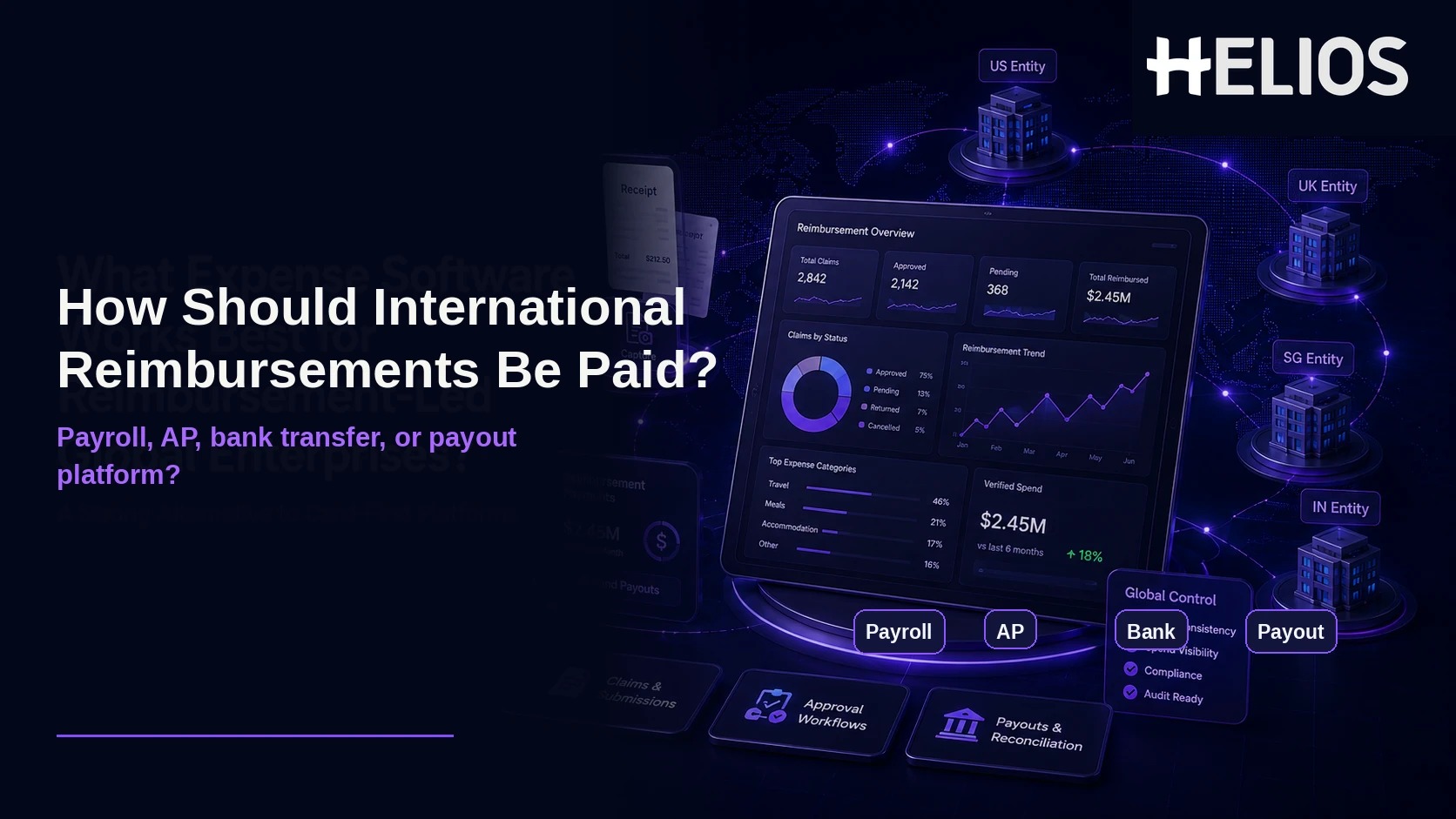
International reimbursements are not only an expense-workflow problem. Once a claim is approved, finance still has to choose a payment route that fits the employee, entity, currency, tax treatment, accounting model, and local banking environment. The fastest rail is not always the safest, and the most controlled rail is not always the best employee experience.
The practical answer is usually a routing policy rather than one global payment method. Classify the reimbursement first, then choose payroll, accounts payable, local bank transfer, or a payout platform according to the legal and operational purpose of the payment.
Start With Classification, Not the Payment Rail
Before deciding how to pay, decide what the payment is. A properly substantiated business reimbursement is different from a taxable allowance, a personal benefit, an employee cash advance settlement, or a supplier payment made on behalf of the employee. Mixing those categories can create payroll, tax, accounting, or audit problems even if the money reaches the employee successfully.
· Business reimbursement. Employee incurred an approved business cost, submitted evidence, and is being made whole.
· Taxable allowance or benefit. Local rules may require the amount to enter payroll, withholding, social-security, or benefit reporting.
· Cash advance settlement. The payment may be a top-up, refund, or return of an outstanding advance rather than a new reimbursement.
· Supplier or third-party payment. If the company is really paying a vendor, the AP or procurement process may be more appropriate than employee reimbursement.
For the tax boundary, see the Helios guide on when employee reimbursements become taxable benefits.
Payroll vs AP vs Local Bank Transfer vs Payout Platform
| Payment route | Best fit | Main strengths | Main watch-outs |
| Payroll | Taxable reimbursements, allowances, benefits, or items local law requires through payroll. | Tax/social-security withholding, payroll reporting, employee identity already mastered. | Can delay payment to payroll cycle; may create unnecessary payroll complexity for ordinary non-taxable business expenses. |
| Accounts Payable (AP) | Employee reimbursements managed through ERP/payables with strong accounting control. | Approval-to-payment audit trail, entity/ledger control, payment run governance, reconciliation. | Employees may need payee records; can be slower; country banking setup and employee privacy need care. |
| Local bank transfer | Lower-volume local reimbursements from a local entity with domestic banking. | Simple local payment, familiar banking rails, low complexity for one country/entity. | Fragmented process, manual payment status, inconsistent FX/fees, harder group-wide reporting at scale. |
| Payout platform | High-volume, multi-country, multi-currency employee reimbursements. | Central orchestration, FX options, beneficiary validation, payment status, scalable local rails where supported. | Coverage, licensing, KYC/AML, payout fees, failure handling, data residency, and ERP integration vary by provider/country. |
No route is universally superior. The important design question is whether the payment method preserves the approved amount, beneficiary identity, currency, tax classification, payment status, and accounting reference without creating duplicate data or manual reconciliation.
When Payroll Is the Right Route
Payroll is strongest when the reimbursement is actually part of employee compensation or local law requires payroll reporting. Examples can include taxable allowances, benefits, excess per diem, or reimbursements that fail local substantiation rules. Payroll already knows the employee, tax jurisdiction, withholding profile, and statutory reporting context.
For ordinary non-taxable business reimbursements, however, payroll can be an unnecessarily heavy rail. It may delay payment until the next payroll cycle, mix expense data with salary data, and make the employee experience harder to understand. A global policy should state exactly which categories must enter payroll and which should stay in the expense-payment flow.
When Accounts Payable Is the Right Route
AP can be a strong fit when the organization wants approved expense reports to move through the same ERP-controlled payment environment used for other liabilities. This can give finance clear entity, ledger, payment-run, bank-account, and reconciliation controls. In many ERP designs, employee expense reimbursements can ultimately be processed through payables and payments even though the underlying transaction is an employee claim rather than a supplier invoice.
The trade-off is operational. Employees may need a payee or employee-supplier record, payment runs can be slower than dedicated reimbursement rails, and global AP teams still need local banking and beneficiary data. The model works best when the ERP is already the trusted payment hub and reimbursement volumes are manageable.
When Local Bank Transfer Works Best
A local bank transfer is often efficient for a small employee population paid by a local legal entity in the employee’s domestic currency. It avoids adding another payment vendor and can fit markets where the company already has reliable treasury and local-banking operations.
The weakness appears at scale. Each entity may develop different file formats, cut-off times, fee structures, FX conventions, approval steps, and payment-status processes. Finance can end up with a globally standardized expense front end but a fragmented payment back end. If local bank transfers remain part of the model, centralize the policy, data fields, reconciliation standard, and payment-status reporting.
When a Payout Platform Makes Sense
A payout platform can be attractive when the company must reimburse employees across many countries and currencies from a centralized operating model. Depending on the provider and market, a platform may offer local payout rails, beneficiary validation, FX conversion, payment tracking, APIs, and standardized reconciliation files.
The platform itself does not remove compliance work. Finance must verify where the provider is licensed or partnered, which countries and currencies are supported, beneficiary/KYC requirements, FX spreads and fees, data-residency constraints, failed-payment handling, return flows, and whether payment status can be written back to the expense system and ERP. Coverage should be tested country by country rather than inferred from a global marketing claim.
A Global Routing Policy Is Usually Better Than One Method
Most multinationals benefit from one global decision logic with multiple approved rails. That preserves consistency without forcing every country into the same banking or payroll design.
| Question | If yes, route toward | Why |
| Is the payment taxable compensation, a taxable allowance, or a benefit that must be reported through payroll? | Payroll | Keeps withholding and statutory payroll reporting aligned with the payment. |
| Is it a normal approved business reimbursement and the company already pays employees through ERP/AP? | AP | Preserves finance controls and a direct link from approved claim to payment and ledger. |
| Is the population small, local, and paid from one domestic entity/bank? | Local bank transfer | Can be operationally simple when payment volume and country complexity are low. |
| Is the program multi-country, high-volume, or FX-heavy, with a need for centralized payment status? | Payout platform | May reduce banking fragmentation if the provider covers the needed employees, currencies, and rails. |
| Is the answer different by country or payment type? | Hybrid routing policy | A global policy can choose different rails while preserving one approval and accounting model. |
The routing decision should happen after expense approval but before payment instruction creation. That way the same approved claim can retain one audit trail even when the final rail differs by country or tax treatment.
How an End-to-End Reimbursement Payment Flow Should Work
- Approve the claim. Validate receipt, business purpose, policy, tax evidence, entity, cost center, project, currency, and approver before any payment instruction is created.
- Classify the payment. Determine whether the amount is a normal business reimbursement, taxable item, cash-advance settlement, or other payment type. The classification drives payroll/AP/payout routing.
- Create the payment instruction. Send the approved amount, employee/payee identifier, currency, bank or payout details, and accounting reference to the chosen rail without manual re-keying where possible.
- Capture payment status and exceptions. Record initiated, pending, paid, failed, returned, cancelled, or partially settled status. Payment failure should reopen finance follow-up rather than disappear outside the expense system.
- Reconcile to accounting. Link the approved claim, payment reference, FX amount, fees where applicable, and ERP posting so finance can prove what was approved, what was paid, and what reached the ledger.
For the audit model behind this handoff, see end-to-end expense traceability.
Design the Policy Around FX, Fees, and Employee Fairness
International reimbursement can create a second policy problem: the claim may be approved in one currency while the employee receives another. Decide whether the employee should receive the approved reimbursement currency, local payroll currency, or another supported settlement currency. Also define who bears transfer fees and how material FX differences are handled.
Keep the payment methodology aligned with the company’s documented cross-border reimbursement exchange-rate policy. The reimbursement rate, settlement rate, and month-end accounting rate can serve different purposes and should not be silently substituted for one another.
A Five-Step Implementation Framework
- Map countries and payment populations. List employing entity, employee count, reimbursement volume, local currency, banking access, payroll provider, current AP setup, and regulatory constraints for each market.
- Define routing rules. Specify which payment types go to payroll, AP, local bank transfer, or a payout provider. Assign owners for exceptions and countries without a standard rail.
- Design the integration contract. Define the data exchanged between expense, HR, ERP, payroll, banking, and payout systems: employee ID, bank details, claim ID, amount, currency, tax classification, payment status, FX, and ledger reference.
- Pilot with real edge cases. Test new hires, leavers, bank changes, failed transfers, duplicate payment prevention, taxable exceptions, cross-border FX, refunds, cash-advance top-ups, and employees without standard local bank accounts.
- Measure and govern. Track time from approval to payment, failed-payment rate, manual touches, FX/fee cost, payroll corrections, reconciliation breaks, employee inquiries, and country exceptions. Review routing as laws and provider coverage change.
Common Mistakes to Avoid
· Using payroll for every reimbursement. This can add cost and cycle time while mixing ordinary business expenses with compensation processing.
· Paying taxable items outside payroll without local review. A fast bank transfer does not eliminate withholding or reporting obligations.
· Letting every entity invent its own payment logic. Local banking may differ, but the classification, audit trail, and reconciliation standard should remain global.
· Ignoring failed and returned payments. Approval is not completion; finance needs final settlement status.
· Comparing payout providers only on FX price. Coverage, controls, beneficiary verification, data handling, support, and ERP integration can matter more than a headline rate.
How Helios Fits Into International Reimbursement Payments
Helios's public product pages describe an end-to-end expense platform covering employee submission, policy, review, accounting, payment, and reporting — but they do not publish a country-by-country matrix for payroll rails, local-bank reimbursement, or third-party payout coverage. That routing decision, and the provider or payroll relationships behind it, still has to be validated in a tailored demo or pilot.
- Flag classification issues before a route gets chosen. Policy rules can identify missing evidence, amount exceptions, or non-compliant claims, and Approval Copilot can help a reviewer check a claim's evidence before funds are released — so a claim is clean by the time finance decides whether it's routed to payroll, AP, local bank, or a payout provider. For example, a claim missing a required tax receipt would get flagged and held at this stage, rather than reaching the payroll or AP queue with an unresolved exception still attached.
- Keep payment status and reconciliation attached to the ledger regardless of the rail used. Helios states that its accounting engine can automatically generate journal entries from expense reports. Finance should validate how payment status, FX, fees, and settlement references integrate with its ERP and bank-reconciliation process for each rail actually in use.
FAQs About International Reimbursement Payments
Should non-taxable business reimbursements be paid through payroll?
Not necessarily. Payroll is useful when local law or tax treatment requires it, but ordinary substantiated business reimbursements may be better handled through AP, bank, or payout rails.
Is accounts payable a good way to reimburse employees?
Yes when the ERP/AP process supports employee payees and the company values centralized payment and ledger controls. It may be slower than a dedicated reimbursement rail.
When is a payout platform better than local bank transfer?
Usually when payment volume, country count, or FX complexity makes local banking fragmented. Confirm actual country, currency, compliance, and integration coverage first.
Can one company use different payment methods by country?
Yes. A hybrid routing policy is often the most practical global model if classification, approval, accounting, and reconciliation remain consistent.
What should finance reconcile after payment?
Match the approved claim, payment reference, settlement amount/currency, final payment status, and ERP posting.