
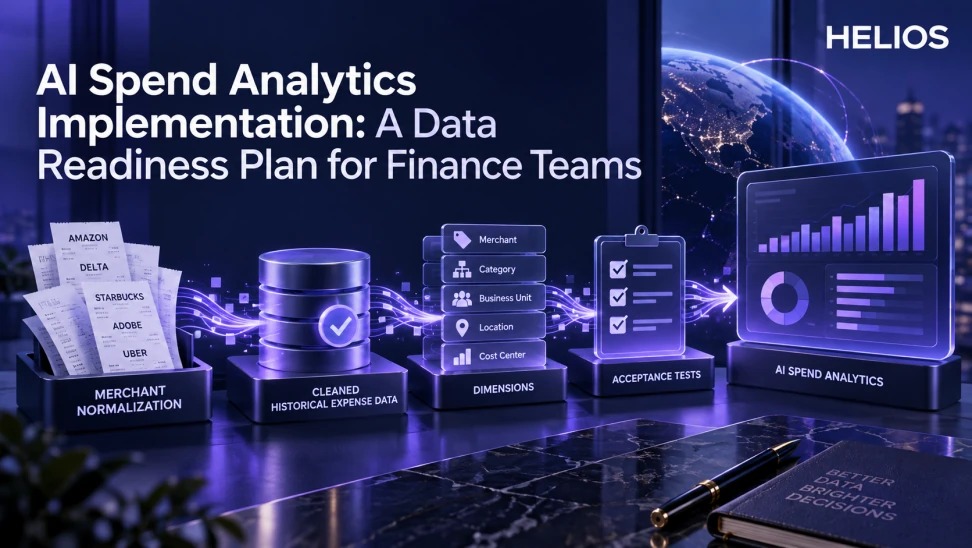
A data-readiness plan for AI spend analytics covering merchant normalization, history cleanup, dimensions, labels, acceptance tests, and ownership.
A practical framework for finance teams
A data-readiness plan for AI spend analytics covering merchant normalization, history cleanup, dimensions, labels, acceptance tests, and ownership.
The method prepares expense data for analytics. It does not claim that Helios automatically cleans all historical data, trains a predictive model, or guarantees an AI insight.
For related guidance, see AI expense management practices.
The framework below starts with the business task, defines the required data and human responsibility, and sets a clear test for whether the workflow produces a useful finance outcome.
AI Spend Analytics Implementation at a glance
| Workstream | Required output | Acceptance test | Owner |
| Source inventory | Channels, fields, dates, controls | Totals reconcile | Data owner |
| Merchant normalization | Canonical merchant and aliases | Sample precision | Finance data steward |
| History cleanup | Duplicates, refunds, currencies, status | Exception log complete | Finance operations |
| Dimensions | Entity, category, project, cost center | Mapping coverage | Accounting |
| Analysis dataset | Versioned features, labels, splits | Reproducible build | Analytics lead |
For related guidance, see expense platform pilot KPIs.
A useful workflow connects reliable inputs, accountable decisions, and measurable outcomes.
Define the decision before the data project
Choose a narrow use case such as merchant concentration, category classification, exception prioritization, budget variance explanation, or duplicate review. State the user, decision, action, and cost of error.
Do not build a universal spend model without a decision. The required data and acceptable quality depend on the task.
For related guidance, see expense categories and GL accounts.
Inventory and reconcile source data
List claims, lines, receipts, card transactions, invoices, advances, reimbursements, approvals, policy results, accounting records, employees, entities, and organizational dimensions.
Record owner, system, keys, refresh, retention, access, date basis, currency fields, and known gaps. Reconcile each channel to control totals before joining.
Normalize merchants and clean history
Create a canonical merchant ID while preserving original text, legal entity, payment processor, location, and confidence. Treat franchise, marketplace, airline, hotel, and aggregator names carefully.
Resolve duplicates, resubmissions, refunds, reversals, missing receipts, incorrect currencies, date errors, and status inconsistencies with an auditable correction log.
Define dimensions and labels
Version mappings for expense category, GL account, tax, entity, department, cost center, project, client, geography, and employee group. Document unknown and multi-label cases.
For supervised analysis, define label source, reviewer, timestamp, disagreement, leakage risk, and class imbalance. A prior decision is not automatically ground truth.
For related guidance, see duplicate payment detection.
Build representative acceptance tests
Test current and historical periods, countries, currencies, languages, rare categories, new merchants, refunds, split allocations, policy changes, and missing data. Separate training, validation, and final test data when modeling.
Set thresholds for reconciliation, coverage, precision, recall, false positives, stability, latency, and explainability based on the business risk.
Operate data quality after launch
Monitor source changes, mapping drift, new merchants, missing fields, population shift, label quality, model or rule changes, and outcome feedback. Assign issue owners and remediation dates.
Record dataset version, logic, inputs, output, reviewer change, final decision, and action. Revalidate after policy, ERP, entity, or workflow changes.
How Helios supports this workflow
Helios can connect mobile expense capture, multilingual OCR, configurable policy controls, role-based approvals, accounting preparation, integration, multidimensional reporting, and confirmed Spark AI conversational scenarios. Voice input, predictive cleaning, autonomous decisions, project forecasting, asset management, procurement, and subscription or cloud-cost optimization should not be assumed and require separate validation.
For related guidance, see multilingual OCR accuracy.
- Provide structured claim, receipt, policy, approval, and reporting data.
- Use multilingual OCR to extract receipt and invoice fields.
- Report across entity, category, project, cost center, user, currency, and time.
- Connect approved expense and accounting status through integrations.
- Use Spark AI in confirmed conversational and policy-review scenarios.
- Supply governed inputs for a separately validated analytics dataset.
A practical conclusion
Start with a narrow task and reliable data. Give employees and reviewers a clear next step, preserve corrections and exceptions, and measure whether the process improves accuracy, speed, control, and business decisions.
See how Helios can support this workflow. Request a Helios demo.
FAQ
What is AI spend analytics implementation?
It is the controlled preparation of data, dimensions, labels, tests, ownership, and operations for a defined spend-analysis decision.
Which data should finance inventory?
Claims, receipts, cards, invoices, approvals, policy results, payments, accounting records, employees, entities, and dimensions.
Why normalize merchants?
The same merchant can appear under many processors, locations, legal names, or spellings, fragmenting analysis.
What makes historical data ready?
Reconciled totals, stable keys, handled duplicates and refunds, documented currencies and dates, versioned mappings, and known limitations.
Which acceptance tests matter?
Use task-specific reconciliation, coverage, accuracy, false-positive, stability, latency, and explainability thresholds.
Does Helios automatically clean every dataset?
No. Helios supplies relevant structured data and reporting; the broader data-readiness program remains governed implementation work.