
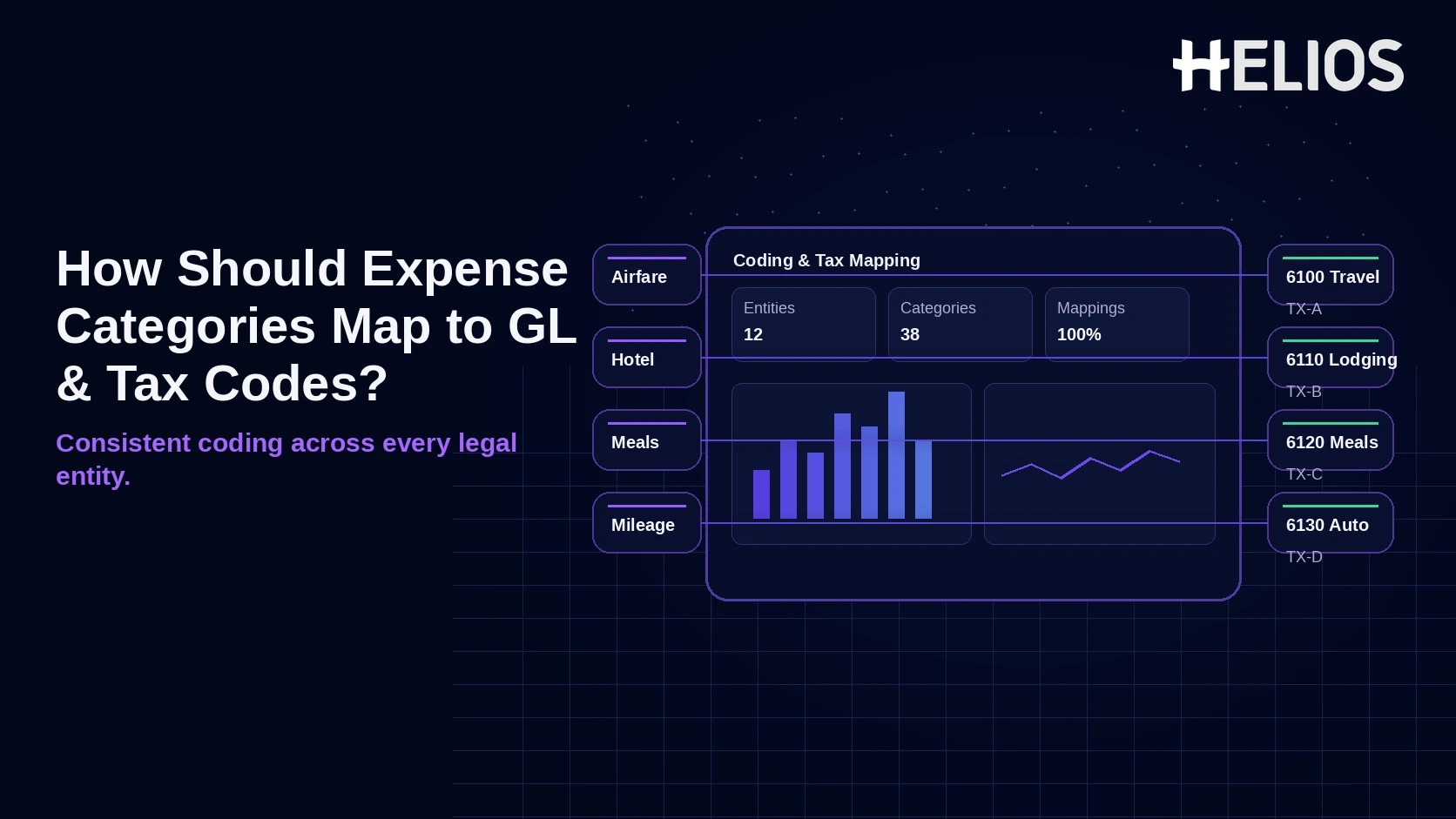
For a global finance team, the cleanest expense coding model separates what employees understand from what the ERP needs. Employees should select a stable business category such as Hotel, Airfare, Meals, Taxi, or Software. Behind the scenes, the system should translate that category into the correct entity-specific GL account, tax code, cost center, project, and other accounting dimensions.
The important point is that category, GL account, and tax code are not the same thing. A category describes the business nature of spend. The GL account determines financial classification. The tax code determines tax treatment and, where applicable, recoverability. One global category can therefore map to different accounts and tax codes across subsidiaries without forcing employees to learn each entity’s chart of accounts.
The Recommended Model: Global Categories, Local Accounting Mappings
A scalable design uses a global category taxonomy as the employee-facing layer and entity-specific mapping tables as the accounting layer. SAP Concur documentation reflects the same principle: expense types are defined in the expense system, while account codes belong to the accounting system, and the mapping connects the two. It also supports different account codes across multiple ledgers and hierarchy levels. Oracle Expenses similarly allows expense types to carry tax-classification defaults while tax recoverability can depend on expense type, location, and the employee’s legal-entity context.
- Global category layer. Keep employee choices simple and consistent across the group. “Hotel” should mean the same business activity whether the employee works for Entity A, B, or C.
- Entity accounting layer. Translate the category into the natural account and other ERP dimensions approved for that legal entity or ledger.
- Tax determination layer. Use entity/tax registration, transaction location, evidence, date, tax status, and recoverability rules to select the correct ERP tax code.
- Posting layer. Send the approved transaction with category, entity, GL, tax code, cost object, source IDs, and audit context to the ERP.
Do Not Build a One-to-One Category-to-GL-to-Tax Map
A common implementation mistake is to hard-code Hotel → GL 6100 → VAT code A and assume the rule works everywhere. It fails as soon as another subsidiary uses a different chart of accounts, a country requires a different tax treatment, a receipt is missing required evidence, or an expense is partly non-recoverable. The mapping should be contextual and effective-dated, not a single static lookup.
| Layer | Question It Answers | Typical Owner | Example |
| Expense category | What did the employee buy? | Global finance / expense team | Hotel, Meals, Taxi, Software |
| Natural GL account | What type of cost is this in this entity’s books? | Entity finance / ERP COA owner | Travel-Lodging, Client Entertainment, Ground Transport |
| Cost object | Who or what bears the cost? | ERP / controlling / project owner | Department, cost center, client, project |
| Tax code | How should tax be calculated, reported, and recovered? | Tax + entity finance / ERP tax master | Standard, reduced, zero, exempt, recoverable, non-recoverable |
A Practical Mapping Hierarchy Across Multiple Entities
Finance should evaluate the most stable determinants first and the most transaction-specific determinants later. The hierarchy below is a useful starting point, but the exact sequence depends on the ERP and tax engine.
- Identify the legal entity and ledger. The employee’s legal employer, paying entity, or expense-report entity determines which chart of accounts, tax registration, currency, and local rules are relevant.
- Apply the global expense category. Use a controlled list with clear definitions. Avoid creating a new category simply because one entity uses a different GL account.
- Derive the entity-specific GL account. Map the category to the natural account for that entity or ledger. Cost center, project, client, and department normally provide additional dimensions rather than replacing the natural account.
- Determine the tax treatment using transaction context. Consider transaction location, supplier/merchant tax information, expense date, tax evidence, business purpose, and recoverability. A default tax code can help, but it should not override facts that require a different treatment.
- Validate the final accounting combination. Reject inactive accounts, invalid entity/cost-center combinations, expired tax codes, and missing required evidence before the expense reaches final posting.
Illustrative Mapping: One Category, Different Entity Outcomes
The following example uses fictional account and tax-code labels to show the architecture. They are not jurisdictional tax advice or recommended statutory codes; each entity should use its ERP-approved accounts and tax rules.
| Global Category | Entity Context | Illustrative GL | Illustrative Tax Result | Additional Driver |
| Hotel | Entity A / Ledger A | 610100 – Travel Lodging | Tax code derived locally | Invoice country, tax evidence, business use |
| Hotel | Entity B / Ledger B | 471100 – Hotel & Travel | Different local tax code | Entity tax registration and recoverability |
| Meals | Entity A / Ledger A | 610300 – Business Meals | Recoverability rule may differ | Attendees, business purpose, receipt |
| Meals | Entity C / Ledger C | 520130 – Meals & Entertainment | Different local tax code | Local law, expense type, evidence |
Tax Codes Need More Context Than the Expense Category
Tax is where oversimplified mappings create the most risk. Oracle’s tax-recoverability model for expense payment requests can use the expense type, expense location, and employee legal-entity location as tax-determining factors. Its expense data model also stores a tax classification code on the expense item. SAP Concur’s VAT configuration likewise groups expense types under country-specific tax authorities and can map reclaim tax codes to integrated accounting systems.
The design implication is important: “Meals” is not itself a tax code. A tax rule may need to know where the purchase occurred, which entity claims the tax, whether a valid tax invoice exists, whether the spend is business-only, and whether local rules permit full, partial, or no recovery. Finance should therefore configure a default plus exception logic rather than rely on category alone.
- Use defaults for speed. A category can carry a default tax treatment for a given entity or country when the facts are predictable.
- Override only with controlled reasons. Missing evidence, cross-border supply, mixed personal use, special merchant types, or non-recoverable categories should trigger a documented alternate treatment.
- Keep tax codes effective-dated. When rates, recoverability, or ERP tax masters change, new transactions should use the new rule without rewriting previously posted expenses.
Who Should Own the Mapping?
Ownership should follow business meaning. Global finance owns the shared category taxonomy; entity controllers own the target GL accounts; tax and local finance own tax logic and recoverability; ERP/MDM owns the actual financial master codes. The expense platform or integration layer can execute approved mappings, but changes should use maker-checker approval, effective dates, testing, and version history rather than creating GL or tax masters independently.
Integration Pattern: Reference Data In, Accounted Transactions Out
The strongest architecture keeps GL accounts, tax codes, entity structures, cost centers, and projects governed in the ERP or finance master-data layer, then synchronizes the active values into the expense platform. The expense platform applies policy, captures evidence, derives mappings, and sends approved accounting transactions back to the ERP.
- Load governed reference data. Synchronize entity, ledger, GL, tax, cost center, project, and related master data with stable keys and effective dates.
- Apply mapping during expense processing. The platform uses category plus entity and transaction context to derive or propose the correct accounting values.
- Validate before approval or posting. Block invalid or inactive combinations and route uncertain tax cases to finance or tax review.
- Post with source identifiers. Send expense report ID, line ID, category, GL, tax code, cost objects, currency, and evidence references to the ERP.
- Return posting status and reconcile. Do not treat “exported” as “posted.” Capture ERP acceptance, rejection, correction, and final journal identifiers for traceability.
How to Govern Mapping Changes Across Entities
Mapping maintenance becomes difficult when finance teams edit spreadsheets independently. Instead, treat category-to-GL and tax-code changes like controlled financial configuration. Every change should identify the affected entities, reason, approver, effective date, test evidence, and rollback approach.
- New entity onboarding. Start from the global category taxonomy, then build the local GL and tax mapping before the entity goes live.
- Chart-of-accounts change. Map old and new accounts by effective date. Preserve the account used on historical posted expenses.
- Tax-code change. Coordinate with tax and ERP owners, update future-dated rules, and test recoverable/non-recoverable scenarios.
- Category change. Avoid unnecessary category proliferation. If the business meaning is unchanged, prefer local mapping rather than a new employee-facing category.
- Exception monitoring. Track manual overrides, unmapped transactions, ERP posting failures, and frequent reclassifications as signals that the rule design needs attention.
How Helios Supports Category-to-Accounting Control
The failure mode this article is guarding against - category, GL account, and tax code getting collapsed into one static lookup - is exactly what a policy engine and an accounting engine have to avoid reintroducing. Two parts of Helios matter most here:
- Policy control keeps the employee-facing category layer clean. Automated policy rules can require the right category, documentation, and approval condition before a claim moves toward accounting, and OCR-captured receipt/invoice data gives finance more structured evidence to support the tax-code decision downstream. Entity-specific exceptions should stay governed rather than spawning a new category per subsidiary.
- Journal automation still depends on entity-specific mappings behind it. Helios states its accounting engine can generate journal entries from expense reports, but the mapping needs to route each category to the GL account and tax code approved for that specific entity or ledger - not a single global account per category - and retain the source expense identifiers for reconciliation. Mapping depth, connector behavior, and error handling should be verified per entity during the pilot, not assumed to work uniformly.
Approval routing and multi-dimensional reporting can layer on top of this - routing category exceptions to the right entity or tax reviewer, and surfacing mapping overrides or posting failures by entity - but neither replaces the underlying mapping design.
FAQs About Expense Category, GL, and Tax Mapping
1. Can one expense category map to different GL accounts by entity?
Yes, and it usually should. That is the correct design whenever subsidiaries use different charts of accounts or ledgers - the category stays consistent for employees while the natural account changes by entity context behind the scenes.
2. How should finance test a multi-entity mapping design before rollout?
Run real scenarios per entity: standard expenses, missing receipts, cross-border purchases, non-recoverable tax, inactive cost centers, an in-flight mapping change, and a failed ERP posting. Reconcile each final journal entry back to the source expense before calling the design validated.
Final Takeaway
The scalable model is simple for employees but precise for finance: one global category taxonomy, entity-specific GL mappings, and tax determination based on the facts of each transaction — not a single static lookup that quietly breaks the first time a subsidiary's chart of accounts differs.