
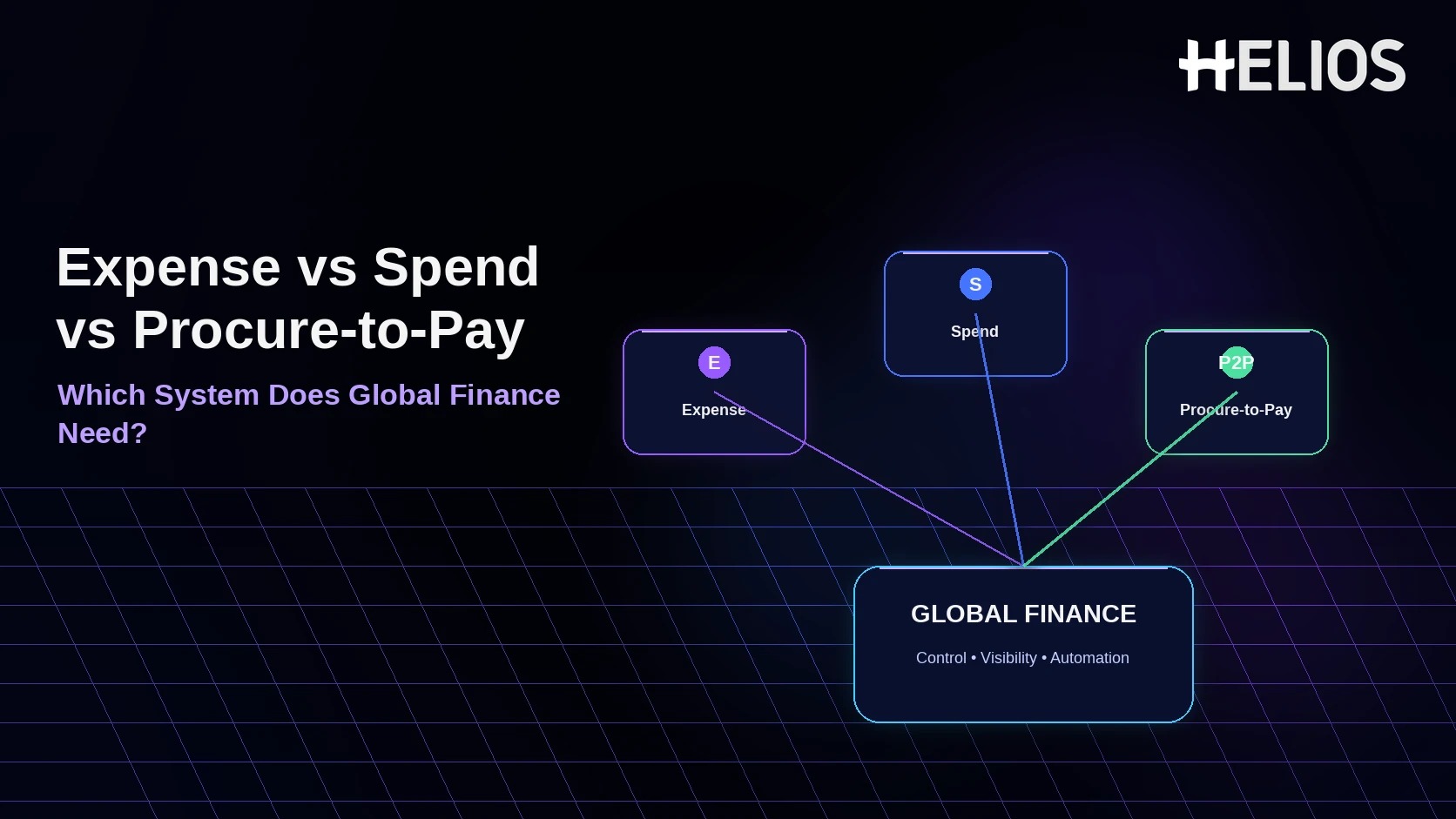
Global finance teams often hear three overlapping labels when they modernize spending processes: expense management, spend management, and procure-to-pay. The terms sound similar because all three influence company spend, but they solve different operational problems and begin at different points in the purchasing lifecycle.
Choosing the broadest suite is not automatically the safest decision. A business trying to fix slow employee reimbursements can create a much larger transformation than necessary by buying a full procurement stack. The opposite is also true: an expense system cannot replace supplier sourcing, purchase orders, receiving, invoice matching, and supplier payment when those processes are the real source of control gaps.
The right answer starts with the spend journey you need to control. This guide explains the differences, shows where the categories overlap, and provides a practical framework for deciding whether your global finance team needs focused expense management software, a broader spend-management layer, a procure-to-pay suite, or a deliberately connected combination.
What Is Expense Management?
Expense management is centered on employee-initiated business spend: travel, meals, mileage, entertainment, small purchases, and other costs that employees submit for reimbursement or document after using an approved payment method. The workflow normally starts with the employee, receipt, trip, or claim rather than a purchase requisition.
- Capture and submission. Employees upload receipts, enter business purpose, code the expense, and provide project, cost-center, entity, or client information.
- Policy and approval. The system checks company rules and routes the claim to the correct manager, budget owner, or finance reviewer.
- Reimbursement and accounting. Approved claims move to employee payment and the correct ledger, account, tax, and reporting dimensions.
Expense management is usually the best starting point when the pain sits with employee experience, policy enforcement, reimbursement speed, finance review, or expense-to-accounting automation. It is a narrower scope than P2P, but that focus can make implementation faster and operating ownership clearer.
What Is Spend Management?
Spend management is the broadest and least standardized label of the three. In practice, vendors use it for platforms that create visibility and control across several categories of company spend rather than only employee reimbursement. Depending on the suite, that may include procurement, corporate cards, employee expenses, invoicing or AP, budgets, suppliers, contracts, and payments.
The defining idea is not one specific workflow. It is a common control layer over how money is committed and spent. Finance and procurement can use budgets, merchant or category rules, supplier data, approval policies, analytics, and payment controls to influence spend before and after a transaction.
Spend management earns its label when one vendor genuinely bundles several of those layers under one governance model — not just an expense module with a broader name attached. Before buying on the category label, open the product and check whether strategic sourcing, AP, and card controls are actually deep, or whether one of them is thin.
What Is Procure-to-Pay?
Procure-to-pay (P2P) is a structured supplier-purchasing process. It begins before the purchase is made and normally connects a request for goods or services with purchase approval, a purchase order, receiving or service confirmation, supplier invoice validation, and payment. In a mature P2P model, those records remain linked so procurement and finance can see what was requested, ordered, received, invoiced, and paid.
- Requisition and approval. A user requests a product or service and the organization approves budget and purchasing authority.
- Purchase order and receipt. Procurement creates or releases the PO, and the business confirms goods or services received.
- Invoice and payment. AP validates the supplier invoice against the purchasing record and routes approved liability to payment.
P2P is the right scope when the core challenge is supplier purchasing, PO compliance, three-way matching, invoice processing, supplier onboarding, or payment control. It can include employee expenses as an adjacent module, but employee claims are not the process that defines P2P.
Expense Management vs Spend Management vs Procure-to-Pay at a Glance
| Dimension | Expense Management | Spend Management | Procure-to-Pay |
| Primary focus | Employee expenses and reimbursement | Broader visibility and control across company spend | Supplier purchasing and payment lifecycle |
| Typical starting point | Receipt, trip, card transaction, or employee claim | Budget, card, expense, supplier, invoice, or purchase event | Requisition or approved purchasing need |
| Core users | Employees, managers, finance, accounting | Finance, procurement, business leaders, AP, employees | Procurement, requesters, receiving teams, AP, finance |
| Key controls | Receipt rules, policy, approval, reimbursement, accounting | Budgets, categories, cards, suppliers, approvals, analytics | Sourcing, PO controls, receiving, invoice matching, supplier payment |
| Best fit | Fix employee-spend efficiency and control | Unify several spend channels under common governance | Standardize supplier buying from request through payment |
Where the Three Systems Overlap
The categories overlap because enterprise software suites have expanded beyond their original boundaries. A spend-management platform may contain expense and procurement modules. A P2P suite may include employee expenses. An expense platform may integrate with cards, AP, travel, and payments. The label is therefore less important than the operating scope you actually buy and implement.
For global finance teams, four overlaps deserve special attention: approval workflow, policy or compliance, accounting integration, and analytics. All three system types can provide these capabilities, but they apply them to different records. Expense software applies controls to employee claims; P2P applies them to requisitions, POs, receipts, and supplier invoices; spend management tries to create a common view across several spend channels.
That distinction matters for ownership. If finance buys a broad suite but procurement does not redesign sourcing and purchasing, P2P value may never materialize. If procurement chooses a suite but employee expense usability is weak, reimbursement work can remain fragmented. Scope should follow the business problem, not the size of the product catalog.
Which System Does a Global Finance Team Actually Need?
Use the primary control problem as the first filter. Many organizations ultimately connect more than one layer, but one system should usually lead the transformation.
- Choose expense management first when employee-paid expenses, travel claims, receipt capture, policy review, manager approval, reimbursement, and expense accounting are the main pain points. This is especially relevant when finance wants quick operational improvement without redesigning procurement.
- Choose spend management first when the problem is fragmented visibility across cards, expenses, AP, supplier spend, and budgets. The value comes from common policies, analytics, categories, and controls across multiple forms of spend.
- Choose procure-to-pay first when purchasing discipline is the priority: requisitions, catalogs or sourcing, POs, receipt confirmation, invoice matching, supplier onboarding, and payment governance.
- Use a connected architecture when different teams need deep specialist workflows. A focused expense platform can coexist with a P2P or spend suite as long as employee, entity, accounting, policy, and payment data are governed consistently.
A Practical Global Finance Architecture
For many multinationals, the best answer is not one monolithic application. A global finance architecture may use ERP as the accounting system of record, a P2P suite for supplier purchasing, and a specialized expense layer for employee spend. The interfaces then become part of the control design rather than an afterthought.
The expense layer should preserve employee evidence and approval history, then send approved accounting data downstream. A well-designed automated approval workflow can use department, role, cost center, entity, project, amount, and exception conditions without forcing procurement users to own employee reimbursement decisions.
The finance team should also decide which platform owns policy, master data, payment status, and reporting. The goal is end-to-end traceability from source document through approval and accounting, even when more than one application is involved.
How to Choose: A 5-Step Decision Framework
- Map the spend landscape. Separate employee expenses, corporate-card spend, supplier invoices, PO-backed purchasing, non-PO spend, travel, subscriptions, and local payment processes. Quantify volume, value, countries, and owners.
- Identify the control gap. Decide whether the main problem is reimbursement friction, lack of spend visibility, weak purchasing discipline, invoice processing, supplier risk, accounting handoff, or several issues at once.
- Define the minimum scope. List the processes that must be in the first implementation wave and the processes that can remain integrated rather than replaced. Avoid buying transformation scope that the organization is not ready to govern.
- Test the global operating model. Use real entities, currencies, policies, cost centers, projects, taxes, approvers, supplier scenarios, ERP mappings, reimbursement methods, and exceptions. Global fit is demonstrated by transactions, not a country count.
- Measure total operating value. Compare cycle time, manual touches, exception rate, reimbursement speed, PO compliance, invoice match rate, accounting corrections, support effort, license scope, implementation effort, and change-management burden.
How Helios Fits an Expense-First Finance Strategy
Helios is positioned as an intelligent enterprise expense-management platform rather than a full procure-to-pay suite. That scope is deliberate: it is what lets Helios sit next to a broader P2P or spend suite as the expense-specific layer, instead of asking finance to re-platform procurement just to fix reimbursement. Two capabilities matter most for that scoping decision:
- Automated policy control. Helios applies configured spending rules to reimbursement requests so missing information or out-of-policy expenses surface before final finance review — the discipline finance needs to trust expense as a standalone layer rather than folding it into a bigger suite by default.
- Flexible approval workflows and accounting automation. Approval paths can be configured around department, role, and cost center, and the accounting engine can generate journal entries from approved reports — the two connective points that let an expense-first architecture hand off cleanly into a broader ERP, P2P, or spend-management environment instead of becoming its own island.
What Helios does not claim to be is a sourcing, PO, or supplier-invoice-matching system — organizations evaluating a focused expense layer should test that boundary directly, confirming how it will coexist with procurement, AP, cards, ERP, HR, travel, identity, and payment systems already in place.
Final Verdict
Match the buy to the friction, not the product catalog — the filter in the section above already tells you which of the three to start with. If employee expenses are your starting friction, Helios is worth testing as the focused layer, one built to hand off cleanly into whatever P2P or spend suite already governs the rest of your spend.
FAQs About Expense Management, Spend Management, and Procure-to-Pay
Is procure-to-pay the same as spend management?
No. P2P is a defined supplier-purchasing lifecycle from requisition through PO, receipt, invoice, and payment. Spend management can include P2P but may also cover cards, expenses, budgets, and other spend categories under one governance model.
Does choosing a specialist expense platform rule out a P2P suite later?
No. The two are designed to be layered rather than mutually exclusive — a specialist expense platform can hand off approved accounting data to a P2P suite or ERP rather than compete with it, as long as which platform owns policy, master data, and reporting is decided up front.