
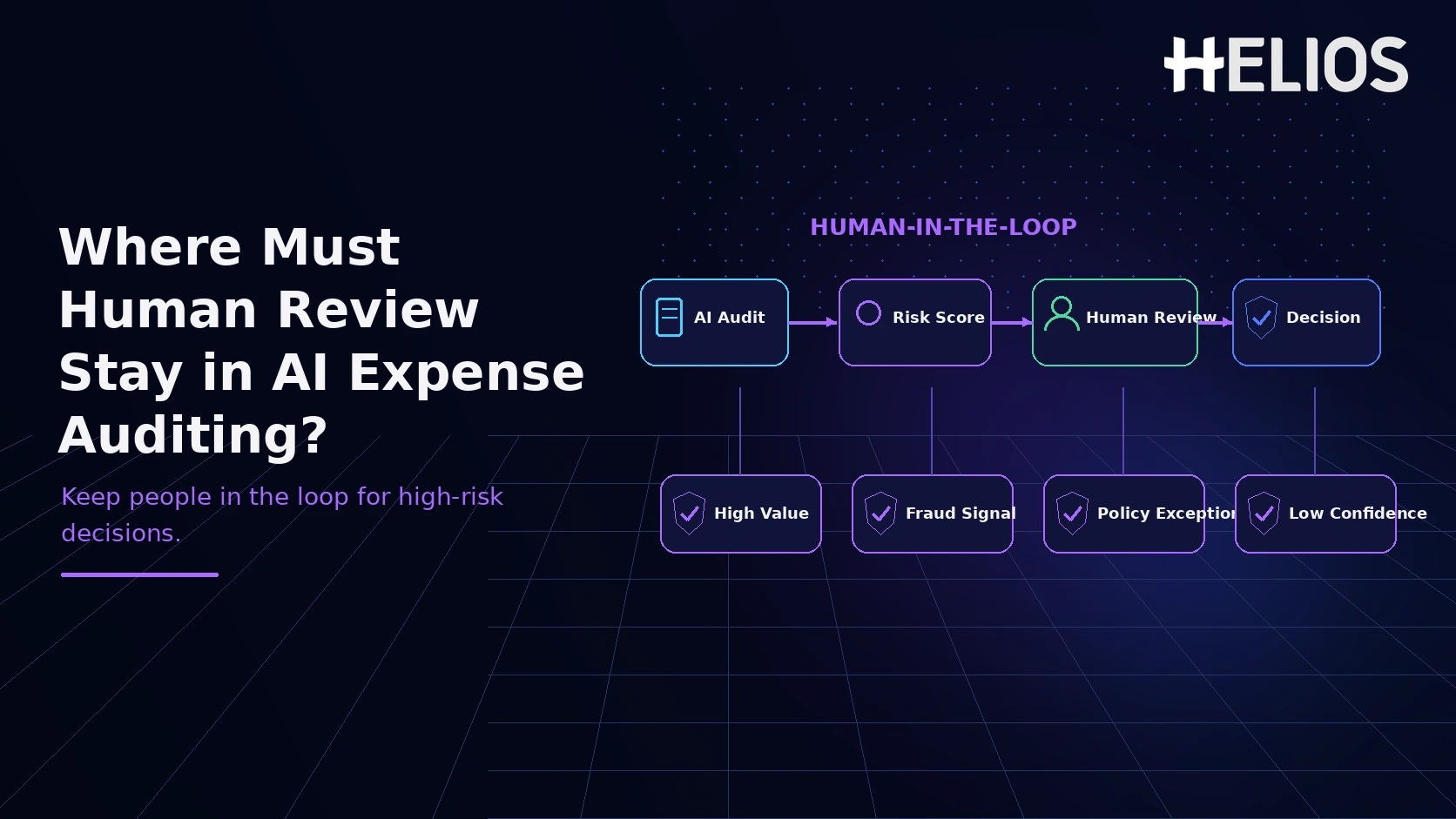
AI can review every expense, compare it with policy, identify unusual patterns, and prioritize exceptions. But "AI-reviewed" should not mean "human judgment eliminated." The safest operating model automates routine, well-defined, low-impact cases while making human review mandatory whenever the decision is materially consequential, legally or tax sensitive, ambiguous, adversarial, or dependent on business context the model may not reliably possess.
No fixed dollar amount defines a universal review line. The mandatory review perimeter should be defined by the company's risk appetite, policy, control framework, local law, and the real impact of a wrong decision. NIST's AI Risk Management Framework similarly calls for organizations to define roles, responsibilities, and human oversight for human–AI configurations rather than treating oversight as an afterthought.
NIST AI RMF: human-AI roles and oversight
Human Review Should Be Mandatory When Risk or Judgment Cannot Be Delegated Safely
| Scenario | Why AI Alone Is Not Enough | Required Human Role |
|---|---|---|
| High-value or financially material claim | A false approval can create a material loss, misstated spend, or difficult recovery. | Validate evidence, business purpose, policy fit, and accounting impact before final approval. |
| Policy exception or override | The decision changes or waives an established control rather than simply applying it. | Approve the exception, document rationale, and confirm the correct authority level. |
| Fraud, duplicate, collusion, or suspicious pattern | Adversarial behavior may mimic legitimate transactions and require investigation across people and systems. | Investigate context, preserve evidence, and decide hold, escalation, recovery, or referral. |
| Tax, legal, sanctions, or regulatory ambiguity | Rules can be jurisdiction-specific and the cost of an incorrect interpretation may exceed the expense itself. | Finance, tax, legal, or compliance confirms treatment before payment/posting. |
| Cross-entity, intercompany, or complex accounting | The correct result may depend on legal entity, beneficiary, transfer-pricing, tax, and GL context. | Validate entity allocation, tax treatment, recharge logic, and posting outcome. |
| Conflicting model/rule signals | High OCR confidence does not resolve a policy anomaly, and a policy pass does not prove the receipt is genuine. | Resolve the conflict and record which evidence overrode which signal. |
| Final rejection, employee appeal, or disciplinary consequence | The decision directly affects an individual and may require fairness, explanation, and recourse. | Provide accountable review, explanation, and appeal/exception handling. |
| New model, policy, threshold, or rule change | Automation behavior can shift after configuration changes or new data patterns. | Approve the change, review test evidence, and monitor post-change outcomes. |
Do Not Use Confidence Score as the Only Human-Review Trigger
Confidence scores answer a narrow question: how sure is the model about a prediction or extraction? They do not answer whether the transaction is high impact, whether the policy is ambiguous, whether the employee has a conflict of interest, or whether the tax treatment requires professional judgment. A 99% confident model can still be confidently wrong on a novel or adversarial case.
A better decision gate combines four dimensions: model confidence, deterministic validation, business risk, and decision impact. Microsoft's guidance for AI approvals follows the same principle: automate repetitive decisions, but route critical or ambiguous cases to manual review so humans remain in control of important outcomes.
Microsoft: AI approvals and human oversight
| Risk / decision state | Typical treatment | Human review? |
|---|---|---|
| Low risk + high confidence + all controls pass | Auto-approve or straight-through process within the approved population. | Not mandatory transaction-by-transaction; monitor by sampling and metrics. |
| Medium risk or uncertainty | Route to an exception queue with evidence and AI explanation. | Yes. |
| High impact regardless of confidence | Require named accountable approver or specialist. | Yes. |
| Hard policy violation with objective evidence | Return/reject under rule; preserve explanation and route appeals if available. | Human review may be required for final rejection, override, or appeal. |
| Conflicting signals / novel pattern | Hold and investigate. | Yes. |
Seven Areas Where Human Judgment Adds the Most Value
- Materiality and executive/high-risk populations. Set mandatory-review rules for claims above defined thresholds, unusual one-time payments, senior executives, sensitive categories, or transactions with disproportionate reputational or financial impact.
- Policy interpretation and overrides. AI can identify the relevant rule and summarize evidence, but discretionary exceptions should be approved by a human with delegated authority. Every override should include who approved it, why, and which policy version applied.
- Fraud and anomaly investigations. Models are useful for finding patterns; humans are needed to test innocent explanations, investigate relationships, compare other systems, and decide whether to hold payment, recover funds, or escalate.
- Tax, legal, and cross-border decisions. Receipt tax evidence, VAT/GST recoverability, taxable benefits, withholding, sanctions, and legal-entity treatment can depend on country-specific facts. Route these to qualified finance, tax, legal, or compliance reviewers when the rule is not deterministic.
- Complex allocation and accounting. Cross-entity splits, intercompany recharges, unusual GL/tax combinations, write-offs, refunds, reversals, and period corrections should require human review when the posting outcome is not fully determined by approved rules.
- Employee-facing adverse decisions. Where a claim is rejected, materially reduced, referred for misconduct review, or contested by the employee, a human should own the final decision and explanation. This preserves accountability and gives employees a route to challenge errors.
- Model and control governance. Humans should approve model/version changes, confidence thresholds, policy changes, new auto-approval cohorts, and material rule changes. A model should not silently expand its own authority.
Human Review Must Be Designed as a Control, Not a Manual Bottleneck
Mandatory review works only when the reviewer receives the right context. If reviewers must search five systems for a receipt, policy version, prior approval, employee profile, and accounting result, the control will be slow and inconsistent. The review package should surface the evidence and the reason the case was escalated.
- Show the original receipt or invoice next to extracted fields and any corrections.
- Show the exact policy rule, policy version, and failed/ambiguous control—not just a generic "AI flag."
- Show amount, currency, employee, entity, cost center/project, merchant, tax, and prior related transactions.
- Show AI confidence, anomaly reason, duplicate candidates, and whether signals agree or conflict.
- Require structured outcomes: approve, reject/return, request evidence, override, escalate, or reclassify—plus reason codes.
- Preserve reviewer identity, timestamp, comments, before/after values, and any subsequent accounting or payment result.
Use Sampling Even Where Transaction-Level Human Review Is Not Mandatory
A low-risk population can be auto-approved without a human touching every claim, but it should not become an unobserved population. Finance should use risk-based or random sampling to detect model drift, policy gaps, false approvals, and new fraud patterns. Sampling also provides the ground truth needed to recalibrate confidence thresholds and expand—or shrink—the safe automation perimeter.
| Metric | Why It Matters |
|---|---|
| False auto-approval rate | Measures the most important control failure: an item that should have been stopped but was automated. |
| Manual-review yield | Shows how often the review queue produces a meaningful change, escalation, or evidence request. |
| Override rate and reason | Reveals whether policy/rules are too rigid, unclear, or being bypassed. |
| Post-payment correction / recovery rate | Shows errors discovered too late and the financial cost of weak gates. |
| Review aging / SLA | Measures whether mandatory human review is creating operational delay. |
| Repeat error by merchant, employee, country, or category | Helps identify model drift, policy gaps, training needs, or fraud patterns. |
How to Set the Mandatory Human-Review Perimeter
Start with the business impact of a wrong decision, not with an arbitrary AI score. A finance-led pilot should test the following five steps:
- Define non-delegable decisions. List decisions that policy, legal, tax, compliance, internal audit, or management require a named person to own.
- Segment risk. Create cohorts by amount, category, employee population, country, entity, payment method, tax sensitivity, novelty, and fraud exposure.
- Measure AI and control performance. Use real historical and pilot cases to measure false approvals, missed anomalies, reviewer corrections, and the quality of explanations.
- Set routing and escalation. Define who reviews each case, required evidence, authority levels, backup reviewers, SLA, and what happens if the reviewer disagrees with the AI.
- Recalibrate continuously. Use sampling, override data, incidents, audit findings, and model drift metrics to revise the automation perimeter. NIST's AI RMF calls for human oversight processes to be defined, assessed, documented, and monitored over the system lifecycle.
How Helios Can Support a Human-in-the-Loop Expense Audit Model
Three Helios capabilities map onto the layered model this article describes—AI narrowing the population, humans owning the decisions that matter most.
- Screen every claim against policy first. Spark AI and Approval Copilot check claims against company policy, helping identify risks and violations before a reviewer spends time on the report—this is what shrinks the population humans need to look at, not what replaces their judgment on it.
- Route the cases that must stay human-owned. Approval flows can be configured by department, role, or cost center. During implementation, verify that materiality, risk flags, exception types, and specialist review can be added to the routing logic this article recommends—generic department routing alone won't guarantee a tax exception reaches a tax reviewer.
- Preserve an accountable review record. Confirm the system records reviewer identity, comments, timestamps, evidence requests, overrides, and final outcome for every case that required human judgment—this is the audit evidence a "mandatory review" policy is only as strong as.
Whatever clears human review still has to post correctly and stay visible afterward: Helios states its accounting engine generates journal entries automatically, and reporting can track exception volume, overrides, and corrections—confirm during the pilot that the fields needed for HITL governance are actually exposed in dashboards or exports, not just captured internally.
Explore Helios expense management
Pilot Questions Before Reducing Human Review
- Can low-risk auto-approved claims be reconstructed later with receipt, extracted values, policy version, AI result, and accounting outcome?
- Can finance force mandatory review for amount, category, employee group, country/entity, tax condition, anomaly, or policy exception?
- Can reviewers see why the AI flagged a claim and which evidence drove the recommendation?
- Can a reviewer override the AI, and are the old value, new value, reason, reviewer, and timestamp preserved?
- Can the organization suspend auto-approval for a cohort if drift, incident rates, or audit findings worsen?
- Can final rejection or adverse treatment be routed through a human-owned appeal or escalation process?
Related reading: What audit-trail evidence should an expense system retain?
FAQs About Human-in-the-Loop Review in AI Expense Auditing
Should high-value claims always require human review? Not universally, but most organizations make materiality a mandatory-review trigger regardless of AI confidence, because the impact of a false approval scales with the amount.
Who should review tax, legal, or sanctions exceptions? Route them to qualified finance, tax, legal, or compliance personnel with the appropriate authority and jurisdiction knowledge—not to a general finance reviewer, since the judgment required is specialist, not volumetric.
How do we know when human review can be reduced? From pilot results, false-approval rates, review yield, post-payment corrections, audit findings, and drift monitoring over time—not from a single confidence-score reading.
Final Takeaway
The goal of AI expense auditing is not to eliminate people from the control environment. It is to concentrate human judgment where it has the highest value. Routine, low-risk, deterministic claims can move faster with automation; material, ambiguous, tax-sensitive, adversarial, employee-impacting, or governance decisions should remain human-owned. The strongest design is therefore not "AI or human." It is AI for coverage and consistency, deterministic controls for repeatable rules, and accountable humans for judgment, exceptions, and change.