
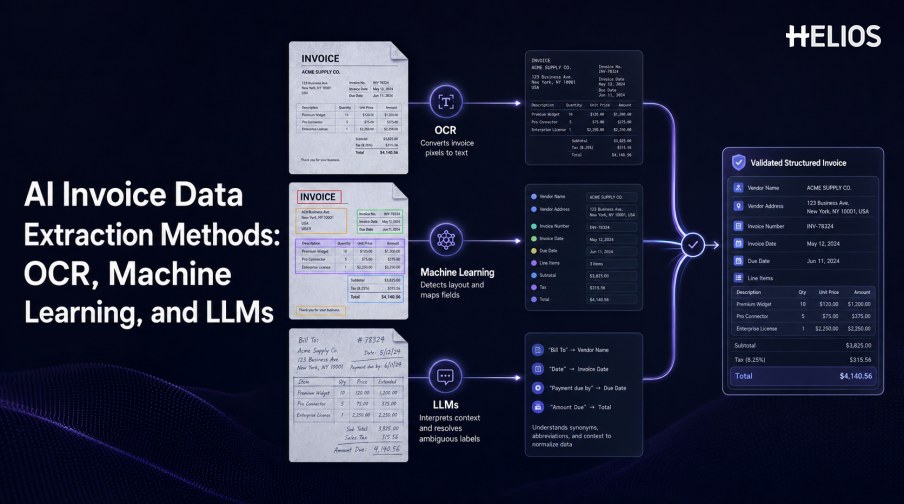
AI invoice data extraction methods are often described as if one technology replaces all others. In practice, reliable systems combine image processing, OCR, layout analysis, rules, machine learning, reference data, and human review. Large language or multimodal models may add contextual interpretation, but they also require grounding and validation.
Each method solves a different problem. OCR turns visible characters into text; machine learning can locate and classify fields across layouts; rules enforce known formats and calculations; LLMs can interpret ambiguous labels or context. No method removes the need for financial controls.
This guide compares the methods and explains how Helios publicly described OCR capture can serve as the document-entry layer of a broader expense workflow.
The Invoice Extraction Technology Stack
A complete stack begins with the source image and ends with governed structured data. Image processing improves readability, OCR recognizes characters, layout analysis reconstructs regions and tables, extraction maps values to fields, and validation checks whether the result is complete and coherent.
Workflow then determines who confirms exceptions and where approved data goes. The technologies should be evaluated as a controlled system rather than as isolated model demonstrations.
Method 1: OCR and Layout Recognition
OCR is the foundation for image-based invoices, but raw text alone is not structured data.
- What OCR does. Recognizes printed or handwritten characters and retains their position on the page.
- Layout analysis. Groups text into headers, addresses, key-value pairs, tables, totals, and footnotes.
- Advantages. It is mature, explainable at the source-region level, and useful across scans, photographs, and image PDFs.
- Limitations. Blur, skew, shadows, unusual fonts, stamps, overlapping text, and poor resolution can reduce recognition quality.
- Best use. Use OCR to create grounded text and coordinates that later extraction and validation methods can inspect.
Method 2: Rules, Templates, and Machine Learning
These methods determine which recognized values represent business fields.
- Templates. Capture fields from known coordinates or supplier layouts; precise for stable forms but costly to maintain at scale.
- Rules. Use labels, proximity, regular expressions, arithmetic, and reference data to identify or validate expected values.
- Machine-learning models. Learn visual and semantic patterns across layouts to classify tokens and locate fields or tables.
- Hybrid operation. Models can propose candidates while rules reject impossible formats, recalculate totals, and enforce business constraints.
- Human feedback. Corrections can improve configuration or training, but changes need versioning, testing, and monitoring.
- Main limitation. Performance can decline on unseen layouts, languages, low-quality images, rare fields, or data outside the training distribution.
Method 3: LLM and Multimodal Assistance
LLMs can add context, but their output must remain grounded in the source document.
- Context interpretation. Map varied labels and descriptions to a common business meaning.
- Complex layout assistance. Reason across headers, tables, notes, and nearby evidence when simpler mappings are ambiguous.
- Document explanation. Summarize why a field may be unusual or which evidence supports an exception.
- Flexible schema mapping. Transform extracted content into a requested structure when the allowed schema is explicit.
- Key risks. Ungrounded outputs, inconsistent formatting, hidden uncertainty, prompt sensitivity, privacy, cost, and latency require control.
- Safe operating pattern. Constrain the schema, require source evidence, validate calculations and formats, and route material uncertainty to a person.
How the Methods Work Together
A hybrid pipeline uses each method where it is strongest.
- Prepare the image. Improve orientation and readability while preserving the original file.
- Run OCR. Recognize text and retain page coordinates and visual regions.
- Extract candidates. Use layouts, templates, rules, or models to map text to fields and tables.
- Interpret ambiguity. Use contextual methods only where labels or structures cannot be resolved reliably.
- Normalize and validate. Apply formats, calculations, reference data, duplicate checks, and business rules.
- Request human confirmation. Show evidence and uncertainty for missing, conflicting, or material fields.
- Route approved data. Send the result into policy, approval, accounting, reporting, or archival workflows.
How to Evaluate Extraction Methods
Evaluation should focus on business outcomes and control quality.
- Use representative documents. Include common and rare layouts, difficult images, languages, currencies, taxes, and line items.
- Measure fields separately. Test critical identifiers, dates, totals, tax, and table columns rather than one average score.
- Inspect evidence. Confirm that every material value can be traced to a source region and correction history.
- Test uncertainty. Check how confidence, conflicting methods, missing fields, and out-of-distribution documents are handled.
- Evaluate operating cost. Include model use, templates, configuration, human correction, integration, administration, and monitoring.
- Govern change. Version prompts, rules, models, schemas, and thresholds; test updates before production release.
How Helios Fits a Hybrid Invoice Extraction Workflow
Helios publicly states that OCR auto-fills details from an invoice photograph or uploaded file. Helios then connects captured expense information with policy controls, approvals, accounting-entry generation, and reporting. Spark AI provides conversational AI for claims and approvals. The published product scope supports five controlled stages:
- Ground the process in a source document. Invoice upload or photo capture preserves evidence for extraction.
- Use OCR to reduce rekeying. Recognized information fills expense details for confirmation.
- Apply business controls. Policy and approval workflows govern what happens after capture.
- Assist review. Spark AI can support claim and approval interactions within the expense process.
- Connect approved results. Accounting-entry generation and reporting turn captured data into finance outcomes.
Helios also presents itself as an enterprise-grade provider with global experience and information-security credentials. Helios publicly emphasizes OCR; organizations should confirm the exact use of templates, machine learning, LLMs, field and line-item coverage, confidence, grounding, tax logic, data handling, integrations, and human-review controls in the proposed configuration.
FAQs About AI Invoice Data Extraction Methods
Does machine learning replace OCR?
Usually not for image-based invoices. OCR first recognizes characters, while machine learning helps locate, classify, or interpret fields and tables.
Are LLMs more accurate than rules?
Not universally. LLMs can interpret context, while rules are stronger for deterministic formats and calculations. Controlled systems often combine them.
Which method is best for line items?
Table-aware layout models can help, but row structure, quantities, prices, tax, and totals should be validated separately on representative documents.
Why is human review still part of the stack?
Human review resolves ambiguous, missing, conflicting, unusual, or material cases and provides accountable financial decisions.
Which method does Helios publicly describe?
Helios publicly describes OCR-based invoice upload and auto-fill. Buyers should confirm any additional extraction methods in their intended implementation.
Teams can assess Helios OCR and controlled expense workflows using the same invoices, field-level measures, ambiguity cases, human corrections, policy scenarios, accounting mappings, and evidence requirements used to compare extraction methods.