
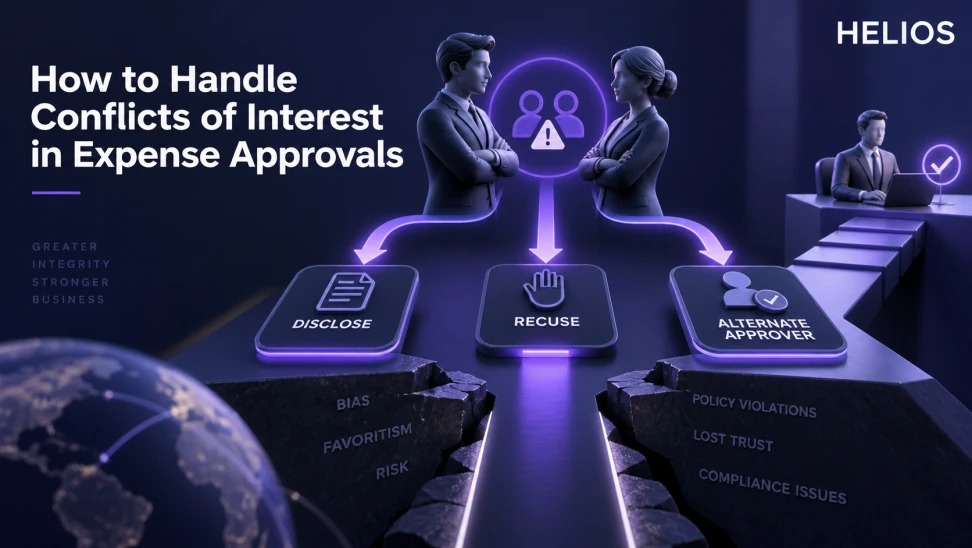
A governance procedure for disclosing, recusing, and independently approving expenses involving personal or shared interests.
A practical framework for finance teams
A governance procedure for disclosing, recusing, and independently approving expenses involving personal or shared interests.
Helios can support role-based approvals and records, but it should not be assumed to identify family, financial, reporting-line, or personal relationships automatically. Conflict determinations require disclosure and authorized review.
For related guidance, see expense fraud detection.
A useful design starts with the decision, then specifies the data, owner, control, timing, and next action. This keeps dashboards, forms, queues, verification, and approvals connected to the work finance must complete.
How to Handle Conflicts of Interest in Expense Approvals at a glance
| Scenario | Conflict risk | Required action | Alternate owner |
| Manager attended meal | Shared personal benefit | Disclose and recuse | Next-level manager |
| Relative owns vendor | Financial relationship | Disclose before purchase | Procurement or compliance |
| Approver shares project benefit | Biased budget decision | Independent review | Unconflicted budget owner |
| Self-submitted expense | Self-approval | Block or reroute | Authorized manager |
| Gift or public official | Ethics and legal exposure | Specialist escalation | Compliance or legal |
For related guidance, see matrix organization approvals.
A clear workflow connects the trigger, evidence, owner, decision, and follow-up.
Define a conflict broadly
A conflict exists when an approver’s personal, family, financial, reporting, or shared-benefit interest could affect, or appear to affect, independent judgment. Actual misconduct is not required.
Publish examples and a safe disclosure route. Employees and approvers should disclose uncertainty rather than deciding privately that a relationship is harmless.
For related guidance, see automated expense approval workflow.
Handle shared meals and events
When a manager attends a meal they are asked to approve, the manager may share the benefit and may not be sufficiently independent. Record attendees, host, purpose, amount, and policy context.
Route the expense to an unconflicted next-level manager or designated alternate. Do not split a receipt or change the submitter solely to avoid review.
Address relatives and connected vendors
Require disclosure when an employee or approver, or a close relative, has ownership, employment, referral, gift, or other material connection with the merchant.
Use procurement, compliance, or legal review before commitment where required. Keep sensitive relationship data access-controlled and collect only what the policy needs.
Use disclosure, recusal, and alternate approval
The conflicted person discloses the relationship, stops participating in the decision, and transfers review through the documented workflow. The alternate approver receives the evidence and has appropriate authority.
Preserve the original assignment, disclosure, recusal, reassignment, final decision, and any conditions. Recusal should not erase accountability for submitting accurate evidence.
For related guidance, see subsidiary approval rules.
Prevent informal workarounds
Prohibit self-approval, shared credentials, reciprocal approvals, approval splitting, changing coding to avoid a threshold, and asking a subordinate to approve a manager’s benefit without independent authority.
Review repeated approver pairs, unusual overrides, shared attendees, and related merchants as signals. A signal requires investigation and does not by itself establish a conflict.
Train and monitor the process
Train employees, managers, administrators, and delegates using realistic scenarios. Provide confidential advice and nonretaliation channels according to company policy.
Measure disclosures, recusals, time to alternate approval, overrides, repeat patterns, late reimbursements, and control exceptions. Review access and authority after role changes.
How Helios supports this workflow
Helios can connect mobile expense capture, multilingual OCR, configurable policy controls, role-based approvals, accounting preparation, integration, and multidimensional reporting. Spark AI can assist in confirmed conversational and policy-review scenarios. Exact delegation, reminder, transfer, risk-scoring, conflict detection, algorithm, and integration behavior should be validated during implementation.
For related guidance, see AI decision explainability.
- Configure role-based and multi-condition approval workflows.
- Record submission, approval, return, and escalation context.
- Collect attendees, purpose, merchant, project, and evidence.
- Route disclosed conflicts to an authorized alternate through configuration.
- Report approvals and exceptions for governance review.
- Preserve workflow records while protecting sensitive access.
A practical conclusion
Design around the decision and the accountable person. Make evidence easy to find, exceptions visible, and next actions explicit. Measure whether the workflow improves control, speed, and employee experience.
See how Helios can support this workflow. Request a Helios demo.
FAQ
What is a conflict of interest in expense approval?
It is a personal, family, financial, reporting, or shared-benefit interest that could affect or appear to affect independent judgment.
Can a manager approve a meal they attended?
The organization should assess independence; many policies route the expense to an unconflicted higher-level or alternate approver.
What should an approver do after disclosure?
Stop participating, recuse through the documented process, and allow an authorized independent reviewer to decide.
How should related vendors be handled?
Disclose the relationship before commitment and use procurement, compliance, or legal review where required.
Can software detect every conflict?
No. Relationship data and context are often incomplete; disclosure, training, review, and monitoring remain necessary.
How can Helios support the process?
Helios can support role-based routing and workflow records, while conflict identification and determinations remain governed human responsibilities.