
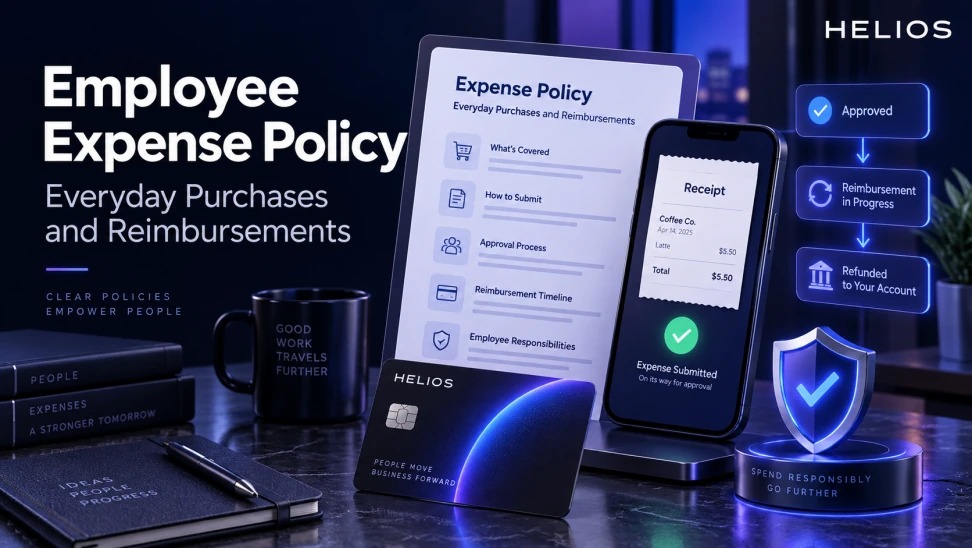
What should an employee expense policy include?
An employee expense policy explains which business purchases are allowed, which payment method to use, what evidence to keep, who approves the expense, how to request an exception, and when an employee will be reimbursed.
The document should be easy to apply to everyday decisions such as meals, local transport, office supplies, software subscriptions, home-office items, training, and client expenses. Employees should not need finance expertise to identify the next step.
This guide focuses on those everyday, mostly non-travel purchases. Travel has its own rule set, so use How to Create a Travel Expense Policy: Rules & Template for airfare, lodging, and per diem. Multinationals that need one global policy with country-level exceptions should read Global Expense Policy: Standardize Rules, Preserve Local Exceptions first and treat this article as the everyday-purchase layer beneath it.
For reimbursement workflow requirements, see expense reimbursement software.
A useful policy combines a short set of global principles with local schedules for currencies, tax documents, and restricted categories, and the workflow should present the relevant rule at the moment the employee acts.
Employee Expense Policy at a glance
| Policy element | Employee question | Rule example | Evidence |
|---|---|---|---|
| Business purpose | Does this support company work? | A team lunch needs attendees and a reason; a personal coffee does not qualify | Purpose, attendees, context |
| Payment method | How should I pay? | Software subscriptions go through procurement; small local purchases may use a card or personal funds | Card or out-of-pocket reason |
| Limit | Is the amount allowed? | Office supplies up to a monthly cap per employee; equipment above a threshold needs pre-approval | Amount, currency, category |
| Receipt | What must I retain? | Itemized receipt unless an approved exception applies | Original document |
| Approval | Who decides? | Manager or budget owner based on rule | Approver and decision |
International rules are discussed in multi-currency expense software for international teams.
An employee expense policy should guide business purpose, payment method, limits, evidence, approval, exceptions, and reimbursement status.
Define reimbursable business expenses
State that an expense must have a clear business purpose, be reasonable, follow the approved purchasing route, and meet category requirements. Give examples of eligible and ineligible costs without pretending the list covers every situation. Everyday categories deserve their own examples: a software subscription bought on a personal card because procurement was slow, a coworking day pass, a replacement laptop charger, a client coffee, a professional membership renewal.
Explain mixed personal and business costs, home-office items that outlast the job, alcohol, gifts, fines, memberships, and other sensitive categories. Local law and employment requirements should be reviewed by qualified teams.
Approval design is covered in automated expense approval workflows.
Set an order of payment methods
Tell employees when to use procurement, direct billing, a corporate card, centrally booked travel, petty cash, or personal funds. Employee payment should have a clear purpose, such as a permitted small purchase or an authorized exception.
Where a corporate card is required, explain what to do when it is unavailable, declined, or not accepted. The employee should be able to document the reason without guessing.
Use understandable limits
List limits by category and location in the currency employees use. Clarify whether limits are per item, day, attendee, trip, month, or event and whether tax and service charges are included.
Avoid vague terms such as reasonable when finance actually applies a numeric threshold. Where judgment is necessary, give factors and examples.
Specify receipts and business context
Require an itemized receipt where appropriate and define alternatives for lost or unavailable documents. Collect merchant, date, amount, currency, category, business purpose, project or cost center, and attendees when relevant.
Set submission deadlines and explain why prompt capture matters. International teams may need original currency, exchange-rate treatment, and local tax fields.
For policy alternatives and controls, review spend management solutions for complex reimbursement and budget control.
Design approvals and exceptions
State when pre-approval is required and who approves ordinary and exceptional expenses. An exception request should identify the rule, business reason, amount, alternative considered, and accountable owner.
Define delegation, escalation, and send-back behavior. Approval should leave a durable record rather than relying on chat or verbal consent.
Explain reimbursement and correction
Tell employees how to submit, view status, respond to questions, and correct a returned claim. Define the expected reimbursement cycle and what happens when payment fails.
Finance should maintain duplicate checks across receipts, card feeds, and prior claims. Refunds and reversals need their own procedure so employees do not conceal a credit in a later report.
Maintain and communicate the policy
Assign a policy owner and review schedule. Use exception, inquiry, correction, and cycle-time data to find unclear or outdated rules. Record effective dates and preserve earlier versions.
Communicate changes before enforcement and embed concise guidance in the expense workflow. Managers and support teams need examples so decisions remain consistent.
How Helios puts employee expense policy into practice
Helios can present policy requirements inside mobile submission, receipt capture, approvals, AI-assisted service, accounting, and reporting workflows. This helps turn a policy document into a consistent employee experience and a traceable finance record.
Employees and finance teams can also use the expense management software guide.
- Mobile submission captures receipts and context close to the purchase.
- Multilingual OCR reduces manual entry for international employees.
- Configurable rules apply category, amount, evidence, and organization conditions.
- Flexible approvals route ordinary and exceptional claims to accountable owners.
- Claim and Service Copilots can guide employees through common questions and tasks.
- Integration and analytics support accounting, monitoring, and policy review.
A practical conclusion
An employee expense policy succeeds when people can use it without interpretation at every purchase. Define the business purpose, payment method, limit, evidence, approval, exception, and reimbursement path, then use workflow data to keep the rules current.
See how Helios can support this workflow. Request a Helios demo.
FAQ about employee expense policies
What is an employee expense policy?
It is the company’s documented rules for authorized business purchases, payment methods, limits, evidence, approvals, exceptions, and reimbursement.
Which everyday purchases are usually reimbursable?
Eligible categories vary, but authorized travel, meals, transport, supplies, training, and other business costs may qualify when they meet policy.
When is a receipt required?
The policy should define receipt thresholds and local requirements. Itemized evidence is generally preferable, with a controlled exception for unavailable documents.
How should employees request an exception?
Identify the rule, explain the business need, state the amount and alternatives, attach evidence, and obtain approval from the accountable owner.
How quickly should employees be reimbursed?
Set a clear service target for complete, approved claims and show status through payment. Timing may vary by country and payment method.
How can Helios enforce an expense policy?
Helios can apply configured rules, capture receipts and context, route approvals, assist employees, integrate approved data, and report policy outcomes.