
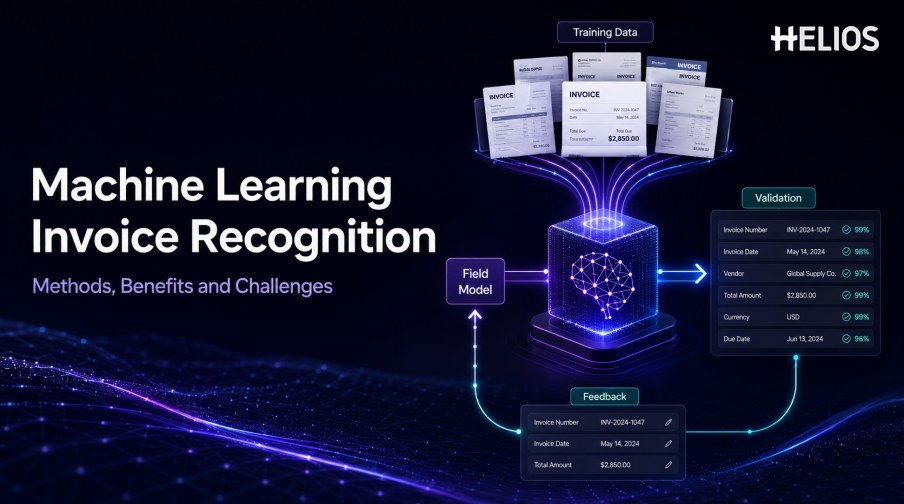
Invoices are semi-structured documents: they contain familiar concepts, but suppliers place those concepts in different positions, formats, languages, and table designs. A fixed template may work for one layout and fail when the logo, labels, line items, or tax presentation changes.
Machine learning invoice recognition addresses that variability by learning patterns that connect document text and layout with business fields. It can help identify supplier, invoice number, dates, currency, subtotal, tax, total, and line items across a broader range of layouts. The output is still a proposal that should be validated before it becomes an expense or accounting record.
This guide explains the main methods, the training and validation loop, the business benefits, and the challenges organizations should address when implementing machine learning invoice recognition with an expense platform such as Helios.
What Is Machine Learning Invoice Recognition?
Machine learning invoice recognition converts invoice images or PDFs into structured data by combining image processing, OCR, layout analysis, field prediction, normalization, and validation. OCR supplies machine-readable words and coordinates; a field model decides which words represent the required business values.
Unlike a purely template-based approach, a learned model can use multiple signals at once. The word near a currency symbol, its relationship to a label such as Total, its position near the bottom of a page, and its numeric pattern can all contribute to a prediction. Confidence and business rules then determine whether the field can proceed or needs review.
Main Methods for Recognizing Invoice Data
Production systems often combine several methods rather than relying on one technique.
- OCR and geometric features. The system reads characters, words, lines, bounding boxes, and page coordinates before classifying fields.
- Label and pattern matching. Rules recognize familiar labels, dates, tax identifiers, currencies, invoice-number patterns, and arithmetic relationships.
- Supervised field models. Models learn from invoices in which supplier, date, amount, tax, and other fields have been labeled with approved values.
- Layout-aware models. Text, position, visual structure, and relationships between page elements are evaluated together across varied templates.
- Document classification. A model first distinguishes invoices, receipts, credit notes, statements, and other documents so the correct extraction logic is applied.
- Table and line-item extraction. Row, column, header, and cell relationships are detected to reconstruct descriptions, quantities, prices, taxes, and totals.
- Hybrid recognition. Machine predictions are combined with deterministic validation, master data, supplier knowledge, and human correction.
A Simple Training and Validation Workflow
A controlled machine learning invoice recognition program typically follows these stages:
- Define the field schema. Specify required document types, fields, languages, currencies, tax data, line items, and downstream formats.
- Collect representative documents. Include common suppliers, long-tail layouts, mobile photos, scans, multi-page files, and difficult image conditions.
- Create verified labels. Authorized reviewers mark the correct source location and normalized value for each field in the training and test data.
- Train and tune the models. The system learns relationships between text, visual layout, document type, and target business fields.
- Test on unseen invoices. Field-level exact match, normalized match, missing values, false values, and correction effort are measured on a separate set.
- Apply confidence and business validation. Low-confidence or conflicting values are routed for review while arithmetic, format, duplicate, and policy checks are applied.
- Capture corrections and monitor drift. Confirmed corrections become governed feedback, and performance is monitored as suppliers, formats, and business rules change.
Business Benefits for Expense and Finance Teams
When it is connected with the downstream workflow, machine learning invoice recognition can deliver practical operating benefits.
- Less repetitive entry. Users confirm proposed values instead of retyping every supplier, date, reference, amount, currency, and tax field.
- Faster submission. Structured data can populate an expense line shortly after the invoice is photographed or uploaded.
- More consistent data. Normalization applies expected date, currency, decimal, identifier, and tax formats before review.
- Earlier control checks. Extracted values can trigger policy, duplicate, arithmetic, and required-field checks before approval.
- Focused human review. Confidence and exception signals direct attention to uncertain or material fields rather than every value.
- Cleaner accounting handoff. Confirmed information can support controlled mappings for entity, category, account, tax, cost center, and project.
- Measurable improvement. Correction rates and exception patterns reveal where documents, models, policies, or user guidance need attention.
Common Challenges and Required Controls
Machine learning improves flexibility, but it does not remove document or process risk.
- Unrepresentative training data. A model trained mainly on clean domestic invoices may perform poorly on photos, foreign languages, credit notes, or new suppliers.
- Field-level performance variation. A high document average can hide weak results for totals, tax, currency, invoice number, or line items.
- Image and OCR errors. Blur, skew, glare, folds, handwriting, stamps, and low contrast can corrupt the text before field prediction begins.
- Model and supplier drift. Layouts, terminology, tax requirements, and spending patterns change, so performance must be monitored over time.
- Over-automation. Material or uncertain values should not be accepted only because a model returned a high score.
- Weak explainability. Reviewers need the source location, proposed value, confidence, rule result, and correction path—not only a final answer.
- Privacy and governance. Training data, access, retention, model use, corrections, and deployment changes require documented ownership and controls.
Implementation Checklist
Before launch, teams should validate the complete recognition-to-accounting path.
- Scope. Document types, fields, languages, currencies, tax regimes, page limits, channels, and line-item requirements are documented.
- Test data. A representative and independent evaluation set includes both normal and difficult cases.
- Metrics. Critical fields have exact-match, false-value, missing-value, correction, and straight-through targets.
- Review rules. Confidence thresholds vary by materiality, and authorized users can see and correct the source-backed result.
- Integration. Expense, policy, approval, master-data, accounting, error-handling, and reporting interfaces are tested end to end.
- Monitoring. Owners review drift, correction patterns, processing time, failed transfers, model changes, and user feedback.
How Helios Supports Machine Learning Invoice Recognition in Practice
Helios combines mobile capture, OCR for invoices and receipts, policy controls, configurable approvals, accounting-entry generation, and reporting. Spark AI adds conversational assistance across claims, approvals, travel, and service. Together, these capabilities connect recognition with five implementation needs:
- Capture realistic source documents. Users can photograph receipts or upload invoices through an expense workflow.
- Populate structured fields with OCR. Recognized values reduce retyping and remain available for user confirmation.
- Validate data inside company controls. Policy rules and review steps can act on extracted amounts, dates, evidence, and context.
- Preserve human ownership of exceptions. Configurable approvals and Spark AI assistance support review without removing accountable decisions.
- Move confirmed data into finance outputs. Approved reports can generate accounting entries and feed dashboards and reports.
Helios also presents itself as an enterprise-grade provider with global experience and information-security credentials. Buyers should test Helios OCR on their document mix and validate field accuracy, confidence handling, correction paths, languages, taxes, line items, integrations, governance, and implementation scope.
FAQs About Machine Learning Invoice Recognition
Does machine learning replace OCR?
No. OCR generally reads text and location, while machine learning helps classify documents and map that content to fields. Many systems combine OCR, learned models, rules, and validation.
How much training data is required?
There is no universal number. Requirements depend on model design, field scope, layout diversity, languages, image quality, and whether a pretrained model is being adapted. Representative coverage matters more than raw volume alone.
How should accuracy be measured?
Measure exact and normalized matches by field, along with false values, missing values, corrections, straight-through completion, and performance on difficult or newly introduced layouts.
Can corrections improve recognition?
Yes, when corrections are verified, governed, and used in an approved feedback process. Uncontrolled user edits should not automatically become training labels.
Where should human review remain?
Keep review for low-confidence, conflicting, high-value, tax-sensitive, duplicate, and policy-exception cases, with thresholds based on business risk.
Organizations can evaluate Helios OCR and expense workflows with representative invoices, field-level metrics, exception rules, correction scenarios, and downstream accounting tests.