
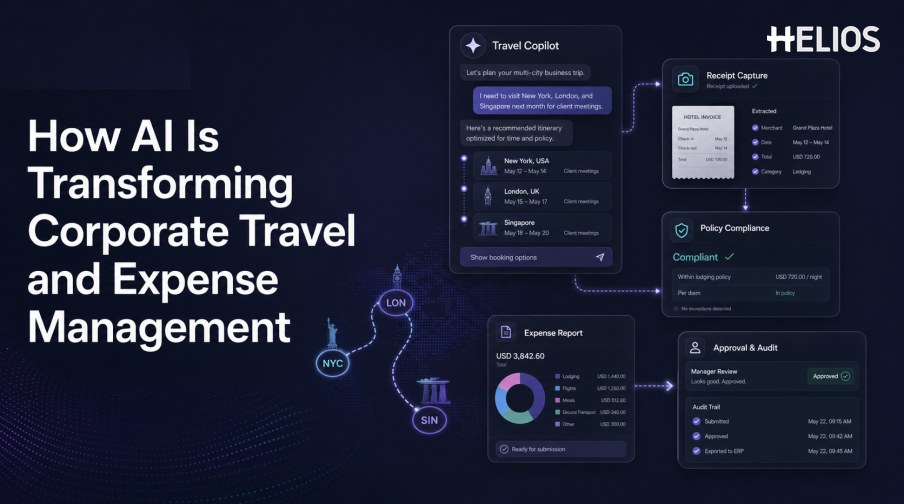
AI in corporate travel and expense management is changing how employees plan business trips, document spending, understand policy, and complete expense reports. It is also changing how managers and finance teams review claims by organizing evidence, applying routine checks, and directing attention to exceptions.
The most useful AI does not operate as an uncontrolled replacement for policy or financial authority. It works inside a governed travel and expense process, using conversational assistance and document intelligence alongside deterministic rules, approval responsibilities, accounting mappings, and audit records.
This guide explains the principal AI use cases across the T&E lifecycle and shows how Helios and Spark AI Travel Copilot, Claim Copilot, Approval Copilot, and Service Copilot can connect travel activity with expense and finance workflows.
What AI Changes in Corporate T&E
Traditional T&E processes ask employees to navigate separate tools, interpret policy documents, copy receipt data, complete forms, and wait for reviewers to identify missing information. AI introduces an interaction layer that can interpret natural-language requests and unstructured documents, then guide the user through the next required action.
Automation and AI have different roles. Automation follows defined instructions, such as routing a report above a threshold to finance. AI interprets less structured inputs, such as a trip request stated in conversation or a photographed receipt. A well-designed process uses both and retains human control over material exceptions and financial decisions.
Use Case 1: Conversational Itinerary Assistance
An employee can describe the intended trip in natural language instead of starting with multiple search forms.
- Understand trip intent. Capture destination, dates, sequence, traveler, business purpose, preferences, and constraints from a conversation.
- Request missing details. Ask focused questions when dates, locations, timing, class of service, or authorization context are incomplete.
- Apply travel guidance. Surface relevant policy requirements before the employee commits to a choice.
- Prepare a structured request. Convert conversational input into itinerary and approval fields that the workflow can use.
- Maintain traveler control. Require confirmation of the proposed itinerary, cost, documents, and submission before action.
- Preserve context. Keep the business purpose and approved trip connected with later expenses where the platform supports that relationship.
Use Case 2: AI-Assisted Expense Submission
AI can shift the employee task from repeated transcription to confirmation and completion.
- Capture the receipt. Photograph or upload the complete document through a governed mobile or web channel.
- Recognize document fields. Extract merchant, date, currency, tax, total, and other required values.
- Prefill the expense. Create a draft line and propose a category or related context where supported.
- Request business information. Ask for purpose, participants, project, trip, entity, or cost center that the receipt cannot prove.
- Validate the draft. Check required fields, arithmetic, duplicate risk, transaction relationships, and document quality.
- Confirm and submit. Let the employee correct the proposed values and deliberately submit the claim.
Use Case 3: Policy Validation and Employee Guidance
AI can make policy easier to use, while deterministic controls decide whether configured requirements are met.
- Contextual answers. Give employees relevant policy guidance for a trip, category, destination, or claim question.
- Required evidence. Identify missing receipts, participants, business purpose, itinerary, or authorization.
- Limit and category checks. Compare the expense with configured amounts, classes, merchant categories, dates, and locations.
- Exception explanation. Show which policy requirement was triggered and what the employee can do next.
- Consistent escalation. Route exceptions according to severity, amount, entity, department, role, or cost center.
- Policy ownership. Keep approved policy content, rule changes, effective dates, and exception authority governed by accountable teams.
Use Case 4: AI-Assisted Review and Approval
Review assistance should organize evidence and risk without hiding the final decision.
- Pre-check completeness. Identify missing data, unreadable evidence, arithmetic differences, and incomplete business context.
- Apply policy checks. Compare the claim with relevant company rules and highlight violations or required exceptions.
- Prioritize attention. Direct reviewers to high-value, unusual, duplicated, conflicting, or policy-sensitive items.
- Present source evidence. Show the receipt, extracted values, employee edits, related trip, policy result, and prior decisions together.
- Support controlled actions. Allow approve, return, reject, correct, request evidence, or escalate according to role.
- Retain explainability. Record the inputs, checks, recommendation context, reviewer decision, comments, and timestamps.
How to Implement AI in Corporate Travel and Expense Management
Begin with controlled use cases and measurable operating outcomes.
- Map the T&E process. Document travel requests, expense sources, policy, approvals, finance review, reimbursement, accounting, and reporting.
- Separate AI from authoritative rules. Define where interpretation is useful and where deterministic validation or human authority is mandatory.
- Prepare trusted data. Govern policies, employee and entity data, categories, accounting mappings, travel context, and reference sources.
- Design human checkpoints. Set confirmation, approval, override, escalation, and audit requirements by risk and materiality.
- Pilot representative scenarios. Include frequent travelers, difficult receipts, foreign currencies, policy exceptions, and complex approvals.
- Measure the complete workflow. Track employee touch time, correction, policy compliance, approval time, review effort, and accounting rejection.
- Monitor and improve. Review model behavior, rule effectiveness, user feedback, overrides, failures, and changing business requirements.
How Helios and Spark AI Support AI-Enabled Corporate T&E
Helios publicly presents a mobile-first expense platform with travel activity, AI-Powered Receipt Capture, automated policy controls, configurable approvals, accounting-entry generation, and analytics. Spark AI adds four conversational copilots that connect travel and expense tasks. Together, they provide five relevant capabilities:
- Conversational travel assistance. Travel Copilot helps employees plan and book business trips through natural-language interaction.
- Faster expense submission. OCR auto-fills document details, while Claim Copilot supports conversational claim creation.
- Policy guidance and control. Service Copilot answers travel and reimbursement questions, while configured controls enforce company rules.
- AI-assisted approval. Approval Copilot checks claims against policy and supports faster, evidence-based review.
- Finance continuity. Approved reports can generate journal entries and feed multi-dimensional reporting.
Helios also presents itself as an enterprise-grade provider with global experience and information-security credentials. Organizations should validate exact travel content, countries, currencies, languages, policy sources, booking and change boundaries, document formats, approval authority, accounting connectors, AI oversight, and implementation responsibilities.
FAQs About AI in Corporate Travel and Expense Management
How is AI used in corporate travel and expense management?
Common uses include conversational trip assistance, receipt recognition, expense prefilling, policy guidance, claim checks, exception prioritization, and reviewer support.
Can AI approve employee expenses automatically?
Automation may process defined low-risk cases, but approval authority, material exceptions, policy overrides, and financial decisions should remain explicitly governed.
What does Travel Copilot do?
Spark AI Travel Copilot is publicly described as helping users plan and book business trips through simple conversation.
How does AI improve compliance?
It makes policy guidance easier to access, checks required information and configured rules, and directs exceptions to accountable reviewers.
Which metrics should companies track?
Track trip-request time, expense touch time, OCR correction, policy exceptions, approval cycle time, finance review effort, accounting rejections, and user adoption.
Organizations can evaluate Helios and Spark AI for corporate T&E with representative travel requests, receipts, policy questions, approval exceptions, accounting mappings, and controlled human checkpoints.