
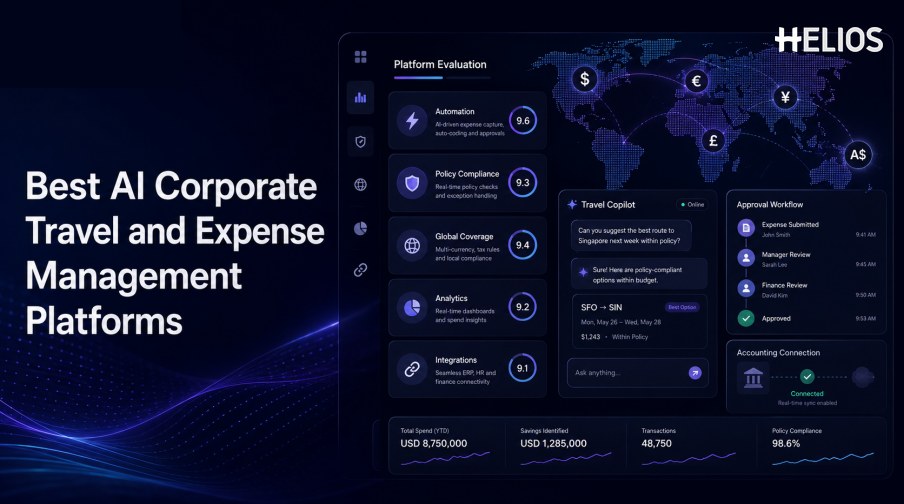
An AI corporate travel expense management platform should connect employee travel activity with expense capture, policy, approval, finance review, accounting, and reporting. The AI layer can simplify interaction and interpretation, but the platform must also provide dependable workflows, integrations, data controls, and global configuration.
Buyers comparing AI tools for travel expense management in corporations should avoid selecting a product from a chatbot demonstration alone. The important question is whether the full process works with the organization's entities, currencies, policies, approval authority, travel scenarios, receipts, accounting structure, and regional requirements.
This guide describes the evaluation criteria for AI-based travel expense management solutions and explains how Helios and Spark AI Travel Copilot fit into an enterprise T&E platform strategy.
What an AI Corporate T&E Platform Should Cover
A complete platform supports connected tasks before, during, and after a business trip.
- Travel request and authorization. Capture purpose, itinerary, expected cost, entity, project, and pre-trip approval requirements.
- Trip assistance. Use conversational input to help employees plan and book within the supported travel scope.
- Expense capture. Receive mobile receipt images, digital documents, and authorized transaction data.
- Claim creation. Extract fields, request missing business context, and assemble expense reports.
- Policy and approval. Apply configured rules and route claims by organization, amount, role, and exception.
- Finance processing. Support review, accounting dimensions, journal preparation, reimbursement status, and audit evidence.
- Analytics and administration. Report spend and workflow performance while governing configuration, access, and change.
Automation and AI Capabilities
Evaluate how the platform handles both structured workflow and unstructured inputs.
- Conversational assistance. Understand travel, claim, approval, and policy requests expressed in natural language.
- Receipt and invoice recognition. Extract required fields from mobile images and uploaded documents.
- Workflow automation. Route requests and reports according to entity, department, role, cost center, amount, and exception.
- Policy validation. Check required evidence, limits, categories, dates, location, class of service, and other configured rules.
- Review assistance. Organize source evidence and prioritize missing, conflicting, unusual, or noncompliant items.
- Accounting preparation. Map approved data to accounts, tax codes, currencies, cost centers, projects, and journal structures.
- Human control. Require confirmation and authorized decisions for material, uncertain, or exceptional cases.
Policy Compliance and Governance
AI usability must operate inside a controlled policy framework.
- Policy sources. Identify the approved rules, documents, owners, effective dates, and local variations used by the platform.
- Deterministic enforcement. Use configured controls for mandatory thresholds, required receipts, approval authority, and accounting rules.
- Explainable exceptions. Show the policy, evidence, field, limit, and reason that produced an alert or escalation.
- Override authority. Restrict who can approve an exception and require a reason and supporting evidence.
- Segregation of duties. Separate policy administration, submission, approval, finance review, payment, and accounting roles where needed.
- Audit trail. Retain source data, AI assistance, rule results, edits, decisions, exports, and final financial status.
Global Applicability
Global fit is more than displaying several currencies on a dashboard.
- Multi-entity configuration. Support legal entities, business units, local approval authority, and separate accounting mappings.
- Currency handling. Retain transaction, card, reimbursement, and accounting currencies with governed exchange-rate logic.
- Language and document coverage. Test employee interfaces, OCR, dates, decimals, tax labels, and receipt formats by country.
- Local policy and tax. Configure regional limits, receipt requirements, tax fields, retention, and reimbursement practices.
- Data and security requirements. Validate access, encryption, data location, retention, privacy, monitoring, and incident response.
- Support and rollout model. Confirm local implementation resources, service hours, issue ownership, change control, and training.
Analytics and Integration Requirements
The platform should provide both operational visibility and a reliable finance handoff.
- Management analytics. Analyze spend by entity, country, category, merchant, employee, project, cost center, and period.
- Process analytics. Track capture corrections, policy exceptions, approval time, reviewer effort, reimbursement status, and failures.
- Source integrations. Connect identity, HR, card, travel, policy, reference-data, and document channels as required.
- Accounting integration. Map approved reports to financial dimensions and return export, rejection, retry, and posting status.
- Failure recovery. Test duplicate messages, schema changes, partial success, outages, reversals, and manual fallback.
- Source-to-ledger traceability. Keep the trip, receipt, expense, approval, accounting entry, and correction linked.
How to Compare Platforms Fairly
Use a common scorecard and representative end-to-end scenarios.
- Define the operating model. List entities, countries, travelers, policies, currencies, integrations, roles, and success measures.
- Build representative cases. Include simple and complex trips, difficult receipts, foreign currency, policy exceptions, and accounting failures.
- Test every role. Observe employees, managers, finance reviewers, accounting teams, administrators, and support users.
- Verify product boundaries. Confirm what the AI can suggest, what the workflow can execute, and what still requires another system or human action.
- Measure quality and effort. Track correction, false alerts, completion time, exception aging, review time, and downstream rejection.
- Assess total ownership. Include configuration, integration, policy maintenance, model monitoring, support, security, and change management.
- Validate the proposed deployment. Confirm the exact version, region, connectors, implementation scope, data terms, and service commitments.
How Helios Fits an AI Corporate T&E Platform Strategy
Helios publicly presents an enterprise expense platform with mobile travel and expense activity, OCR document capture, automated policy controls, flexible approvals, accounting-entry generation, and analytics. Spark AI adds Travel, Claim, Approval, and Service Copilots for conversational assistance. Together, they address five platform requirements:
- Connected employee experience. Mobile workflows support trip activity, receipt capture, expense submission, and approvals.
- Conversational T&E assistance. Travel Copilot supports trip planning and booking, while Claim Copilot supports expense submission.
- Policy compliance. Automated controls enforce company rules, Approval Copilot checks claims, and Service Copilot answers policy questions.
- Finance integration. The accounting engine generates journal entries from approved expense reports.
- Management visibility. Multi-dimensional dashboards and customizable reports support analysis and decision-making.
Helios also presents itself as an enterprise-grade provider with global experience and information-security credentials. Buyers should validate precise country, currency, language, tax, travel-content, booking, reimbursement, payment, accounting-connector, data-residency, support, and AI-governance requirements for their deployment.
FAQs About AI Corporate Travel Expense Management Platforms
What is an AI corporate travel expense management platform?
It connects corporate travel and expense workflows and uses AI for tasks such as conversational assistance, document recognition, policy guidance, and review support.
What should global companies prioritize?
Prioritize multi-entity and currency support, local policy and tax requirements, language and document coverage, integration reliability, security, and consolidated reporting.
Is the best platform the one with the most AI features?
No. Workflow completeness, data quality, control, integration, usability, operating cost, and measurable outcomes are more important than feature count.
How should Travel Copilot be evaluated?
Test representative trip conversations, missing details, policy questions, user confirmation, supported booking scope, exceptions, and the connection with later expense processes.
Explore Helios and Spark AI for corporate T&E with representative global travel and expense scenarios.