
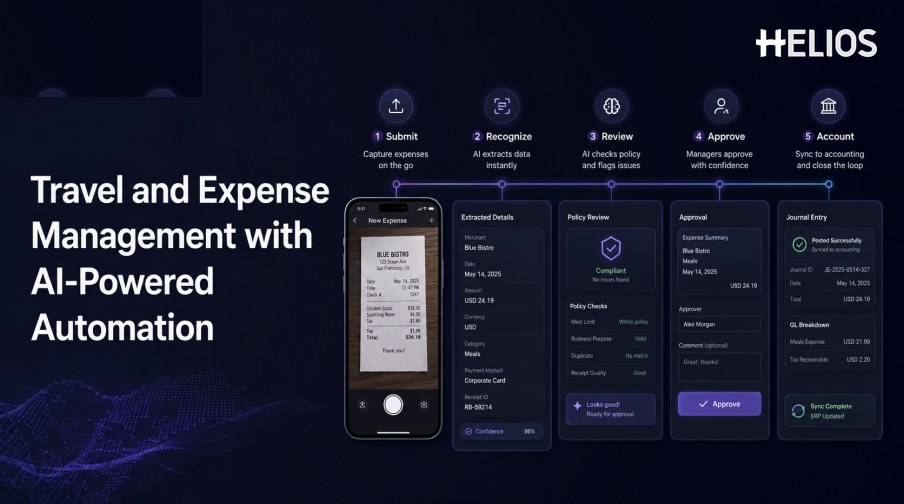
Travel and expense management with AI-powered automation connects the employee's initial travel or expense task with document recognition, policy review, approval, accounting preparation, and reporting. Instead of transferring information between disconnected forms and inboxes, the organization manages one traceable flow from source evidence to financial outcome.
AI contributes interpretation and assistance, while automation applies defined workflow and control rules. Used together, they can reduce repetitive entry, identify missing information earlier, speed routine review, and create more consistent expense data without removing human authority over material exceptions.
This guide explains the complete workflow, efficiency and compliance value, implementation controls, and how Helios and Spark AI support each stage.
AI-Powered Automation Compared with Basic Workflow
A basic digital workflow moves a form from employee to manager and finance. AI-powered automation can also interpret a conversational request, recognize a receipt, propose field values, organize evidence, identify potential issues, and help the user complete the next task.
The process should distinguish suggestions from authoritative decisions. OCR output is a proposed record until it passes confirmation and validation. An AI review signal is a prompt for attention, while policy, approval, accounting, and payment authority remain governed by explicit rules and roles.
The End-to-End AI-Powered T&E Workflow
A connected workflow can be described in seven controlled stages.
- Initiate the task. The employee requests travel, submits a claim, or captures a receipt through mobile or conversational interaction.
- Recognize the evidence. OCR extracts merchant, date, currency, tax, total, and other required fields.
- Complete the record. The user confirms values and adds purpose, trip, participants, category, project, entity, or cost center.
- Run automated checks. Validate required fields, arithmetic, document quality, duplicate risk, transaction context, and policy rules.
- Route review and approval. Use organization, amount, role, department, cost center, and exception type.
- Prepare finance processing. Map approved data to accounts, tax codes, currencies, projects, and journal-entry dimensions.
- Report and retain. Track spend, workflow performance, corrections, approvals, export status, and audit history.
How AI Improves Submission and Recognition
The employee should spend less time transcribing evidence and more time confirming business context.
- Conversational task entry. Allow the employee to describe a trip or expense without navigating every field first.
- Mobile evidence capture. Collect receipts close to the transaction and guide the user when an image is incomplete.
- Field extraction. Recognize document values and normalize dates, amounts, currencies, and tax formats.
- Prefilled claims. Create a draft expense record and request only missing or uncertain information.
- Business-context prompts. Ask for purpose, participants, project, trip, entity, or cost center that cannot be derived from a receipt.
- User confirmation. Show source evidence and proposed values so the employee can correct mistakes before submission.
How AI Improves Review, Approval, and Compliance
AI can focus human attention, but it should not obscure policy evidence or decision responsibility.
- Completeness review. Identify missing receipts, fields, business context, approval evidence, or unreadable documents.
- Policy validation. Check configured limits, categories, dates, locations, attendees, class of service, and other rules.
- Exception prioritization. Highlight high-value, unusual, duplicated, conflicting, or policy-sensitive items.
- Explainable evidence. Present the receipt, extracted values, employee edits, policy result, related trip, and history together.
- Conditional routing. Send each report to the correct manager or finance reviewer according to organization and exception.
- Controlled decision. Record the authorized approval, return, rejection, correction, override, or escalation.
How Automation Connects with Financial Processing
Approved expense data should enter finance systems without losing its source or approval context.
- Accounting mappings. Assign entity, account, tax code, currency, cost center, project, and other required dimensions.
- Journal-entry preparation. Generate controlled accounting records from approved reports instead of retyping totals.
- Transfer status. Track prepared, exported, rejected, retried, posted, reimbursed, and adjusted states.
- Failure handling. Manage duplicates, missing reference data, schema changes, timeouts, partial success, and manual fallback.
- Source-to-ledger traceability. Keep the receipt, expense, policy result, approval, journal entry, and later correction connected.
- Management reporting. Analyze spend and process outcomes across entity, category, employee, project, region, and period.
Efficiency, Compliance, and Implementation Measures
A successful implementation improves speed without weakening control.
- Employee efficiency. Measure capture time, fields entered, correction rate, resubmission, and report completion time.
- Approval efficiency. Track queue time, active review time, return rate, exception aging, and escalation.
- Finance efficiency. Measure manual rekeying, accounting preparation time, failed exports, and downstream corrections.
- Compliance quality. Track missing evidence, policy violations, overrides, repeated exceptions, and unresolved risks.
- AI quality. Monitor OCR correction, false alerts, missed issues, user acceptance, and performance by scenario.
- Audit quality. Test whether source evidence, rules, edits, approvals, exports, and final status can be retrieved quickly.
- Continuous governance. Assign owners for policy, data, models, integrations, access, monitoring, and change control.
How Helios and Spark AI Connect AI-Powered T&E Automation
Helios publicly combines mobile travel and expense activity, OCR receipt capture, automated policy controls, configurable approval workflows, accounting-entry generation, and reporting. Spark AI adds conversational Travel, Claim, Approval, and Service Copilots. This creates five connected stages:
- Initiate through mobile or conversation. Employees can manage trip and expense tasks through a mobile-first interface and Spark AI interaction.
- Recognize and prefill. OCR auto-fills document details, reducing initial receipt transcription.
- Check policy and context. Automated controls and Spark AI help identify requirements and potential exceptions.
- Route accountable approval. Flexible workflows and Approval Copilot support evidence-based review.
- Connect with finance. Approved reports can generate journal entries and feed multi-dimensional analytics.
Helios also presents itself as an enterprise-grade provider with global experience and information-security credentials. Organizations should validate document formats, languages, currencies, travel scope, policy rules, AI review behavior, approval authority, tax and accounting mappings, reimbursement boundaries, system connectors, data controls, and implementation responsibilities.
FAQs About Travel and Expense Management with AI-Powered Automation
What is AI-powered T&E automation?
It combines AI interpretation and assistance with workflow rules to connect travel and expense tasks from submission through review, accounting, and reporting.
Which steps can be automated?
Common steps include receipt capture, field extraction, required-field checks, policy validation, routing, journal preparation, status tracking, and reporting.
Does AI replace expense approvers?
No. AI can organize evidence and highlight issues, while authorized people and deterministic controls remain responsible for material decisions and exceptions.
How does automation improve compliance?
It applies rules consistently, identifies missing evidence earlier, makes exceptions visible, and preserves a traceable review and approval history.
How do Helios and Spark AI support the workflow?
Helios provides mobile expense, OCR, policy, approvals, accounting integration, and reporting, while Spark AI adds conversational travel, claim, approval, and service assistance.
Businesses can test Helios and Spark AI-powered T&E workflows with representative trips, receipts, policy exceptions, approval routes, accounting mappings, integration failures, and measurable employee and finance outcomes.