
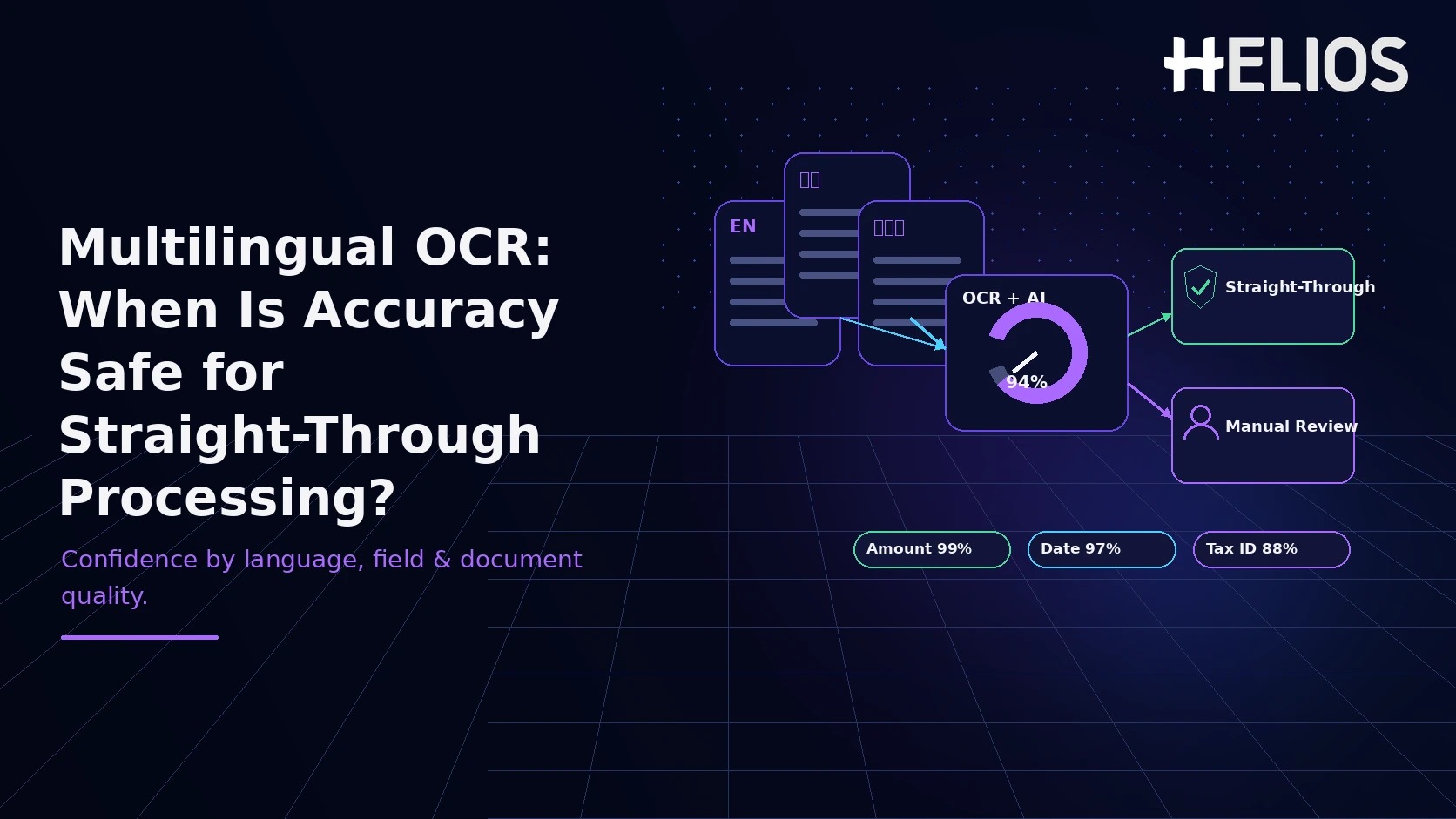
Straight-through processing (STP) is not safe because an OCR engine reports a high average accuracy score. It is safe when the fields that can create financial, tax, duplicate-payment, or period-close risk are extracted accurately enough—and every remaining uncertainty is caught by validation rules or routed to human review.
For multinational finance teams, the question is even harder. A model may perform well on English hotel invoices but degrade on low-resolution taxi receipts, mixed scripts, tax-heavy invoices, handwritten tips, or documents that switch between local language and English. The right design therefore combines field-level accuracy targets, calibrated confidence thresholds, deterministic checks, policy rules, and continuous monitoring.
No Single Percentage Makes OCR Safe for STP
No credible OCR provider can give one universal accuracy percentage that makes every invoice or receipt safe for unattended processing. Microsoft Document Intelligence explicitly recommends calibrating confidence thresholds on a representative pilot and notes that a single character error can be insignificant in one field but critical if it changes the paid amount. AWS similarly advises using confidence thresholds that reflect the sensitivity of the use case; its guidance says financial decisions may require confidence thresholds of 90% or higher.
Microsoft: Document Intelligence transparency and confidence guidance
AWS: Amazon Textract best practices for confidence scores
Confidence is a routing signal, not proof of accuracy. Finance should measure observed field accuracy on its own documents, then use confidence plus business-rule validation to decide which documents qualify for STP.
What "Accuracy" Should Finance Actually Measure?
| Metric | What it measures | Why it matters for STP |
|---|---|---|
| Field exact-match accuracy | How often a field such as total, tax, date, currency, or invoice number is extracted exactly. | More meaningful than document-average OCR because critical fields drive money, tax, and duplicate controls. |
| All-critical-fields-correct rate | Percentage of documents where every critical field is correct. | A document with one wrong total or currency should not qualify as fully correct. |
| Confidence calibration | Whether a 95% confidence score is actually correct about 95% of the time for that field/cohort. | Uncalibrated confidence can create false assurance. |
| False-accept rate | Documents sent straight through even though at least one material field is wrong. | This is the key operational risk metric for unattended processing. |
| STP rate | Share of documents that pass thresholds and validations without human touch. | Measures automation, but must be evaluated together with false accepts. |
| Exception precision | How many documents routed to review truly need review. | Prevents an overly conservative threshold from recreating manual work. |
A Practical Starting Gate for Safe STP
The following is a risk-based starting framework for a controlled pilot—not a statutory standard or a vendor guarantee. Tighten it for higher-value, tax-sensitive, or fraud-sensitive populations, and relax it only when independent validation reduces the risk.
| Field / cohort | Practical pilot target | Additional gate before STP |
|---|---|---|
| Critical financial fields: total, currency, tax amount/rate | Observed exact-match accuracy above 99%; consider 99.5%+ for high-value or tax-sensitive flows. | Arithmetic checks, currency validation, tax logic, amount limits, and no unresolved conflict. |
| Critical identity fields: vendor, invoice/receipt number, date | About 98–99%+ observed accuracy depending on duplicate/payment risk. | Vendor/master-data match, date sanity checks, duplicate search, document-source linkage. |
| Important routing fields: category, entity, cost center/project | About 97–98%+ or deterministic mapping from trusted master data. | Policy and mapping validation; no inactive or invalid dimensions. |
| Supporting fields: address, memo, low-risk line description | Can be lower if they do not determine accounting, tax, or payment. | Human review only when the field is required for policy, tax, or audit evidence. |
| Document eligibility | All critical fields pass thresholds and validation. | No image-quality defect, duplicate warning, policy exception, unsupported language, or high-risk amount. |
Do not confuse a model confidence score of 95 with 95% measured accuracy. Confidence scores are vendor/model outputs; accuracy is the result of testing against known-correct ground truth. Finance should monitor both.
Multilingual OCR Must Be Tested by Language, Script, and Document Type
A global average can hide a weak country or script. STP eligibility should be evaluated by cohorts that reflect how documents are actually received.
- Language and script: test each material language separately, including mixed-script documents and Latin transliterations where they occur.
- Document type: hotel invoices, restaurant receipts, taxi receipts, e-invoices, handwritten additions, and multi-page invoices have different error profiles.
- Numeric conventions: decimal separators, thousands separators, date formats, tax identifiers, and currency symbols can create financially material errors even when the text looks readable.
- Image quality: blur, glare, dark images, cutoff text, small text, and noise should either lower confidence or make the document ineligible for STP. Google Document AI explicitly exposes these types of image-quality defects for document processing.
Google Cloud Document AI: image quality scores and detected defects
- Language drift: new suppliers, new invoice templates, local e-invoice formats, and changing tax documents can degrade a model after go-live even if the original pilot passed.
Use a Decision Engine, Not OCR Alone
The safest STP architecture treats OCR as only the first decision layer. A document moves straight through only if every control layer agrees that the risk is low.
- Capture and quality gate. Reject or route blurry, cropped, unsupported, or ambiguous documents before accounting logic starts.
- Field confidence gate. Apply higher confidence thresholds to total, tax, currency, date, vendor, and duplicate-detection identifiers than to descriptive fields.
- Deterministic validation. Check subtotal + tax = total where applicable, currency codes, date ranges, tax structure, master-data validity, and required fields.
- Policy and risk validation. Apply amount limits, category rules, duplicate detection, unusual merchant logic, and entity-specific controls. A perfect OCR result can still be an invalid expense.
- STP or human review. Only the low-risk population proceeds automatically. Any confidence, validation, policy, or risk failure should create a clear exception reason for review.
How to Pilot Multilingual OCR Before Enabling STP
A finance-led pilot should use real documents from every material operating region, including the ugly examples that users actually submit. A clean benchmark set of perfect PDFs will overstate production safety.
| Pilot test | What to include | Pass question |
|---|---|---|
| Language coverage | Representative volume from each language/script and country. | Does each cohort meet its own critical-field and false-accept thresholds? |
| Field extraction | Totals, tax, currency, dates, vendor, invoice/receipt number, line items where needed. | Are critical fields accurate at the exact-match level, not just "close"? |
| Image quality | Blur, glare, low light, folds, cropped edges, mobile photos, small thermal receipts. | Are unsafe images rejected or routed to review rather than accepted? |
| Format variability | Hotel folios, restaurant receipts, tax invoices, e-invoices, multi-page and mixed-language documents. | Does accuracy remain stable across layouts and document types? |
| Business validation | Arithmetic, tax, duplicate, policy, entity/GL mapping, high-value limits. | Can rules catch material OCR errors before posting/payment? |
| End-to-end STP | Capture through approval/accounting/ERP posting on eligible documents. | Is the false-accept rate inside finance risk appetite and fully traceable? |
Monitor the Error Budget After Go-Live
OCR accuracy is not a one-time certification. Finance should monitor accuracy and exception patterns by language, country, supplier, document type, and field. A rising STP rate is not success if false accepts also rise.
- Track critical-field exact-match accuracy from reviewed samples and corrected exceptions.
- Track false-accepts separately from false-rejects; the former creates control risk, while the latter creates operational cost.
- Review top correction reasons: total, tax, currency, vendor, date, category, or image quality. Feed recurring errors into model/rule improvement.
- Set automatic STP suspension rules for a language, supplier, or document cohort when observed quality drops below the approved threshold.
- Retain the original image, extracted values, confidence, corrections, approval, and accounting result so the control remains auditable.
How Helios Supports a Safer OCR-to-Accounting Workflow
Three Helios capabilities map directly onto the risk layers this article describes. Exact multilingual model coverage and STP thresholds are not published in detail and should be verified in a representative pilot before go-live.
- Capture accuracy at the source. Helios's OCR auto-fills invoice and receipt fields from a photo or upload, which is the layer this article's accuracy targets and cohort testing apply to directly. Run the language/script/document-type pilot in this article against Helios's actual output before trusting any average accuracy figure.
- Policy validation after extraction. Automated Policy Control checks spending rules against the extracted fields, giving finance a second layer beyond raw OCR—useful for catching a correctly-read but non-compliant expense, though it does not by itself validate arithmetic or tax logic.
- Exception routing as a question to ask, not an assumed feature. Flexible approval workflows can route flagged claims to a named reviewer, but Helios's public materials don't specify whether an OCR confidence score is exposed at all or whether it can drive that routing. Ask directly: does a document that fails a confidence or validation check surface as a distinct exception reason to the reviewer, or does it just look like an ordinary claim in the queue? A concrete way to test this in a demo: submit a blurry taxi receipt where the total is genuinely ambiguous — if the platform is doing this well, the claim should land in the reviewer's queue tagged something like "OCR confidence below threshold, verify total," not simply post through with a silently guessed amount.
Approved data still has to reach accounting and reporting correctly—Helios states its accounting engine generates journal entries automatically—so the field-mapping accuracy validated in the pilot should carry through to that step rather than being re-checked from scratch.
Explore Helios expense management
Go-Live Checklist for Multilingual OCR STP
- Every material language, script, document type, country, and image-quality cohort has been tested separately.
- Critical-field accuracy and confidence thresholds are documented by field and risk tier; no single average score controls all documents.
- Arithmetic, currency, tax, duplicate, policy, and master-data validations are active before automatic posting or payment.
- Low-confidence and failed-validation documents enter a clear human-review queue with correction history and ownership.
- False-accept rate, STP rate, correction reasons, language-level drift, and audit evidence are monitored after go-live.
FAQs About Multilingual OCR Accuracy and Straight-Through Processing
Should every language use the same confidence threshold? Use the same risk standard, not necessarily the same numeric threshold. Calibrate each language/script cohort against its own measured accuracy and false-accept rate—a script with less training data usually needs a stricter gate, not a looser one.
Can business rules compensate for imperfect OCR? Only for detectable errors. Arithmetic checks, tax validation, duplicate detection, and master-data matching catch many mistakes, but a misread that still passes those checks—a transposed digit that happens to balance, for instance—will not be caught by rules alone.
When should STP be disabled for a cohort? As soon as observed false-accept rate, confidence calibration, or validation pass rate for that specific language, supplier, or document type drops outside the threshold set for it—don't wait for the blended average to move, since a blended average can mask one cohort failing while others compensate.
Final Takeaway
The goal is not the highest possible STP rate — it's the highest automation rate that still produces accurate, compliant, and auditable accounting.