
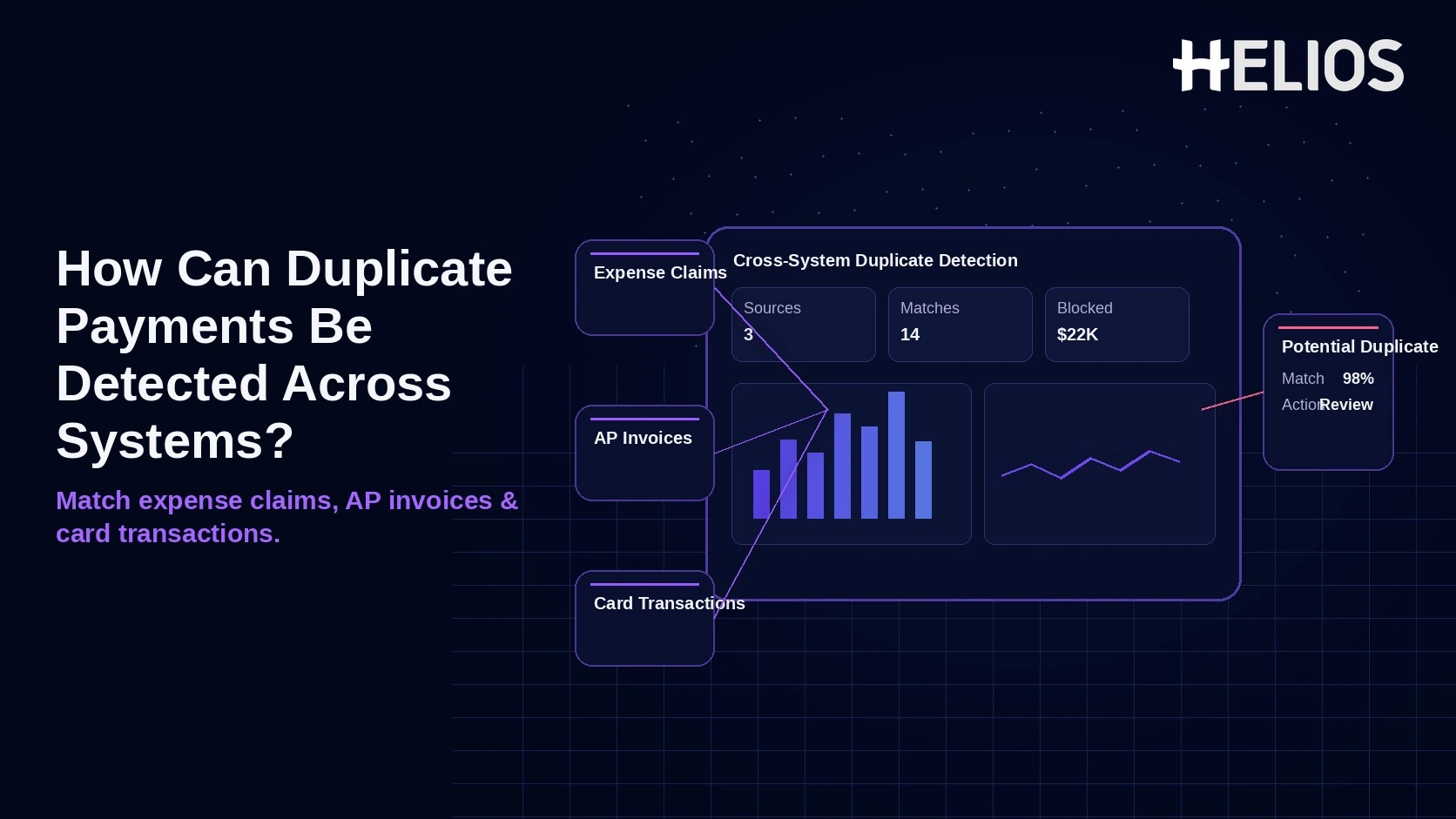
Duplicate payments are rarely confined to one system. A hotel charge may appear as a corporate-card transaction, an employee may also submit the receipt for reimbursement, and the hotel or travel agency may separately send an invoice to Accounts Payable. Each record can look legitimate in isolation even though only one economic event should be paid.
The control objective is therefore broader than “find duplicate expense reports.” Finance needs to connect the evidence and payment ownership across expense, AP, card, and settlement data; normalize how each source describes the same purchase; and stop the second payment before cash leaves whenever possible.
Why Cross-Source Duplicate Payments Are Harder to Detect
Duplicate detection inside one module is useful but incomplete. Cross-source duplicates often involve different identifiers, different dates, different merchant spellings, and different accounting paths. A claim may show the hotel brand, an AP invoice may use the legal supplier name, and a card feed may carry an acquirer-formatted merchant string.
| Source combination | How the duplicate can arise | Typical prevention point |
| Expense claim + card | Employee requests cash reimbursement for a purchase already charged to a corporate card. | Submission/approval: verify payment ownership and match the card transaction. |
| Expense claim + AP invoice | Employee pays or claims a cost while AP also receives an invoice from the merchant or intermediary. | Approval/AP intake: compare merchant, amount, dates, receipt/invoice references, and business context. |
| AP invoice + card | AP prepares supplier payment even though the invoice was already settled by company card. | Invoice approval/payment run: confirm settlement method and card match. |
| Expense claim + expense claim | Same receipt is submitted twice, across reports or employees. | Capture/approval: exact and near-duplicate receipt and transaction checks. |
| AP invoice + AP invoice | Same supplier invoice enters twice through email, portal, EDI, or manual entry. | Invoice intake: supplier + invoice ID plus fuzzy checks for altered references. |
| Card + card | Issuer/import creates duplicate transactions or a transaction is re-imported. | Card ingest/reconciliation: use card transaction IDs and issuer references. |
Build a Shared Duplicate Fingerprint
The best design is to create a normalized fingerprint for each payable event, regardless of where it originated. Not every field must match. The fingerprint should make comparable the fields that matter most and retain the original values for auditability.
- Counterparty: normalized merchant/vendor name, supplier ID, merchant tax ID, bank account or card merchant identifier where available.
- Economic value: transaction amount, tax, tip, currency, base-currency amount, and whether the record is gross or net.
- Timing: transaction/service date, invoice date, posting date, statement date, and reasonable tolerance windows.
- Evidence: invoice number, receipt number, OCR text, document/image fingerprint, PO or booking reference, and attachment similarity.
- Business context: employee, cardholder, entity, department/cost center, project/client, trip, expense category, and payment method.
- Settlement status: unpaid, employee-paid, company-card-paid, AP-paid, reimbursed, reversed, refunded, or returned.
Use Matching Levels Instead of One Exact-Match Rule
| Match level | Example logic | Recommended action |
| Exact / deterministic | Same supplier + invoice ID, or same card transaction ID, or identical receipt fingerprint. | Hard hold or automatic duplicate exception; reviewer confirms source-of-truth record. |
| Strong cross-source | Normalized merchant + same currency + same/near amount + close date + same employee/entity/project. | Hold before payment and route for review. |
| Fuzzy / near duplicate | Merchant similarity, small amount variance from tip/tax/FX, close dates, similar invoice/receipt reference. | Risk-score and show matched records side by side. |
| Contextual / semantic | Same trip or service, different document forms, recurring merchant, invoice and claim describing the same deliverable. | Low-confidence queue; require business explanation rather than automatic rejection. |
Oracle Fusion Expenses illustrates the value of multi-field matching: its duplicate-expense logic uses fields such as amount, date, currency, expense type, and merchant, and it can identify duplicates created from corporate-card charges as well as other expense-entry methods.
External reference: Oracle duplicate expense detection
SAP Concur similarly provides duplicate-transaction controls, and recent product documentation describes duplicate-invoice checks using invoice ID and merchant tax ID. These examples reinforce a broader principle: exact identifiers are powerful when they exist, but enterprise controls still need fuzzy matching and cross-source context when identifiers differ.
External reference: SAP Concur duplicate transaction controls
A Practical Cross-Source Duplicate Detection Workflow
- Ingest all relevant sources. Bring employee claims, AP invoices, corporate-card transactions, payment status, refunds/credits, and key master data into a common control layer or searchable dataset.
- Normalize before comparing. Standardize merchant/vendor names, currencies, dates, tax fields, invoice references, and payment ownership. Keep both normalized and raw values.
- Generate candidate matches. Run deterministic keys first, then tolerant/fuzzy rules. Compare historical as well as current items so an old paid transaction can block a new claim or invoice.
- Score and explain the risk. Show why two records matched: same receipt, same invoice ID, merchant similarity, near amount, card ownership, or prior payment. Avoid black-box alerts without evidence.
- Hold the second payment path. A suspected duplicate should stop the later reimbursement, invoice payment, or payment run while preserving the first valid record. Use a retry lock so a rejected item cannot simply be re-created and paid.
- Resolve and record the relationship. Mark confirmed duplicate, legitimate repeat, split/partial payment, refund/credit, or false positive. Link the records and retain reviewer, reason, evidence, and financial action.
- Reconcile and learn. Confirm that any prevented, reversed, or recovered amount is reflected in the bank/card/ERP record and feed root causes back into matching rules and employee/vendor guidance.
Do Not Confuse Legitimate Relationships with Duplicates
False positives usually come from valid patterns that look similar. The control should recognize these relationships explicitly rather than weakening the entire duplicate rule set.
| Looks like a duplicate | Why it may be legitimate | Control treatment |
| Same merchant and amount on consecutive days | Recurring subscription, parking, daily transit, or fixed meal charge. | Use date/service context and recurring-payment profile. |
| Invoice and card charge have the same amount | Card may have been the authorized settlement method for the invoice. | Link invoice to card as paid-by-card; do not create a second AP payment. |
| Claim and card transaction differ slightly | Tip, tax, FX, or partial personal/business split. | Compare component amounts and payment ownership before deciding. |
| Two employees use the same receipt | One employee may have paid for a shared/group expense—or it may be duplicate reimbursement. | Require payer/attendee context and reimbursement ownership. |
| Negative card item matches prior charge | Refund, reversal, or card credit rather than duplicate spend. | Link to the original charge and apply reversal/credit accounting. |
Controls That Prevent Duplicate Cash Out
- One source of payment truth: every transaction should clearly indicate employee-paid, card-paid, AP-paid, prepaid, advanced, or other funding ownership.
- Payment-stage recheck: rerun duplicate logic just before reimbursement/AP payment, because new card or invoice data may have arrived after approval.
- Unique identifiers: preserve claim ID, invoice ID, supplier ID, card transaction ID, payment ID, bank reference, and any refund/reversal links.
- Master-data normalization: map merchant aliases to supplier/vendor records where practical; standardize entity, currency, and cost-object codes.
- Exception governance: define who can override a duplicate warning, which evidence is required, and which high-risk overrides require second-level review.
- Post-payment reconciliation: detect the duplicates that escaped pre-payment controls, recover cash, and close the accounting trail rather than merely flagging the error.
Metrics Finance Should Track
| Metric | What it tells finance |
| Potential duplicates detected | Volume of control alerts by source pair and rule. |
| Confirmed duplicate value prevented | Cash outflow stopped before payment. |
| Duplicate value recovered | Cash or card value recovered after payment. |
| False-positive rate | Whether matching rules are creating unnecessary review work. |
| Time to resolve | How long duplicate exceptions remain open. |
| Override rate by rule/reviewer | Where controls are being bypassed and need redesign. |
| Repeat root causes | Whether employee, vendor, integration, or process problems are recurring. |
What to Test in a Real Pilot
A vendor demo should include deliberate cross-source collisions, not only a repeated receipt inside one expense report. Ask the implementation team to run at least these cases:
- Employee cash claim for a transaction already present on the employee’s corporate card.
- AP invoice for a hotel or software purchase already settled by company card.
- Same supplier invoice received twice with formatting changes in the invoice number or vendor name.
- Same receipt submitted by two employees, including one legitimate shared-expense scenario.
- Near-duplicate with tip, tax, FX, or partial amount differences.
- Refund/card credit linked to a prior charge so the system does not misclassify it as duplicate spending.
- Duplicate found only after payment, requiring recovery, reversal, and reconciliation.
How Helios Supports a Cross-Source Duplicate-Control Model
Helios's public product page does not publish a native specification for duplicate matching across employee claims, AP invoices, and corporate-card transactions as one shared engine - card-feed ingestion, AP/invoice data access, cross-source fingerprinting, and post-payment recovery workflows all need validating in a pilot. Three published capabilities feed into that model even without a unified cross-source engine:
- Clean, structured inputs before matching even starts. OCR-based receipt capture extracts merchant, date, amount, currency, and document fields, which gives exact and fuzzy matching far better raw material than free-text claims. Automated policy control can then require clear employee-paid versus company-paid ownership and supporting evidence before a claim proceeds - the payment-ownership signal this article treats as central to cross-source detection.
- A structured exception path for reviewers, not a generic warning. Approval Copilot supports AI-assisted review against policy and claim evidence; for duplicate controls specifically, reviewers need to see the suspected match, source system, prior payment status, and matching signals side by side rather than a flat "possible duplicate" flag. Illustrative logic a pilot should test for: if a submitted claim's amount, date, and merchant match an invoice already logged in AP, then the reviewer workflow should hold the claim, label it as a duplicate-payment risk, and surface the matching AP invoice next to it for comparison — rather than silently approving the claim or leaving the match to be found after payment.
- Stable references carried into accounting. Helios states its accounting engine can generate journal entries from expense reports; preserving claim IDs and accounting dimensions in that handoff is what lets finance later distinguish valid expense posting from payment duplication and trace a recovery or reversal back to its source.
Related Helios guides: duplicate payment detection in expense management
FAQs About Duplicate Payments Across Expense, AP, and Card Data
- Is matching amount and date enough to detect duplicates?
No. Use merchant/vendor identity, currency, document references, receipt/invoice evidence, employee/entity context, payment ownership, and prior payment status as well.
- Should every suspected duplicate be blocked automatically?
No. Exact high-confidence duplicates can be hard-held, but near matches should usually be reviewed to avoid blocking recurring or legitimately split charges.
- How do we detect a claim that duplicates an AP invoice?
Normalize both sources and compare counterparty, amount, currency, dates, invoice/receipt references, business purpose, and whether the company has already paid or plans to pay.
- Can card credits and refunds create false duplicate alerts?
Yes. Link negative card items to the original charge and treat them as refund/reversal relationships, not new duplicate spending.
- What is the most important architecture requirement?
Connected payment ownership and stable IDs across expense, AP, card, payment, and ERP records so finance can match one economic event across systems.
Final Takeaway
Duplicate payment control works best when finance stops thinking in documents and starts thinking in economic events — one purchase can spawn a receipt, a claim, an AP invoice, and a card transaction, and only one of them should get paid.
Learn more about Helios expense management