
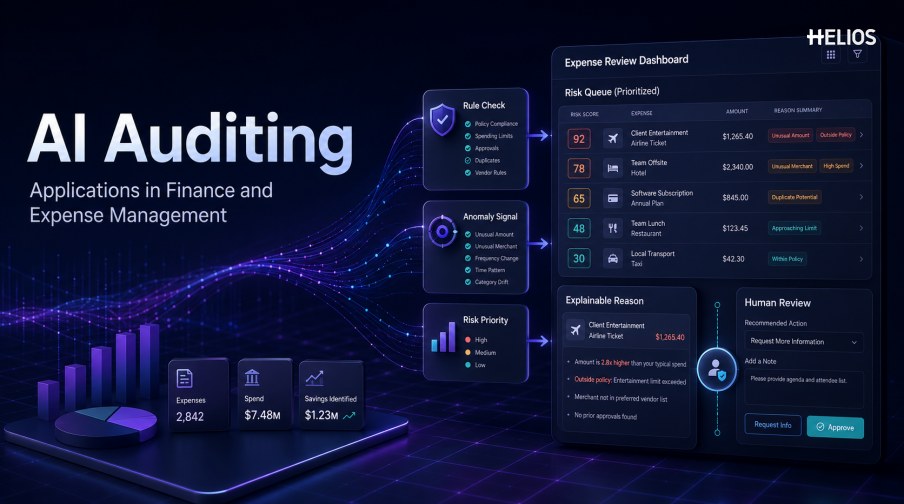
Finance teams review large volumes of transactions, claims, documents, and approvals. Many records follow expected patterns, while a smaller group contains missing evidence, policy exceptions, unusual amounts, duplicate signals, coding conflicts, or other conditions that deserve attention.
AI auditing uses rules, statistical methods, machine learning, document recognition, and workflow data to support that review. In expense management, it can check configured requirements, identify unusual patterns, prioritize risk, and present reasons to a human reviewer. The purpose is to make internal finance and expense review more consistent and focused—not to replace statutory audit, external assurance, legal judgment, or accountable management decisions.
This guide defines AI audit concepts, explains common applications and boundaries, and shows how Helios automated controls and Spark AI can support expense-review workflows.
What Does AI Audit Mean in Finance Operations?
In this context, an AI audit is a technology-assisted review of financial or expense records against defined rules, historical patterns, document evidence, and workflow context. The system may return a pass result, an exception, a risk score, or a recommendation for further review.
AI auditing is not one algorithm. It can combine deterministic policy checks, OCR, duplicate comparison, anomaly detection, peer or historical baselines, natural-language explanations, and workflow routing. The result should remain traceable to the source data, rule, model signal, and human decision.
Applications in Finance and Expense Management
Common AI audit applications include the following internal review tasks:
- Evidence checks. Confirm that required receipts, invoices, attendee lists, approvals, or supporting documents are present.
- Policy validation. Compare category, amount, date, destination, merchant, role, and other fields with configured company rules.
- Duplicate detection. Compare images and structured fields to flag possible repeated receipts, claims, or reimbursement requests.
- Anomaly identification. Surface unusual amounts, merchants, timing, frequency, category changes, split claims, or behavior relative to an appropriate baseline.
- Coding review. Flag missing or inconsistent entity, account, tax, cost-center, project, and other finance dimensions.
- Approval-path review. Check whether the correct approvers acted in the expected order and whether required escalation occurred.
- Risk prioritization. Rank records for human review according to materiality, confidence, rule severity, and anomaly strength.
- Management insight. Aggregate recurring exceptions and correction patterns for policy, training, and process improvement.
A Simple AI Auditing Workflow
A controlled finance and expense review can follow these stages:
- Collect the record and evidence. Bring together claim fields, receipt or invoice images, employee context, policy version, approvals, and related history.
- Normalize and validate data. Convert formats, confirm required fields, reconcile totals, and assess document-recognition confidence.
- Run deterministic rules. Evaluate limits, evidence requirements, dates, categories, approvals, and other explicit controls.
- Calculate AI or statistical signals. Compare the record with relevant historical, peer, supplier, category, or behavioral patterns.
- Combine risk and materiality. Prioritize issues based on severity, amount, confidence, business context, and possible impact.
- Explain and route the result. Show the evidence, rule or signal, source values, and recommended action to an authorized reviewer.
- Record the human decision. Retain comments, corrections, approvals, escalations, and final outcomes as an audit trail.
- Monitor performance. Measure false alerts, missed issues, reviewer overrides, cycle time, policy trends, and model drift.
Rules, Anomalies, and Risk Prioritization
Rules and AI signals solve different problems and work best together.
- Rules express known requirements. They are appropriate for receipt thresholds, category limits, prohibited merchants, required approvals, and defined evidence.
- Anomaly models surface unexpected patterns. They can identify records that differ from relevant history even when no explicit rule has been broken.
- Materiality changes priority. The same signal may require different handling for a small routine claim and a large or tax-sensitive expense.
- Context reduces noise. Role, location, trip purpose, department, seasonality, project, and supplier information can make comparisons more meaningful.
- Risk scores need components. Reviewers should see which rules, anomalies, missing data, and confidence values contributed to the priority.
- Thresholds require monitoring. A queue that flags too much will be ignored, while a queue that flags too little may miss material issues.
Human Oversight, Explainability, and Boundaries
Responsible AI auditing keeps authority, evidence, and limitations visible.
- Keep accountable reviewers. AI can recommend, prioritize, or summarize, but authorized people own approvals, escalations, investigations, and exceptions.
- Show reasons and source evidence. A reviewer should see the record, document, policy, comparison basis, confidence, and signal that produced the result.
- Separate errors from misconduct. An anomaly is not proof of fraud. It may reflect a legitimate trip, data error, new supplier, or unusual business event.
- Protect sensitive data. Access, retention, model use, logging, exports, and training data require controls appropriate to financial and employee information.
- Define prohibited automation. Organizations should identify decisions that cannot be made solely by an automated score.
- State the assurance boundary. Internal AI review does not constitute a statutory audit opinion, legal conclusion, or substitute for professional audit procedures.
Implementation Measures and Success Metrics
A pilot should test both control quality and operating impact.
- Coverage. Measure the percentage of in-scope records with usable documents, required data, and applicable checks.
- Alert precision. Track how many flagged records represent a real policy, data, process, or risk issue.
- Issue recall. Use reviewed samples and known cases to assess material problems that the system failed to surface.
- Reviewer effort. Measure time per record, queue size, evidence gathering, correction steps, and rework.
- Override and explanation quality. Monitor accepted recommendations, reviewer changes, unresolved reasons, and feedback themes.
- Process outcomes. Track late submissions, duplicate recovery, policy exceptions, approval time, accounting corrections, and repeat issues.
- Drift and fairness. Review performance across entities, roles, regions, categories, and time periods without treating protected characteristics as risk shortcuts.
How Helios and Spark AI Support Expense Review
Helios combines OCR capture, automated policy controls, configurable approvals, accounting-entry generation, and reporting. Spark AI adds claim, approval, travel, and service copilots. For finance and expense review, this supports five practical requirements:
- Create structured review data. Receipt and invoice capture reduces manual entry and makes document values available for checks.
- Apply explicit company rules. Automated policy controls evaluate configured spending requirements.
- Assist document review. Approval Copilot can help reviewers assess claims against company policy and summarize relevant issues.
- Keep decisions in governed workflows. Configurable approvals preserve roles, escalation paths, and accountable human action.
- Analyze outcomes. Dashboards, customizable reports, and accounting outputs support trend analysis and process monitoring.
Helios also presents itself as an enterprise-grade provider with global experience and information-security credentials. Organizations should validate policy coverage, anomaly logic, explanations, reviewer permissions, audit records, data governance, integrations, monitoring, and the boundary between operational review and formal audit responsibilities.
FAQs About AI Auditing
Is AI auditing the same as a statutory audit?
No. In this article, AI auditing means technology-assisted internal finance and expense review. It does not produce an audit opinion or replace external assurance, legal analysis, or professional judgment.
What is the difference between a rule and an anomaly?
A rule tests an explicit requirement. An anomaly identifies a record that differs from an appropriate pattern or baseline, even when no written rule has clearly been violated.
Can audit AI prove expense fraud?
No. A signal can prioritize a record for review, but an unusual pattern may have a legitimate explanation. Evidence, context, investigation, and authorized judgment are still required.
Why is explainability important?
Reviewers need to understand the source values, policy, comparison, confidence, and signal behind a recommendation so they can verify it and record a defensible decision.
Where does Spark AI fit?
Spark AI provides conversational copilots for claims, approvals, travel, and service. In expense review, Approval Copilot can assist policy-aware document review while the organization retains workflow and decision ownership.
Teams can explore Helios and Spark AI with defined expense-review cases, representative records, clear escalation rules, human review, and measured control outcomes.