
What counts as spend management savings?
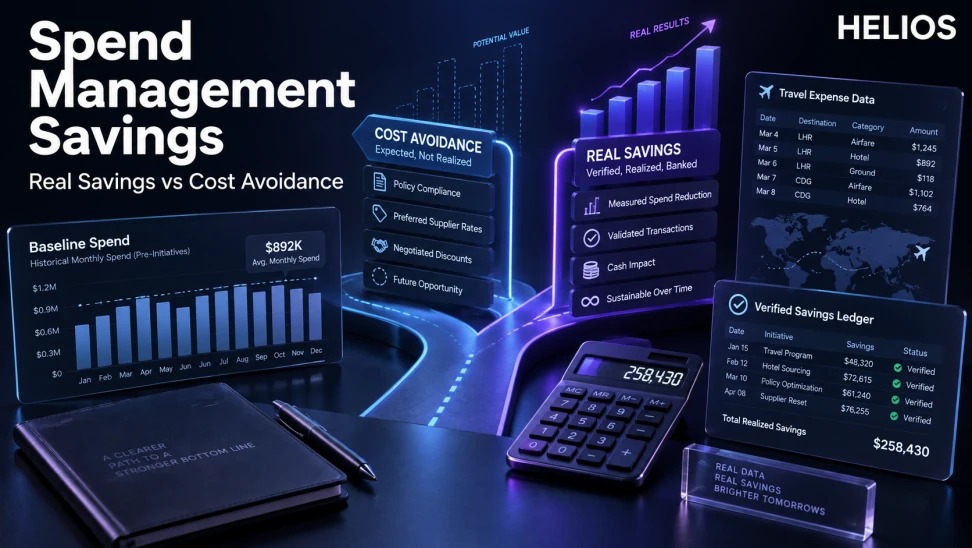
Spend management savings should represent a measurable economic improvement against a defined baseline. Realized savings reduce an expense that would otherwise appear in the same scope and period. Cost avoidance prevents or limits a future increase but may not reduce the current profit and loss statement.
Both measures can be useful, but combining them without labels creates inflated claims. This worked method uses employee travel expenses to separate price change, volume change, mix change, avoided demand, and cost transferred to another team or channel.
For related guidance, see spend management for complex reimbursement and budget control.
All examples are illustrative. Helios can support expense visibility and analysis, but no specific saving percentage is promised. Finance should approve the baseline, formula, evidence, and treatment before reporting results.
Spend Management Savings at a glance
| Component | Classification | Verification | Reporting treatment |
|---|---|---|---|
| Lower unit price | Potential realized savings | Comparable route, timing, and service | Savings after normalization |
| Lower trip volume | Savings or avoidance | Reason demand changed | Separate policy effect from business decline |
| Lower-cost mix | Potential realized savings | Equivalent business outcome | Savings if substitution is sustainable |
| Demand avoided | Cost avoidance | Approved need eliminated | Report separately |
| Cost transferred | Neither until consolidated | Other budget or party absorbs cost | Exclude or disclose |
For related guidance, see automated expense tracking and financial visibility.
A savings bridge separates price, volume, mix, avoided demand, and transferred cost before value is reported.
Define the baseline
Choose a period, population, categories, currencies, and normalization method. For travel, control for route, cabin, city, season, booking lead time, trip length, and business purpose where possible.
A baseline should represent a credible “without change” scenario. Freeze it before measuring results and record approved exclusions, refunds, cancellations, and one-time events.
For related guidance, see expense automation reporting.
Separate price, volume, and mix
Total spend changes because the unit price, quantity, and mix of purchases change. A lower average airfare may reflect cheaper routes rather than better buying. Lower hotel spend may reflect fewer trips rather than negotiated rates.
Use a bridge that changes one factor at a time. Reconcile the components back to total spend so unexplained residuals remain visible.
Classify cost avoidance
Avoidance includes prevented price increases, eliminated future demand, or reduced risk of higher cost. It should have a documented counterfactual, owner, time period, and evidence.
Do not present avoided demand as cash savings if the budget remains available or the expense never entered the baseline. Report avoidance separately and explain whether it affects forecast, budget, or capacity.
Identify transferred and deferred costs
A stricter travel rule can move spend to employee time, another department, a customer, or a different payment channel. A delayed trip may return next quarter.
Review adjacent accounts, reimbursement channels, fees, cancellations, support effort, and productivity. Exclude transfers from savings or disclose them clearly.
For related guidance, see travel and expense management automation.
Create a savings verification ledger
Record initiative, owner, baseline, formula, period, amount, type, evidence, confidence, finance reviewer, and whether the benefit has been realized. Prevent duplicate credit across projects.
Reconcile verified savings to financial results where possible. Explain timing differences rather than forcing every operational measure into the ledger.
Measure sustainability
Track savings retention, policy adoption, exceptions, traveler changes, service quality, approval time, and reimbursement effort. A short-lived price improvement is different from a durable operating change.
Revalidate assumptions when volume, exchange rates, business mix, or supplier conditions move materially.
How Helios supports savings analysis
Helios can provide structured employee expense data, policy outcomes, approvals, accounting connections, and multidimensional reporting. Finance can use that evidence to build and monitor a savings ledger without treating a dashboard trend as proven savings.
For related guidance, see finance automation for expense management.
- Consolidate structured expense and receipt data.
- Analyze spend by category, entity, cost center, project, and other dimensions.
- Connect policy and exception outcomes with transaction trends.
- Preserve approval and business-purpose context.
- Integrate approved expense data with finance systems.
- Monitor changes after policy or workflow actions.
A practical conclusion
Savings become credible when finance can reproduce the baseline, isolate the driver, rule out transfers, and verify realization. Keep cost avoidance visible, but report it separately from savings that reach the financial statements.
See how Helios can support this workflow. Request a Helios demo.
FAQ about spend management savings
What is the difference between savings and cost avoidance?
Realized savings reduce comparable cost, while cost avoidance prevents a future increase or expense that may never enter the current financial statements.
How should travel savings be normalized?
Control for route, cabin, city, dates, booking lead time, trip length, currency, and business purpose where data permits.
Is lower spending always a saving?
No. It can result from lower business volume, delayed activity, transferred cost, missing data, or weaker service.
What is a savings verification ledger?
It records each initiative’s baseline, formula, type, evidence, owner, reviewer, timing, and realized amount.
Can Helios guarantee spend savings?
No specific saving should be guaranteed. Helios can support visibility, controls, workflows, integration, and analysis used to identify and verify opportunities.
How often should savings be revalidated?
Review them periodically and whenever volume, exchange rates, business mix, policy, or supplier conditions change materially.