
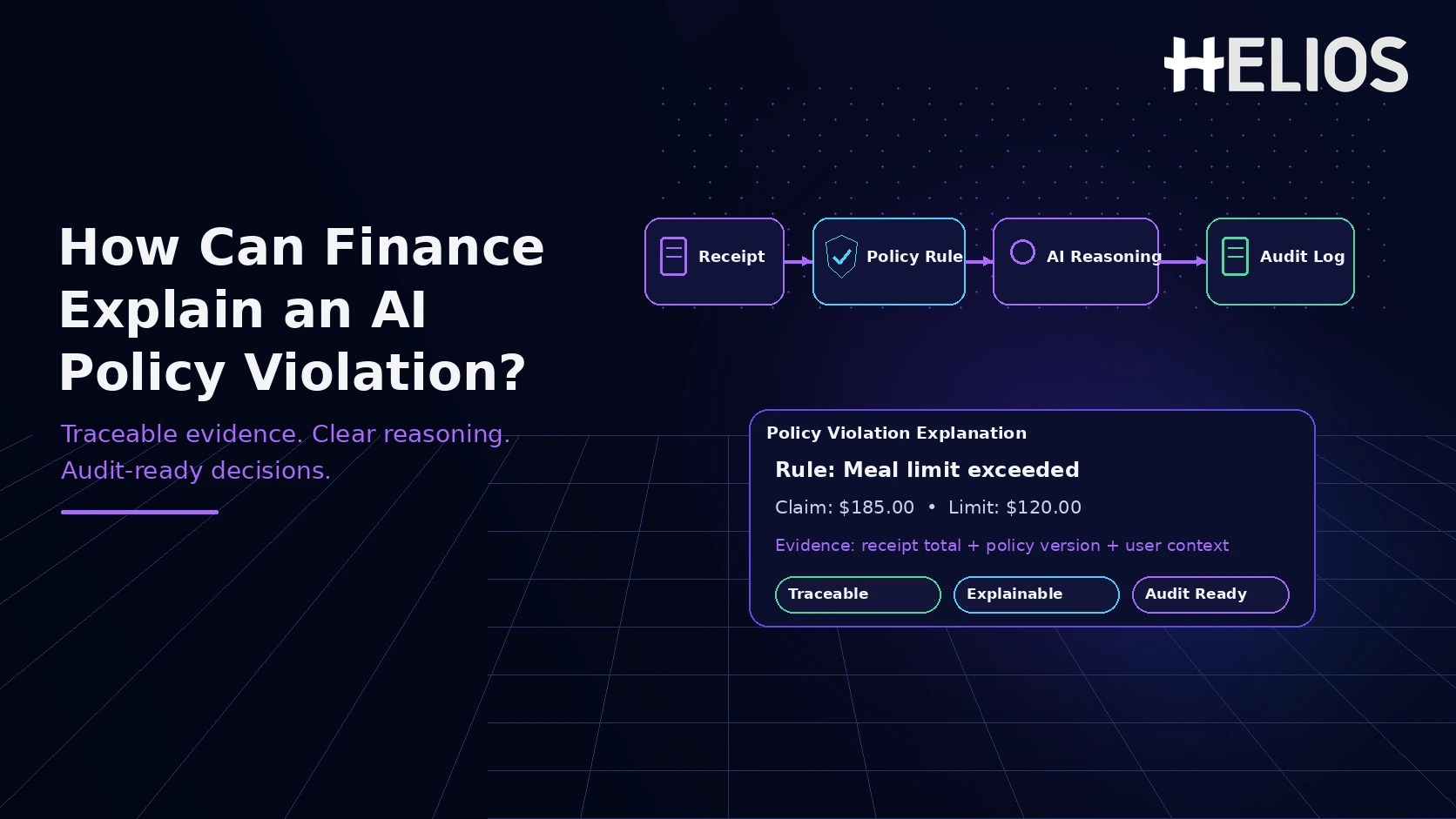
AI can flag an expense-policy violation in seconds. Finance still needs to answer a harder question: can a reviewer understand exactly why the decision was made, verify the evidence, reproduce the result, and see who ultimately owned the outcome? If the answer is no, the control may be fast—but it is not audit-ready.
A strong explanation should not expose hidden model reasoning. It should expose the business evidence: the facts used, the policy version and rule triggered, the structured reason code, relevant confidence or risk signals, any human override, and the downstream payment or accounting result.
What Must Be Explainable in an AI Policy-Violation Decision?
| Question an Auditor or Reviewer Should Be Able to Answer | Evidence the System Should Retain |
|---|---|
| What exact policy applied? | Policy name, clause/rule ID, version, effective date, entity/country scope, and threshold or condition. |
| What facts did the system use? | Original receipt/invoice, extracted fields, employee/entity, merchant, amount, currency, date, category, tax and cost-object context. |
| What condition failed? | Deterministic rule result or structured AI finding, including comparison values such as "hotel cap = USD 250; claimed = USD 310." |
| How reliable was the signal? | Field/model confidence, anomaly/duplicate signals, validation outcomes, data-quality warnings, and model/version identifier where available. |
| What happened next? | Auto-return, manual review, approval, rejection, request for evidence, override or escalation—with reviewer identity and timestamp. |
| What was the financial outcome? | Approved amount, payment/reimbursement status, GL/tax mapping, ERP document or journal ID, and any later correction/reversal. |
Use a Three-Layer Explanation: Evidence, Policy, Decision
- Evidence layer. Preserve the source document and the data the AI actually evaluated. If OCR or a user later corrected a field, retain before/after values rather than overwriting history.
- Policy layer. Point to the exact policy clause and version. Avoid generic explanations such as "not compliant." Show the threshold, eligibility condition, documentation requirement, or category rule that was applied.
- Decision layer. Record the reason code, recommended action, confidence/risk signals, human reviewer or override, and final outcome. The decision record should show whether AI merely flagged the issue or whether a person made the final decision.
NIST's AI Risk Management Framework calls for AI systems and outputs to be explained, validated, documented, and interpreted in context, and for human oversight processes to be defined and documented. That is a useful design principle for expense controls even when a specific regulation does not prescribe the exact format of the explanation.
NIST AI RMF: explainability, documentation, and human oversight
Confidence Score Is Not an Explanation
A score such as 0.91 can help triage risk, but it does not tell a finance reviewer what the employee did, which policy was violated, or what evidence supports the result. A good explanation is business-readable and testable. For example: "Meal expense exceeds the entity's USD 80 client-entertainment cap by USD 24; receipt is present; attendee list is missing; route to manager review."
Finance should avoid treating hidden chain-of-thought or free-form model narrative as the audit record. Instead, retain structured evidence and outcomes that can be independently checked: rule ID, inputs, comparison values, reason code, model/version identifier, reviewer action, and final financial result.
| Keep in the Audit Record | Do Not Rely on as the Primary Evidence |
|---|---|
| Source documents and normalized input fields | A single overall confidence percentage |
| Exact policy/rule version and effective date | A generic "AI says non-compliant" message |
| Structured reason code and comparison values | Unverifiable free-form model narrative |
| Model/version or configuration identifier where available | A screenshot with no link to source record |
| Human review, override reason, and timestamp | Oral explanations reconstructed months later |
| Payment/ERP/accounting references | A final status with no event history |
Build a Reproducible "Decision Packet"
For material or disputed cases, finance should be able to export one compact decision packet. The goal is similar to good audit documentation: an experienced reviewer who did not participate in the original decision should be able to understand the evidence, procedure, conclusion, and review history. PCAOB AS 1215 uses this reviewability concept for audit work papers; it is a useful benchmark for designing system records.
PCAOB AS 1215: audit documentation and reviewability
| Decision-Packet Component | Minimum Content |
|---|---|
| 1. Source snapshot | Receipt/invoice file, claim ID, employee/entity, amount, date, merchant, currency and supporting attachments. |
| 2. Data lineage | OCR/extracted fields, corrections, data source, master-data values and timestamps. |
| 3. Policy snapshot | Policy name, rule/clause ID, version, threshold, jurisdiction/entity applicability and effective date. |
| 4. AI/control result | Reason code, rule outputs, relevant confidence/anomaly signals, model/configuration version if exposed. |
| 5. Human action | Reviewer/approver, comments, evidence request, override/rejection reason and timestamps. |
| 6. Final result | Approved/rejected amount, payment status, ERP/journal reference, tax/GL mapping and later correction/reversal if any. |
Example: Explain a Hotel Policy Violation Without a Black Box
| Record Element | Illustrative Decision Record |
|---|---|
| Source facts | Hotel receipt: EUR 340; one night; Paris; employee from Entity FR01; project PRJ-204. |
| Policy rule | TRAVEL-HOTEL-014, v3.2: Paris standard hotel cap EUR 280/night unless approved exception is attached. |
| Control comparison | Claimed EUR 340 vs cap EUR 280; exception approval not found. |
| AI / risk signals | Receipt fields high-confidence; merchant/date/amount validations pass; no duplicate found. |
| Reason code | AMT-OVER-LIMIT + MISSING-EXCEPTION. |
| Recommended action | Route to manager for business justification and exception approval; do not auto-reject. |
| Human outcome | Manager approves EUR 340 with documented event-related justification; finance reviewer confirms policy exception authority. |
| Financial outcome | Approved amount EUR 340; posted to configured travel GL/project; approval and exception remain linked to the journal reference. |
This format makes the decision understandable without exposing private model reasoning. It also shows an important distinction: the AI/control layer can identify the violation, while a human with delegated authority can decide whether a valid exception changes the final outcome.
How Finance and Audit Should Reproduce the Decision
- Retrieve the original evidence. Start from the claim ID and open the original receipt/invoice, attachments, employee/entity record, and the source values used at decision time.
- Lock the historical policy and configuration. Use the policy version, thresholds, entity scope, and effective date that applied when the decision was made—not today's policy.
- Re-run deterministic validations. Confirm arithmetic, dates, currency, receipt requirements, limits, duplicate checks, tax/master-data validations, and any other hard rules.
- Verify the AI finding and explanation. Confirm that the structured reason code and evidence are consistent with the stored model/configuration version and with the facts in the record. If the platform cannot reproduce the model output exactly, the stored decision output must still be immutable and reviewable.
- Verify human review and override. Check who reviewed the case, whether the reviewer had authority, what evidence or rationale was added, and whether the override changed only the permitted fields/outcomes.
- Trace the financial consequence. Follow the approved amount into payment/reimbursement and ERP/journal posting, then verify any later refund, reversal, correction, or employee appeal remains linked to the original decision.
Human Review and Appeals Are Part of Explainability
An explanation is incomplete if the employee or finance reviewer has no way to challenge an error. Human review should remain available where the rule is ambiguous, the decision is high-impact, the employee disputes the facts, tax/legal interpretation is involved, the AI signals conflict, or an exception can legitimately be granted.
- Preserve the original AI/control finding even if a human later overrides it.
- Require an override reason code and comment for material exceptions.
- Keep the original and revised amount/category/accounting fields in the event history.
- Link employee appeals or additional evidence to the same case rather than creating an unrelated second claim.
Govern Policy, Model, and Rule Changes Like Financial Controls
A decision can only be reproduced if the organization knows which policy and system configuration produced it. Effective-dated policies, versioned rules, controlled model/configuration changes, and regression testing are therefore part of the audit trail—not just IT housekeeping.
| Change | Control to Require |
|---|---|
| Policy wording / threshold | Owner approval, effective date, affected entities/countries, version ID and communication record. |
| Reason-code logic | Versioned mapping, regression tests and documentation of added/retired codes. |
| Model / prompt / configuration | Change approval, validation results, rollout date, monitored cohorts and rollback plan where applicable. |
| Auto-approval / review threshold | Finance/risk approval, back-test results and post-change false-positive/false-negative monitoring. |
| Master-data or accounting mapping | Owner approval, effective date, test posting and reconciliation evidence. |
Metrics That Tell You Whether AI Decisions Are Truly Explainable
| Metric | What It Reveals |
|---|---|
| Reason-code completeness | Whether every violation has a standardized, searchable business explanation. |
| Policy-version traceability | Whether decisions can be tied to the rule in force at that time. |
| Audit reproduction success rate | Whether an independent reviewer can reconstruct sample decisions without asking the original operator. |
| Human override rate by reason | Where AI/rule logic may be too rigid, unclear, or miscalibrated. |
| Employee appeal / reversal rate | Whether adverse decisions are generating avoidable disputes or corrections. |
| Missing-evidence rate | Whether the system is making decisions without sufficient source documentation. |
How Helios Can Support Explainable and Auditable Policy Decisions
- Automated Policy Control ties each violation to a specific rule. Map every exception to a policy requirement and reason code—"AMT-OVER-LIMIT + MISSING-EXCEPTION," not a generic failure status—since a reason code is the smallest unit this article's whole audit-reproduction argument depends on.
- Approval Copilot keeps the finding and the human decision on one record. It checks claims against company policy; confirm during implementation that the AI finding, reviewer decision, comments, and exception rationale stay linked to the same claim rather than living in separate systems.
- Reporting turns individual decisions into a monitorable control. Track violations, overrides, recurring exceptions, reviewer behavior, and post-approval corrections against the metrics above to show the explanation system is actually working, not just present.
Whatever a human approves still has to post correctly—Helios can generate journal entries from expense reports—so keep the policy decision linked to the final ERP/journal reference rather than treating posting as a separate, unlinked event.
Helios's public pages do not specify model-version logs, explanation exports, immutable AI-decision histories, or configurable reason-code schemas; validate these explicitly in a demo or pilot if your audit requirements depend on them.
Helios expense management platform
Helios Spark AI and Approval Copilot
FAQs About Explaining and Auditing AI Policy Violations
What should happen when an employee disputes an AI violation? Route the same case to an accountable human reviewer, preserve the original finding rather than deleting it, attach the new evidence, record the final decision, and keep the complete history linked to one case rather than opening a second claim.
How long should AI decision records be retained? Follow the organization's existing retention matrix by country, entity, record type, and tax/audit requirement—an AI-generated decision record needs the same retention discipline as any other audit evidence, not a separate policy invented for it.
Final Takeaway
An AI-generated policy violation is audit-ready when an independent reviewer can see the evidence, rule, reason, accountable decision owner, and resulting payment or ledger impact.