
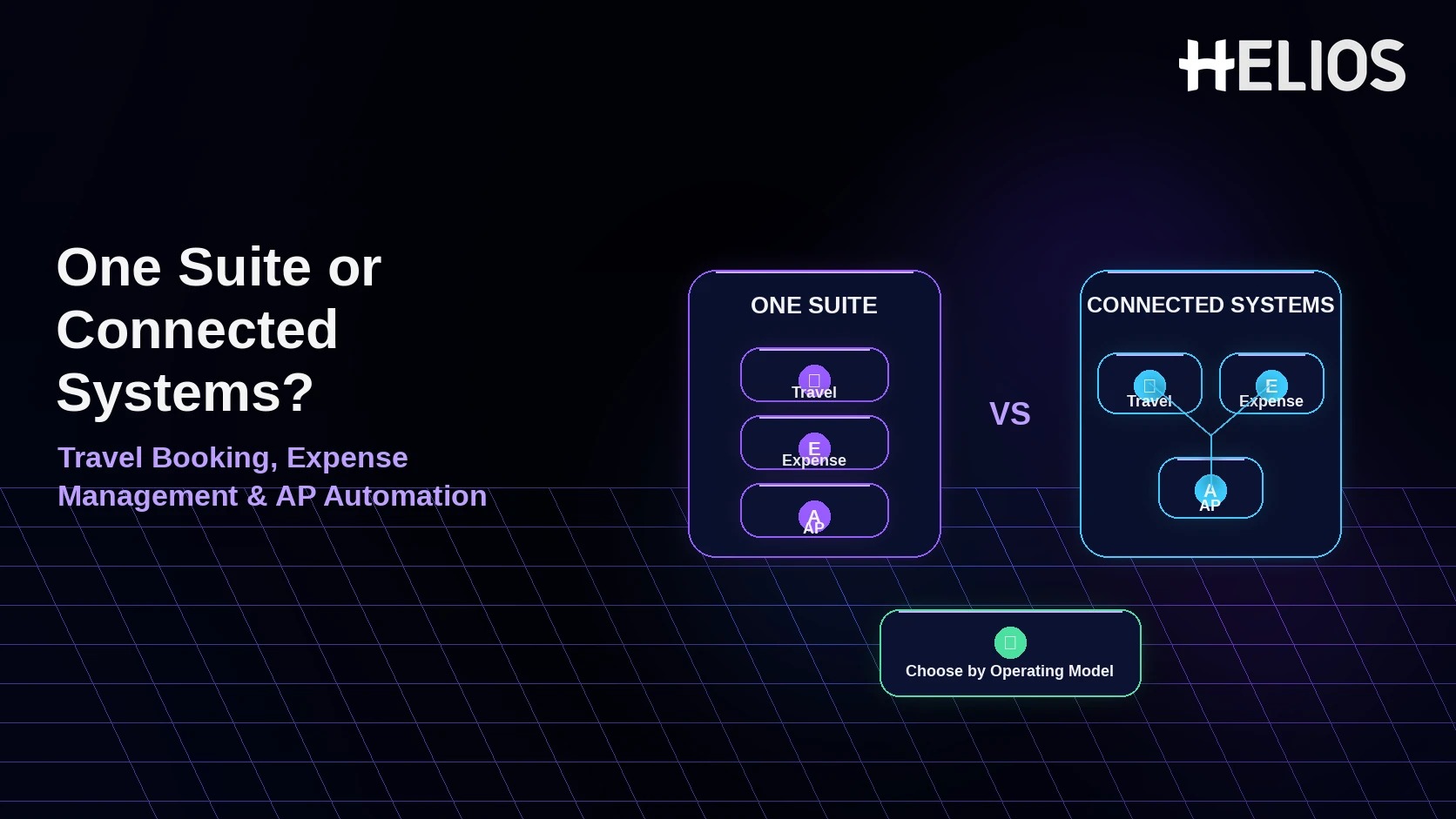
Travel booking, employee expenses, and accounts payable all involve business spending, but they begin with different events and serve different users. Travel starts with a trip need and booking decision. Expense management starts with employee-paid or company-paid spend that must be documented, reviewed, reimbursed, and posted. AP starts with a supplier invoice and may also depend on purchase orders, receiving, tax, and payment controls.
That overlap creates a common architecture question for global finance teams: should the three processes live in one suite, or should specialized systems connect through shared master data and integrations? The right design depends on where process depth matters most, how much local variation exists, which systems already work well, and how much integration governance the organization can sustain.
This guide builds on the distinction between expense management, spend management, and procure-to-pay, and focuses specifically on how travel, expense, and AP should fit together.
Why Travel, Expense, and AP Are Connected but Not the Same
The three processes share employees, entities, currencies, cost centers, projects, accounting dimensions, and policy data. They can also touch the same trip or supplier. A hotel reservation may start in travel, appear on an employee expense report, and later be reconciled to accounting. A conference registration may be paid by an employee, a corporate card, or a supplier invoice.
- Travel booking. The platform searches travel content, applies trip policy, manages approvals or pre-trip requests, creates itinerary data, and supports traveler changes and duty-of-care workflows.
- Expense management. The platform captures receipts and claims, applies policy, routes approval, reimburses employees, records exceptions, and sends accounting-ready data to the finance system.
- AP automation. The platform captures supplier invoices, validates vendors and tax information, performs PO or receipt matching where required, routes invoice approval, manages payment status, and reconciles supplier payments.
The architecture should therefore connect shared data without pretending the operating workflows are identical. A suite may reduce handoffs, while specialized tools may provide greater depth in one or more areas.
Three Architecture Options Global Finance Teams Should Consider
Most organizations do not face a binary choice. In practice, three models appear repeatedly: one integrated suite, separate best-of-breed systems, and a hybrid model that keeps travel and expense together while AP remains in an ERP or specialist payables platform.
| Architecture | Best fit | Main advantages | Main trade-offs |
| One integrated suite | Organizations prioritizing standardization, fewer vendors, and shared reporting. | Common master data and user experience; fewer integration points. | Module depth may be uneven; wider implementation and vendor lock-in. |
| Best-of-breed integrated | Organizations with specialized travel, expense, or AP requirements and strong integration capability. | Best-fit workflow in each domain; easier to replace one component independently. | More interfaces, duplicate master data risk, and higher governance effort. |
| Hybrid architecture | Global teams that want travel and expense connected but need deeper supplier/AP capabilities elsewhere. | Preserves employee experience while allowing AP depth and phased modernization. | Requires clear system-of-record ownership and disciplined handoffs. |
When One Suite Is the Better Architecture
A single suite is attractive when the organization values standardization more than specialist depth. SAP Concur is a clear example of this model: its public platform combines Concur Travel, Concur Expense, and Concur Invoice, allowing travel, employee expense, and invoice/AP data to operate on one connected platform. Broader spend-management suites can extend the same idea into procurement and payments.
- Shared master data. Employees, entities, accounts, cost centers, projects, policies, and approval roles can be governed once and reused across modules.
- Fewer handoffs. Trip details can flow into expense records, and invoice or AP data can contribute to a broader spend view without rebuilding the same reporting layer.
- Simpler ownership. One vendor, contract, security review, release calendar, and support model can reduce administrative overhead.
- Faster cross-process reporting. Finance may find it easier to compare travel, employee expense, and supplier spend when modules use a common data model.
The risk is assuming that every module is equally strong. A suite should still be tested against real travel content, local expense rules, invoice matching, supplier onboarding, tax, payments, accounting, and exception handling. The right question is not whether the suite has a module, but whether that module meets the operating requirement.
When Separate Systems Work Better
Best-of-breed architecture makes sense when one or more processes are strategically complex. A global travel program may need specific TMC content, negotiated fares, traveler support, and regional fulfillment. Expense management may need highly configurable approval, reimbursement, and accounting logic. AP may require supplier onboarding, purchase-order matching, tax validation, mass payments, or country-specific bank controls that are materially deeper than a general spend suite provides.
- Keep proven systems. If the travel platform or AP automation tool is already delivering strong results, replacing it only to reduce vendor count can destroy value.
- Select for process depth. Each domain can use the product that best supports its users, controls, regional requirements, and scale.
- Modernize in stages. Finance can replace the weakest component first instead of launching a large transformation across travel, expenses, and AP at the same time.
- Reduce lock-in. A modular architecture can make it easier to renegotiate or replace one component without redesigning the entire spend stack.
The trade-off is integration discipline. Separate systems must agree on employee IDs, entities, suppliers, cost centers, projects, currencies, account mappings, payment status, and ownership of corrections. Without those rules, best-of-breed quickly becomes fragmented-by-design.
The Hybrid Model Is Often the Most Practical
For many global finance teams, the most practical design is to connect travel and expense closely while leaving supplier AP in a dedicated system or ERP. Travel and expense share the same employee, trip, policy, receipt, approval, and reimbursement journey. AP is more supplier-oriented and often depends on purchase orders, invoice matching, tax, vendor master data, and payment operations.
This is why an integrated travel-and-expense experience can be valuable even when AP remains separate. The objective is not maximum consolidation. It is a controlled architecture in which each system owns a clear part of the lifecycle and exchanges complete, traceable data.
How to Decide: A Five-Step Evaluation Framework
- Map the real processes. Document travel booking, pre-trip approval, expense submission, reimbursements, supplier invoice capture, PO matching, invoice approval, supplier payment, accounting, and reporting. Include exceptions, not just happy paths.
- Define systems of record. Decide which system owns employee data, travel profiles, suppliers, cost centers, projects, policies, GL accounts, payment status, and final accounting objects. Duplicate ownership creates reconciliation work.
- Test cross-process journeys. Run scenarios such as a booked hotel becoming an expense, a canceled trip producing refunds, a conference cost paid by employee versus invoice, foreign-currency reimbursement, and an AP invoice coded to the same project as employee expenses.
- Evaluate integration failure handling. Confirm how APIs or files handle missing master data, rejected journal entries, duplicate records, retries, status updates, attachment transfer, and corrections. Integration quality is as important as initial connectivity.
- Compare total operating cost. Include software, implementation, integrations, TMC or payment fees, administration, master-data maintenance, support, release testing, and change management. A cheaper license can become expensive if the architecture creates permanent manual reconciliation.
How Helios Fits a Connected Finance Architecture
Helios is publicly positioned as an intelligent expense management platform rather than a full AP automation suite — a boundary that matters directly to this decision, since it means AP can stay in the ERP or a specialist AP platform while Helios owns the travel-and-expense side of the architecture.
- Connect travel with employee expense. Helios allows users to manage business trips and book flights and hotels from mobile, while Spark AI Travel Copilot supports conversational trip planning and booking. Trip and employee expense workflows can therefore stay close to the same user experience instead of living in a separate booking tool.
- Route approval with human ownership. Flexible approval workflows can use department, role, or cost center. Approval Copilot helps reviewers examine claims and policy context, while the authorized manager or finance reviewer remains responsible for the decision — the control layer that has to hold regardless of whether AP sits inside or outside the suite.
- Produce accounting-ready outputs. Helios states that its accounting engine can automatically generate journal entries from expense reports — the handoff that a hybrid architecture depends on. Global teams should still validate account mappings, dimensions, taxes, currencies, attachment transfer, error responses, and reconciliation against whatever AP or ERP system sits on the other side of that interface.
Because Helios is not publicly positioned as supplier AP automation, it fits the hybrid model directly: keep AP in the ERP or a specialist platform, and use Helios as the travel-and-expense layer, with the interface exchanging the finance dimensions and posting status needed for a complete group view.
What a Good Integration Contract Should Define
Whether the company chooses one suite or separate systems, finance should document the handoff contract between processes. At minimum, the design should specify:
- Shared identifiers for employee, entity, cost center, project, supplier, trip, invoice, expense report, payment, and accounting document.
- Which system creates and updates each master-data object, and how changes are synchronized.
- Which attachments and policy/approval evidence must follow the transaction into accounting or audit storage.
- How posting failures, duplicate messages, rejected integrations, refunds, credit notes, and reopened expenses are resolved.
- Which dashboard is authoritative for travel spend, employee reimbursement, supplier liabilities, payment status, and group reporting.
This governance is especially important in a hybrid model. A well-integrated architecture should feel unified to finance even if several systems operate behind the scenes.
FAQs About One-Suite vs Integrated Travel, Expense, and AP
Is one suite always cheaper than separate systems?
Not automatically. A suite may reduce integration and support cost, but broader licenses and implementation scope can offset that. Compare total operating cost across both models, not vendor count alone.
What is the single biggest risk in a best-of-breed architecture?
Integration governance gaps — mismatched master data, failed postings, duplicate records, and unclear system-of-record ownership can quietly recreate the exact fragmentation the architecture was meant to solve.
Final Recommendation
For most global teams, the practical default is the hybrid model — keep travel and employee expense connected, and leave supplier AP in a specialist platform or ERP unless standardization is genuinely worth more to you than process depth. Test that choice against the cross-process scenarios in the framework above before committing.