
Mileage reimbursement looks simple until a company operates across countries. The same business trip may be measured in miles or kilometres, reimbursed under a government benchmark or a company rate, treated differently for employee tax, and subject to different rules for commuting, private mileage, company cars, motorcycles, bicycles, or electric vehicles.
The strongest global design is not one worldwide cents-per-mile number. It is one governance framework with local, effective-dated rate schedules and a consistent evidence model. Finance sets the common principles; local tax or payroll owners maintain the country rules; the expense system applies the correct rate, routes exceptions, and preserves an audit trail.
Why Global Mileage Reimbursement Needs Local Rules
Four variables make mileage harder to standardize than ordinary receipt-based expenses: the rate itself, what counts as business travel, how the payment is taxed, and what evidence is required. Those variables can change independently. A rate can also change during the year, so using a static annual spreadsheet can create overpayments, underpayments, and inconsistent payroll treatment.
· Rate authority. Some countries publish tax-approved or deduction rates; others leave the reimbursement rate to company policy.
· Eligibility. Travel between two work locations may qualify while ordinary home-to-office commuting does not.
· Tax treatment. A company can reimburse the same number of kilometres in two countries and create different employee tax outcomes.
· Evidence. Trip purpose, start/end locations, distance, vehicle type, and supporting records may be needed even when no fuel receipt exists.
Country Examples: Rates and Tax Treatment in 2026
The examples below illustrate why global companies should use local schedules rather than one universal rate. They are current as of August 2026 and should be revalidated whenever local tax authorities publish changes.
| Country / rule | 2026 reference | What it means for employer policy | Important caution |
| United States | IRS business mileage: 72.5¢/mile Jan–Jun 2026; 76¢/mile from Jul 1, 2026. | Maintain effective-dated rates and accountable-plan evidence for business use. | The IRS rate is optional; actual-cost methods can also apply. Do not reimburse commuting as business mileage. |
| United Kingdom | 2026/27 AMAP: cars/vans 55p for first 10,000 business miles, then 25p; motorcycles 24p; cycles 20p. | Track annual mileage bands and vehicle type for each employee. | The approved amount is a tax benchmark. Paying above it can create reporting/tax consequences. |
| Australia | ATO 2026/27 cents-per-kilometre deduction rate: A$0.91/km. | Use the rate as a tax-reference point when designing policy, but separate employer payments from employee deduction rules. | A cents/km payment can be assessable to the employee; the deduction method is not automatically a tax-free employer reimbursement ceiling. |
| Singapore | No prescribed standard mileage reimbursement rate. Company policy sets a reasonable rate. | Define a reasonable company rate and require trip-level business purpose and distance evidence. | Business-trip mileage can be non-taxable; private mileage is taxable. Employer deductibility of private-car costs follows separate corporate tax rules. |
The U.S. example is especially important because the rate changed mid-year: the IRS standard mileage rate is 72.5 cents per mile for January through June 2026 and 76 cents per mile from July 1. In the UK, HMRC approved mileage rates use an annual mileage threshold. Australia’s 91 cents/km rate is an employee deduction reference for 2026/27, while Singapore explicitly states that there is no prescribed mileage reimbursement rate and the company’s rate should be reasonable.
Build a Global Mileage Policy with Three Layers
- Global Principles
Keep the non-negotiables common: reimbursement is for necessary business travel; ordinary personal commuting is excluded unless local rules say otherwise; employees must submit accurate distance and purpose; duplicate or unsupported claims can be returned; and every payment must be traceable to an employee, entity, cost object, rate, and effective date.
- Country Rate Schedules
Maintain local tables for rate authority, unit of measure, vehicle type, annual thresholds, effective dates, taxable excess rules, required evidence, and owner. A country schedule should be version-controlled so a July trip cannot accidentally use a January rate after a mid-year change.
- Controlled Exceptions
Exceptions should be explicit rather than informal. Examples include inaccessible worksites, emergency travel, unusually high-cost regions, locally mandated collective agreements, special vehicle categories, or a temporary rate true-up after a major fuel-price change. Each exception needs an owner, reason, approval path, start date, and end/review date.
This follows the same design principle: standardize the governance model, not every local number.
What a Mileage Claim Should Capture
Mileage claims usually have less third-party documentary evidence than hotel or meal expenses, so the structured data on the claim becomes the primary control. Capture enough information to reproduce the calculation and distinguish business travel from private travel.
| Field to capture | Why it matters |
| Date and employee | Applies the correct effective-dated local policy and rate schedule. |
| Origin and destination | Supports business-purpose review and helps distinguish commuting from business travel. |
| Business purpose / client / project | Shows why the trip was work-related and can drive coding or approval. |
| Distance and unit | Records miles or kilometres and avoids silent conversion errors. |
| Vehicle type / ownership | Supports country-specific rate bands and separates private, company, motorcycle, or bicycle rules where relevant. |
| Rate, currency, and effective date | Makes the reimbursement calculation reproducible and auditable. |
| Map, diary, calendar, or route evidence | Supports the distance claimed where local substantiation or company controls require evidence. |
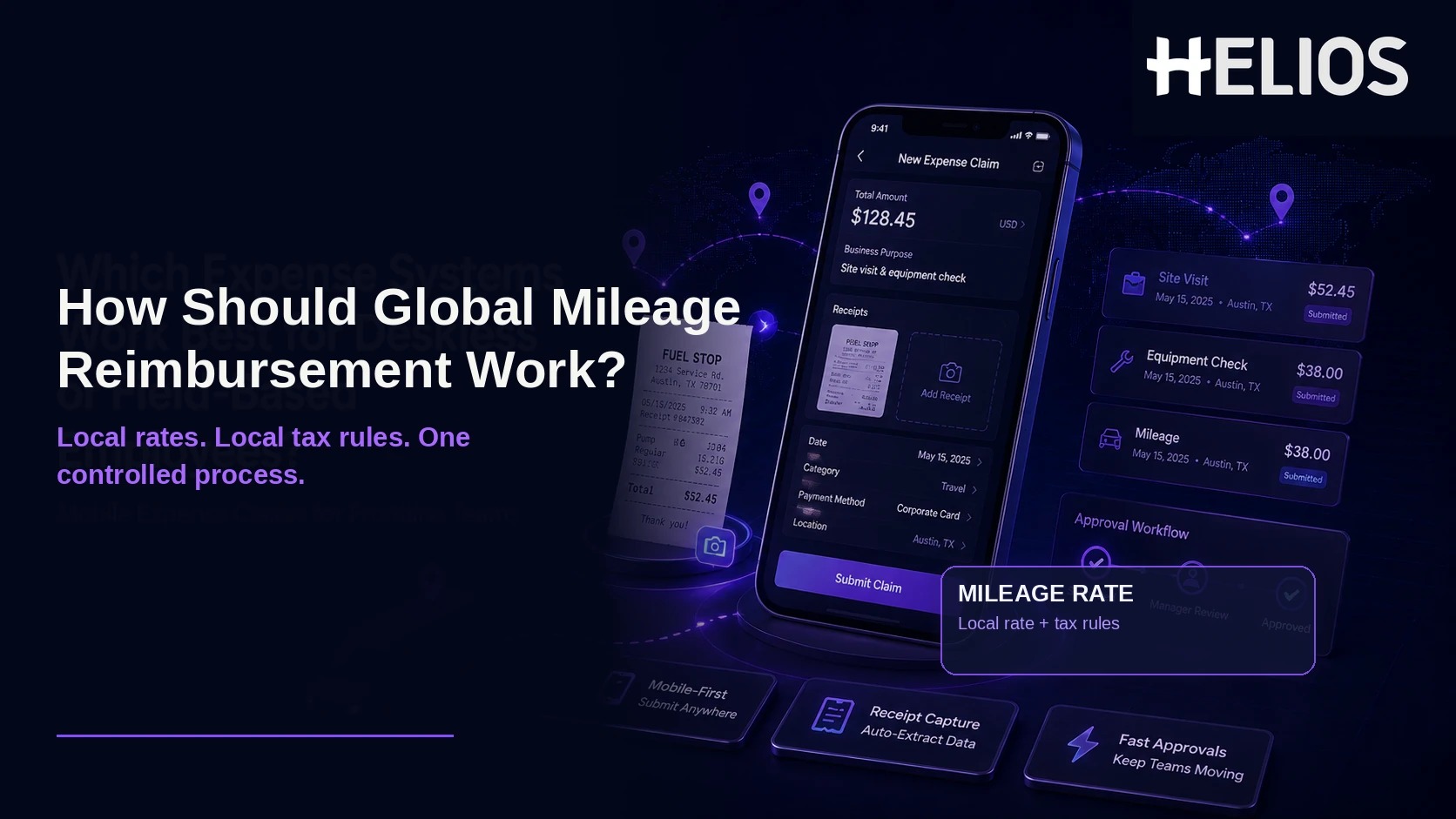
Figure 1. Helios provides a mobile-first experience for travel and expense tasks, which can support field-based employees submitting mileage-related claims from mobile devices.
How to Handle Rate Differences Without Creating Payroll Problems
A local government mileage rate is not always the same thing as a mandatory employer reimbursement rate or a tax-free ceiling. Global policy teams should map each country’s rate to its legal purpose before copying it into the expense system.
· Tax benchmark vs. company reimbursement. Decide whether the local published rate is a safe-harbor/approved amount, an employee deduction benchmark, an advisory rate, or simply one reference point.
· Taxable excess. If the company chooses a higher rate than the locally approved amount, send the excess to payroll or another required reporting process rather than hiding it inside expense reimbursement.
· Lower company rate. A company may choose a lower rate in some jurisdictions, but employees may have relief, deduction, labor-law, or fairness implications that local teams must assess.
· Allowances vs. reimbursements. Some countries distinguish a fixed allowance from a trip-specific reimbursement. Keep those payment types separate in policy and payroll mappings.
Australia is a useful caution: the ATO’s cents-per-kilometre rate is a deduction rate. A cents/km employer payment can still be assessable to the employee, so the number should not be copied into a global “tax-free reimbursement” field without local analysis. Singapore provides the opposite design challenge: there is no prescribed mileage rate, so the organization must define what is reasonable and document the business trips covered.
A Five-Step Operating Model for Global Mileage Reimbursement
- Map countries and employee populations. Identify where employees use private vehicles for business, which legal entity reimburses them, and whether the population includes sales, service, field, home-based, or frequent-travel roles.
- Assign a local policy owner. Give local tax, payroll, or finance responsibility for confirming the rate authority, eligibility, evidence, vehicle categories, taxable excess rules, and effective dates.
- Configure effective-dated rules. Store rate schedules by country, vehicle type, mileage band, and date. Decide how the system converts miles and kilometres and what happens when a claim crosses a threshold or rate-change date.
- Automate validation and approval. Check business purpose, distance, duplicate-looking trips, commuting rules, required fields, and local thresholds before the claim reaches finance. Route exceptions to the correct manager or specialist rather than reviewing every trip manually.
- Monitor, update, and audit. Review rate changes at least annually and whenever tax authorities update them. Track exception volume, employee disputes, taxable excess, manual rate overrides, duplicate mileage, and approval cycle time.
Common Mileage Reimbursement Mistakes
· Using one global rate. A single USD- or EUR-based rate ignores local tax purpose, market cost, thresholds, and employee fairness.
· Treating commuting as business mileage. Home-to-office travel is frequently treated differently from travel between workplaces or to client sites.
· Hard-coding rates without effective dates. Mid-year changes can make old claims and new claims use the same incorrect rate.
· Confusing a tax deduction rate with an employer tax-free rate. Australia is a clear example of why the legal purpose of the published rate matters.
· Failing to separate taxable excess. Where reimbursement above a threshold creates taxable income, expense and payroll need a defined handoff.
· Weak trip evidence. A total monthly kilometre number without routes, purpose, dates, or a reasonable calculation is difficult to audit.
How Helios Can Support a Global Mileage Reimbursement Framework
Helios's public product pages describe mobile submission, automated policy control, configurable approval workflows, automatic journal-entry generation, and multi-dimensional reporting — but they do not currently describe a dedicated mileage engine, GPS route capture, or a country-specific mileage-rate library. Companies should validate those mileage-specific requirements in a tailored demo or pilot rather than assume they exist out of the box.
- Enforce whatever local thresholds and rate rules finance configures. Policy controls can require the fields a mileage claim needs (date, distance, purpose, vehicle type), flag claims above a country's threshold, and route the exception to the correct budget owner or finance reviewer instead of a generic approver — but the rate tables, effective dates, and taxable-excess logic have to be built and maintained by finance; Helios does not ship a mileage-rate library.
- Keep the taxable-excess coding attached to the ledger. Helios states that its accounting engine generates journal entries from approved expense reports, so once finance has classified a mileage payment — ordinary reimbursement versus taxable excess — that treatment can carry through to entity, cost center, and currency coding instead of being re-keyed. Finance should confirm during implementation that rate version and override data remain reportable for audit.
FAQs About Global Mileage Reimbursement
Should every country use the same mileage rate?
No. Use one global governance framework, but maintain local rate schedules and tax treatment by country.
Should companies always use the government mileage rate?
Not necessarily. First determine what the published rate legally represents, then decide whether company policy will match it or use another permitted rate.
How should mid-year mileage-rate changes be handled?
Use effective-dated rules so trips before and after the change automatically use the correct local rate.
What evidence should an employee provide for mileage?
At minimum, capture date, origin, destination, business purpose, distance, vehicle details where relevant, and the rate applied.
Can mileage reimbursement create taxable income?
Yes. Tax treatment varies by country and can depend on business purpose, payment type, rate limits, and documentation.
Global mileage programs work best when finance standardizes governance while local teams own changing rates and tax details. Organizations can explore Helios expense management and test their own mileage schedules, effective dates, employee populations, approval rules, accounting mappings, and local tax scenarios in a controlled pilot.