
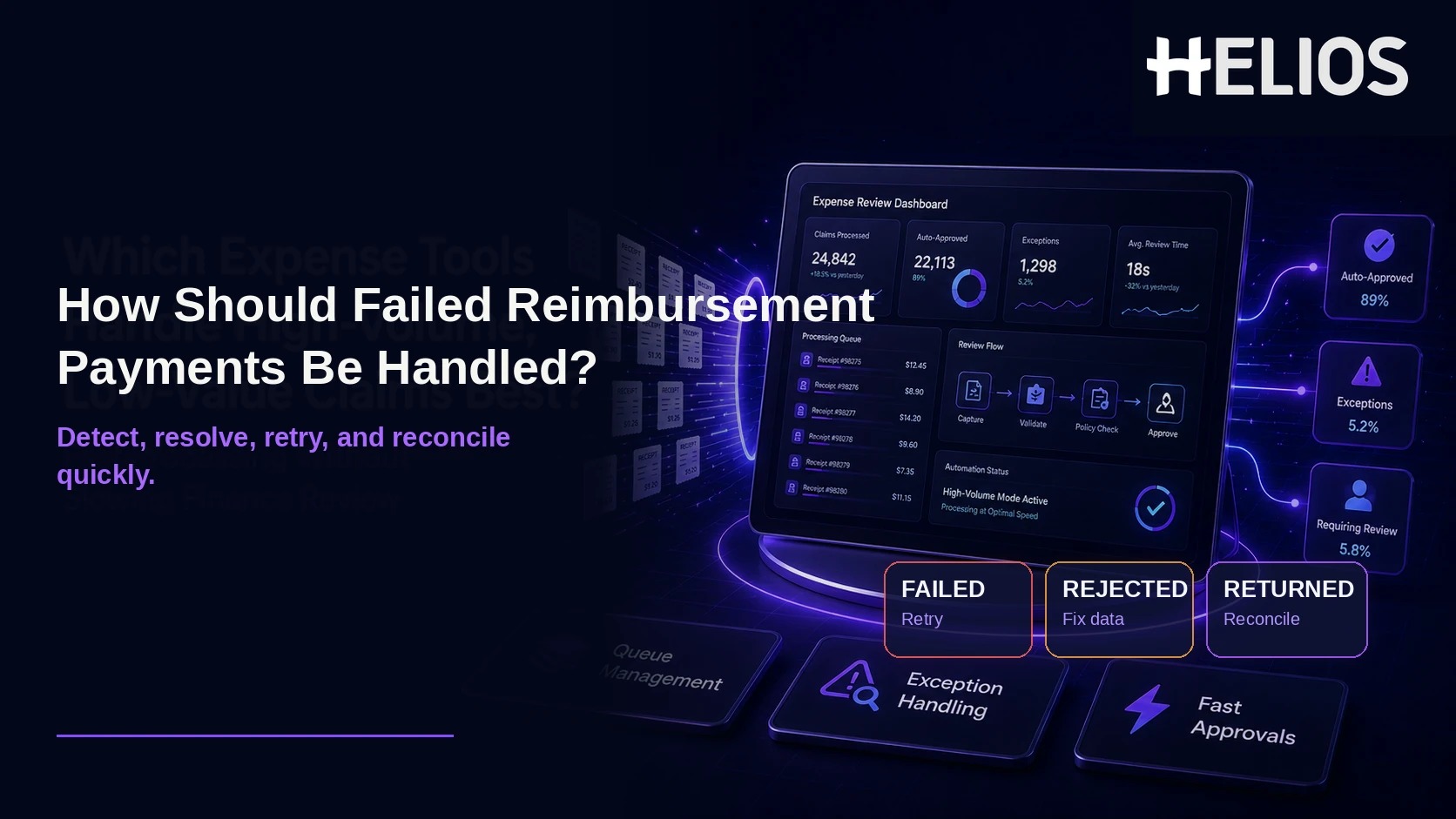
Employee reimbursement payments do not always end when finance clicks “pay.” A transfer can fail immediately, be rejected during validation or bank processing, or appear to have been sent and then return days later. If those states are treated as the same problem, teams risk duplicate retries, open employee liabilities, confusing communication, and unreconciled cash.
The strongest process keeps the original approved claim intact while managing the payment exception as a linked operational and accounting event. Finance should identify the payment state, understand where the cash is, correct the root cause, reissue only when appropriate, and close the loop in the ERP and employee record.
Failed, Rejected, and Returned Payments Are Not the Same
Payment providers use different labels, so the exact status names should be mapped during implementation. Operationally, finance teams should distinguish at least the following states:
| Status | What It Usually Means | Immediate Finance Response |
| Failed | The payment could not complete or credit the destination. The cash may never have left the company or may already be reversing. | Stop automatic retry until the reason and cash position are known. |
| Rejected | A bank, payment provider, compliance rule, or destination validation blocked the payment. | Capture the rejection reason and determine whether data, documentation, or payment method must change. |
| Returned | The payment was initially sent or posted but later came back from the recipient bank or payment network. | Record the return, keep the employee payable open, correct the destination, then reissue deliberately. |
| Posted but unconfirmed | The sending system shows success, but the employee has not received funds yet. | Use trace/reference information and wait for the applicable banking window before creating a second payment. |
That distinction matters because some payment networks can show a transfer as posted or paid before a downstream bank return is known. The employee-facing message, retry decision, and accounting entry therefore depend on both the payment status and the actual movement of cash.
Why Employee Reimbursement Payments Fail or Come Back
Most exceptions fall into a small number of root-cause categories. A structured reason taxonomy makes routing, employee communication, and trend analysis much easier.
· Beneficiary data. Incorrect account numbers, routing codes, IBAN/SWIFT details, beneficiary names, or stale employee bank records are common sources of failure.
· Closed or restricted accounts. The employee may have changed banks, closed an account, or provided an account that cannot receive the selected payment type or currency.
· Country, currency, or rail mismatch. The destination may not support the chosen local transfer, cross-border route, currency, amount limit, or payment purpose.
· Compliance or bank review. Payments can be held or rejected because a provider or bank needs additional information or applies its own regulatory screening.
· System or integration issues. Bad mappings, missing master data, duplicate files, incorrect payment status callbacks, or batch errors can create operational failures even when bank details are correct.
· Timing and status confusion. A payment may be delayed, returned after initial posting, or still inside the normal settlement window when an employee reports non-receipt.
A Standard Workflow for Payment Exceptions
Finance should manage reimbursement exceptions through one queue with named ownership, service levels, and a complete activity history. A practical workflow is:
- Detect and freeze duplicate retry. Receive the bank, payout-provider, ERP, payroll, or employee alert. Mark the payment as an exception and prevent scheduled automation from creating a second transfer.
- Classify the state and capture the reason. Record whether the payment is failed, rejected, returned, delayed, or unconfirmed. Preserve the provider reason code, timestamps, payment reference, amount, currency, and original claim ID.
- Establish where the cash is. Confirm whether cash never left the company, is still in flight, has been returned, or has been credited to an unknown destination. Do not reissue until the cash position is sufficiently clear.
- Investigate the root cause. Check the employee master record, payment destination, currency, legal entity, payment method, approval history, and provider/bank message. Escalate compliance or unusual cases to the appropriate team.
- Correct securely and communicate. Ask the employee only for the information that is genuinely needed. Changes to bank details should use an approved secure process rather than ordinary email or chat.
- Reissue, reroute, or settle. Create a new payment only after the original attempt is controlled. Where appropriate, switch to an approved alternative rail or currency instead of repeating the same failing route.
- Reconcile and close. Update the payment status, bank/clearing entries, employee liability, exception ticket, and management reporting. Link the replacement payment back to the original claim and failed attempt.
How Fast Should Finance Resolve the Exception?
A single universal SLA is rarely practical because local bank windows, return timing, compliance reviews, and employee responsiveness differ. A better model is to define an internal acknowledgement target, a root-cause target, and a closure target by exception type. High-value, travel-critical, payroll-linked, or hardship cases can be prioritized without losing control.
Accounting and Reconciliation: Keep the Expense Separate from the Payment
A payment exception does not normally change the underlying approved business expense simply because the reimbursement failed. The expense and employee payable remain valid unless the claim itself is reversed or changed. What changes is the cash/clearing side and the status of the employee liability. Exact entries depend on the ERP, bank integration, and accounting policy, but a typical design looks like this:
| Scenario | Typical Accounting Logic | Control Point |
| Payment fails before settlement | No new expense. Keep the employee payable open; reverse or clear any temporary payment run entry if one was created. | Confirm no cash was credited before retry. |
| Payment posts, then returns | Record the returned cash or clearing movement while restoring/retaining the employee payable. | Link the bank return and original payment reference. |
| Replacement payment issued | Clear the employee payable when the replacement is actually settled. | Replacement must reference the same approved claim. |
| Duplicate payment discovered | Record recovery/receivable or reverse the second payment as permitted by the payment method and local rules. | Do not delete the audit trail; document recovery. |
| Aged or unclaimed reimbursement | Move through the company's approved aged-liability or unclaimed-funds process where applicable. | Finance/legal should define local treatment and retention. |
This is why payment status needs to flow back to finance records. A “sent” flag is not enough: the organization needs enough information to explain which claim was approved, which payment attempt failed or returned, which replacement was sent, and when the employee liability was finally cleared.
Employee Communication and Bank-Detail Changes
Payment exceptions are operational issues, but they quickly become employee-experience issues. Clear communication reduces duplicate tickets and unsafe data sharing.
· Acknowledge quickly. Tell the employee that finance is investigating, whether action is required from them, and when the next update will arrive.
· Use plain status language. Explain whether the payment failed, was returned, or is still being traced. Avoid saying “paid” when receipt has not been confirmed.
· Protect banking information. Collect new account details through the approved secure channel and apply stronger verification for bank-detail changes or high-risk destinations.
· Keep one case owner. A single finance or shared-services owner should coordinate payroll, treasury, AP, IT, compliance, and the payment provider as needed.
· Confirm closure. When the replacement settles, notify the employee and close the case with the final payment reference and accounting status.
Controls That Reduce Repeat Failures
The best exception process is paired with preventive controls. Useful controls include:
· Beneficiary validation at capture or change. Validate required formats and, where supported, beneficiary-name or account checks before the next payment run.
· Effective-dated employee master data. Track when banking changes become valid and avoid overwriting the historical details used for prior payments.
· Retry locks and idempotency. A failed status should not automatically create unlimited new payments. The system should know whether a replacement already exists.
· Country and currency routing rules. Define which payment methods are approved by country, legal entity, currency, amount, and employee type.
· Exception queues and aging. Monitor failures, returns, unresolved non-receipt cases, replacement payments, and aged employee liabilities together.
· Regular reconciliation. Bank or payout-provider returns should be matched promptly to payment attempts and employee payables rather than discovered at month-end.
What to Test Before Going Live
A realistic Pilot should include more than a successful reimbursement. Test a wrong account number, a closed account, a name mismatch, an unsupported currency, a payment that returns after initially appearing posted, a duplicate retry attempt, and a reissue on an alternative payment method. Confirm that the employee message, approval history, provider reason, cash movement, replacement payment, and ERP balance can all be reconstructed from the record.
How Helios Fits Into a Controlled Reimbursement Exception Process
Helios's public product pages describe mobile submission, automated policy compliance, flexible approvals, accounting automation, and multi-dimensional reporting. Those capabilities support the claim and finance-control layers around a payment exception — the exact payout-status integration and supported payment rails still need to be confirmed for the company's target countries and payment providers.
- Keep the claim and review context intact while the payment is fixed. A failed payment shouldn't force finance to rebuild the underlying expense review. Helios enforces the configured spending policy on the claim itself, and Approval Copilot can give a reviewer the claim-level context back quickly. Approval paths are configurable by department, role, and cost center — whether that configuration can specifically flag a reissue as high-risk (material amount, changed payment instructions, an aged case) without reopening the original approval is a pilot question to confirm, not a given.
- Keep the expense-to-accounting handoff structured through the exception. Helios states that its accounting engine can automatically generate journal entries from expense reports. For payment exceptions specifically, finance still needs an integration design that also reflects returned cash, the reopened employee liability, and the replacement-payment reference in the ERP — the journal entry from the original claim is only half of that picture.
- Use reporting to see the exception pattern, not just the single case. Once payment-provider or bank status data is integrated into the operating model, dashboards can track exception volume, aging, repeated root causes, reissue frequency, and which entities or countries generate the most manual work — turning a one-off fix into a trend finance can act on.
FAQs About Failed or Returned Reimbursement Payments
1. Should finance immediately resend a failed reimbursement?
Usually not. First confirm the reason and whether the original funds are still in flight, have returned, or never left the company; then create one controlled replacement payment.
2. What if the payment shows as paid but the employee has not received it?
Treat it as unconfirmed rather than automatically failed. Check the normal settlement window, payment reference or trace information, and recipient bank status before retrying.
3. Should a returned payment reverse the original business expense?
Normally the payment event and the approved expense are separate. If the claim remains valid, the employee liability generally stays open until a successful reimbursement is made.
4. How should new employee bank details be collected?
Use the organization’s approved secure master-data process, with appropriate verification and change controls. Avoid collecting sensitive banking data through ordinary email or chat.
5. Which metrics should finance track?
Useful measures include payment failure/return rate, average resolution time, reissue rate, aged employee liabilities, repeat root causes, and the cost or manual effort of payment exceptions.
Build an Exception Process That Closes the Loop
Failed, rejected, and returned reimbursements are inevitable — the workflow above is what keeps them from turning into duplicate payments or unreconciled cash. In a Helios evaluation, test these exception scenarios in a demo alongside normal submission, approval, and accounting flows.