
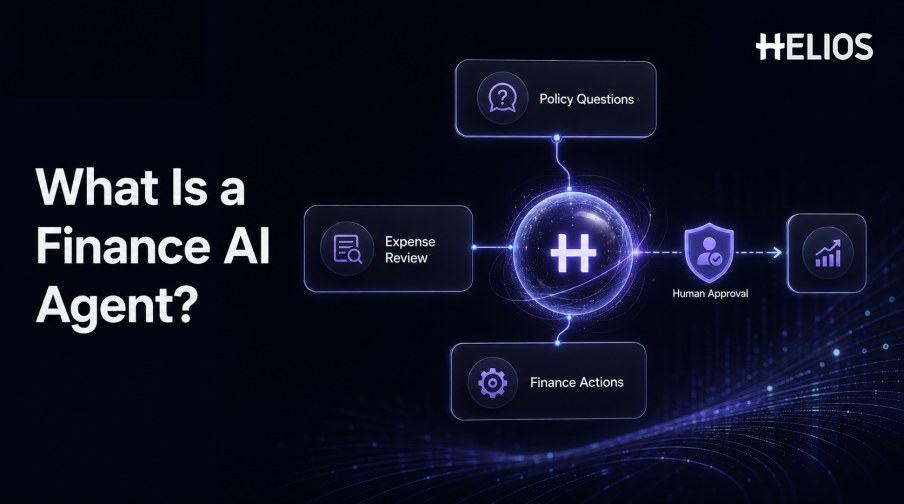
A finance AI agent is a software component that can interpret a finance-related request, gather permitted context, propose or execute defined steps, and return a result through a controlled interface. Unlike a static chatbot, an agent may coordinate tools, records, policies, and workflow actions across a multi-step task.
Finance agents can help users find expense guidance, prepare a claim, summarize policy exceptions, assist a reviewer, or trigger an approved finance operation. Their value depends on bounded permissions, reliable source data, clear decision rights, traceable actions, and a way for people to review uncertain or high-impact outcomes.
This guide explains the capabilities, use cases, limitations, and governance of financial AI agents, with examples from Helios expense management and Spark AI conversational copilots.
What Is a Finance AI Agent?
A finance AI agent combines a language or reasoning layer with access to approved data, policies, tools, and workflow functions. It can understand an objective, break it into steps, retrieve relevant information, call permitted functions, evaluate intermediate results, and request confirmation before completing an action.
The term does not imply unrestricted autonomy. A well-designed financial AI agent operates within a defined task boundary, data scope, permission model, approval policy, logging standard, and fallback path. The more consequential the action, the stronger the control should be.
Core Capabilities of Finance AI Agents
Different finance AI agents combine several capabilities in different proportions.
- Natural-language understanding. Interpret questions, instructions, expense descriptions, and follow-up context without requiring users to know a system’s field structure.
- Grounded retrieval. Locate approved policies, records, report data, and workflow status while respecting user access and source freshness.
- Document intelligence. Read receipts or invoices, extract fields, identify missing information, and connect documents with the relevant claim.
- Reasoning and task planning. Determine which allowed steps are needed, what information is missing, and when confirmation or escalation is required.
- Tool use. Invoke approved functions such as creating a draft, checking policy, routing a record, generating an accounting proposal, or producing a report.
- Explanation and interaction. Show the sources, assumptions, proposed changes, exceptions, and next action in language a finance user can review.
- Memory within scope. Maintain task context while avoiding unauthorized persistence or reuse of sensitive information.
A Simple Finance Agent Workflow
A governed agent interaction can follow these steps:
- Receive the request. The user asks a question or requests an expense or finance task through an approved interface.
- Confirm identity and scope. The system checks the user’s role, entity, data access, and permitted actions.
- Retrieve grounded context. The agent gathers relevant policy text, expense records, documents, workflow state, and approved reference data.
- Plan permitted steps. It identifies required tools, validations, dependencies, and approval gates without exceeding its task boundary.
- Produce a draft or recommendation. The agent fills fields, summarizes evidence, proposes a decision, or prepares an authorized action.
- Request review when required. A user confirms material values, exceptions, accounting impacts, payments, or other high-impact steps.
- Execute and verify. The system performs only the authorized operation and confirms the resulting status.
- Log the activity. It records sources, tools, inputs, outputs, edits, approvals, timestamps, and errors for later review.
Finance AI Agent Use Cases in Expense Management
Expense management offers bounded, evidence-rich tasks that are suitable for agent assistance.
- Policy questions. Explain receipt rules, spending limits, category requirements, trip guidance, or the next approval step using approved content.
- Claim preparation. Use receipt data and conversation to draft an expense report, identify missing evidence, and request confirmation.
- Review assistance. Summarize claim details, compare them with policy, highlight conflicts, and organize evidence for an approver.
- Exception handling. Request a reason, route the record to the correct owner, and retain the approved exception path.
- Accounting preparation. Generate a controlled journal-entry proposal from approved expense data and configured mappings.
- Status and reporting. Answer permitted questions about claim status, review queues, spend trends, and recurring exceptions.
Limitations, Risks, and Human Control Requirements
Financial AI agents can fail even when their interface appears confident.
- Incorrect or unsupported answers. Require grounded sources, visible uncertainty, validation, and an escalation path when policy or data is incomplete.
- Over-broad permissions. Use least-privilege access, separate read from write authority, and restrict high-impact tools.
- Hidden assumptions. Expose material assumptions, calculations, currency treatment, dates, thresholds, and policy versions.
- Automation bias. Train users to review evidence and avoid treating a recommendation as an authoritative decision.
- Sensitive-data exposure. Apply access controls, data minimization, retention rules, and monitoring across prompts, records, and outputs.
- Uncontrolled loops or actions. Set step limits, timeouts, spend or value thresholds, idempotency controls, stop mechanisms, and confirmation gates.
- Changing business context. Monitor policy updates, system integrations, data quality, model behavior, and performance over time.
How to Evaluate and Implement a Finance AI Agent
Start with one bounded task and measurable acceptance criteria.
- Choose a narrow workflow. Select a frequent task with clear sources, permissions, rules, owners, and escalation paths.
- Map actions and authority. Separate information retrieval, drafting, recommendation, approval, execution, and reversal.
- Define trusted sources. Identify the policies, expense data, documents, system records, and reporting datasets the agent may use.
- Test realistic cases. Include missing information, ambiguous instructions, exceptions, access conflicts, integration failures, and high-impact requests.
- Measure task quality. Track completion, corrections, grounded-answer rate, review time, user acceptance, failures, and control exceptions.
- Release progressively. Begin with read-only or draft assistance, then add approved actions only after evidence supports the change.
- Maintain oversight. Assign owners for sources, prompts, tools, permissions, monitoring, incidents, and retirement.
How Helios and Spark AI Support Finance Agent Use Cases
Helios provides the controlled expense-management foundation, including OCR capture, policy controls, approvals, accounting-entry generation, and reporting. Spark AI provides conversational Travel, Claim, Approval, and Service Copilots. Together, the published capabilities support five bounded agent patterns:
- Answer expense questions. Service Copilot provides context-aware answers to policy and travel questions.
- Assist claim creation. Claim Copilot lets users submit expenses through conversation rather than relying only on forms.
- Support policy-aware review. Approval Copilot checks claims against company policy and assists the reviewer.
- Route work through controls. Helios policy and approval workflows keep exceptions and decisions within configured processes.
- Connect approved data with finance. Accounting-entry generation and reporting carry controlled expense outcomes downstream.
Helios also presents itself as an enterprise-grade provider with global experience and information-security credentials. Organizations should validate the exact agent tools, source grounding, permissions, confirmation gates, logging, error handling, accounting actions, data residency, and implementation scope in their proposed configuration.
FAQs About Finance AI Agents
What is the difference between a finance AI agent and a chatbot?
A chatbot primarily returns conversational responses. A finance AI agent may also retrieve governed context, plan steps, invoke approved tools, and update a workflow within defined permissions.
Are finance agents autonomous?
Autonomy is a design choice, not a requirement. Many valuable finance agents are limited to retrieval, drafting, recommendation, or actions that require human confirmation.
What tasks should remain under human control?
Material approvals, exception judgments, payments, postings, access changes, policy changes, investigations, and other high-impact decisions should retain controls appropriate to the organization.
How can a finance AI agent be made auditable?
Log its sources, retrieved records, tools, inputs, outputs, intermediate results, edits, approvals, errors, and final system state.
How does Spark AI relate to finance agents?
Spark AI presents conversational copilots for travel, claim submission, approval, and service questions. Buyers should validate the exact autonomy and controls available for their intended workflow.
Organizations can assess Helios and Spark AI finance agent workflows by testing grounded questions, representative claims, policy exceptions, approval gates, accounting proposals, permissions, failure handling, and audit retrieval.