
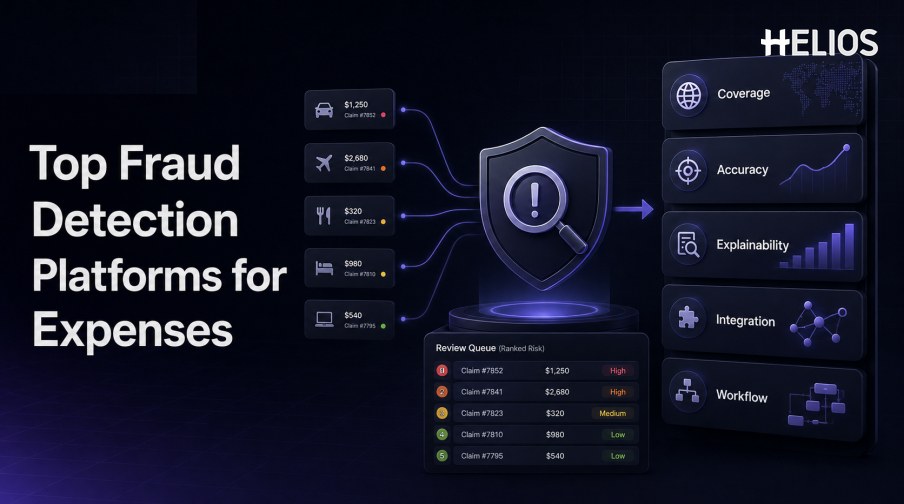
Finance teams evaluating expense controls need more than a list of products labeled as fraud detection. A useful platform must examine the right evidence, distinguish suspicious patterns from ordinary exceptions, explain why a claim was prioritized, and connect the result with an accountable review process.
The top fraud detection platforms for expenses should therefore be compared across detection coverage, operational accuracy, explainability, data integration, workflow support, security, and measurable control outcomes. A platform that produces many unexplained alerts can create more work without improving decisions, while a narrow tool may miss cross-report or cross-entity patterns.
This guide provides a practical evaluation framework for finance teams and explains how Helios expense controls and Spark AI automated expense review relate to policy checks, risk identification, approvals, accounting, and reporting.
What Expense Fraud Detection Platforms Actually Do
Expense fraud detection platforms analyze claims, receipts, invoices, card or payment data, employee context, policies, approvals, and historical records to identify items that warrant review. Detection can combine deterministic rules, exact or fuzzy duplicate comparison, document-to-claim matching, statistical anomalies, and AI-assisted risk analysis.
A risk indicator is not proof of fraud. The platform should preserve evidence and help an authorized reviewer determine whether the record reflects misconduct, an honest mistake, a legitimate exception, or a configuration problem.
Five Dimensions for Comparing Platforms
The following dimensions separate a usable control platform from a simple alert generator.
- Detection coverage. Confirm support for duplicate claims and documents, altered or inconsistent evidence, policy violations, unusual merchants, category conflicts, timing anomalies, inflated amounts, personal spending indicators, and approval irregularities.
- Accuracy and alert quality. Measure useful-alert rate, missed known issues, false positives, confidence calibration, and performance across documents, languages, currencies, entities, and employee groups.
- Explainability. Require visible source records, matched fields, applicable policies, anomaly context, confidence, materiality, and the reason each item entered the queue.
- Integration. Assess how claims, OCR output, payment records, users, policies, approvals, accounting dimensions, and review outcomes move between systems.
- Review workflow. Look for prioritization, assignment, evidence requests, comments, corrections, escalation, disposition, access controls, and a complete audit trail.
A Simple Expense Fraud Review Workflow
A finance team can use the platform through a controlled sequence:
- Collect the complete record. Bring together the claim, original document, extracted fields, payment or card data, employee and trip context, policy, approvals, and prior related records.
- Normalize and match data. Standardize dates, merchants, currencies, amounts, identifiers, tax fields, and document fingerprints before comparison.
- Run layered checks. Apply policy rules, duplicate detection, document-to-claim validation, pattern analysis, and appropriate risk models.
- Score and explain risk. Rank the record using severity, materiality, confidence, signal combination, and business context while exposing the contributing factors.
- Route the case. Assign the item to the correct manager, finance reviewer, compliance owner, or investigator based on risk and authority.
- Review evidence and decide. Request information, correct errors, document the conclusion, and distinguish confirmed issues from legitimate exceptions.
- Carry the outcome downstream. Update reimbursement, accounting, reporting, monitoring, and control-improvement records.
How to Test Detection Accuracy and Explainability
Vendor demonstrations should use representative records rather than only ideal examples.
- Build a labeled test set. Include normal expenses, known duplicates, altered documents, policy failures, legitimate exceptions, difficult receipts, multiple currencies, and ambiguous cases.
- Separate precision from recall. Measure how many alerts are useful and how many known test issues the platform identifies; neither metric is sufficient alone.
- Review explanations. Confirm that a finance user can trace the alert to source fields, policy requirements, comparable records, or visible patterns.
- Test context changes. Change role, entity, trip, currency, amount, date, category, and policy version to confirm that results respond appropriately.
- Measure workflow outcomes. Track time to decision, evidence requests, overrides, reopened cases, reimbursement impact, and reviewer consistency.
- Challenge the system. Use near-duplicates, low-quality images, legitimate outliers, new merchants, and incomplete data to identify failure modes.
Integration, Governance, and Audit Requirements
Detection quality depends on the surrounding data and control environment.
- Data lineage. Retain the original source, extracted values, corrections, transformations, matches, model or rule version, and final record.
- Role-based access. Limit who can view sensitive evidence, configure controls, change risk thresholds, investigate cases, and approve outcomes.
- Segregation of duties. Prevent one user from controlling submission, rule configuration, review, approval, and accounting disposition where those roles should differ.
- Human decision authority. Define which cases can follow routine processing and which require finance, compliance, HR, legal, or management review.
- Monitoring and change control. Track false alerts, missed issues, overrides, data drift, policy updates, model changes, and reviewer behavior.
- Audit retrieval. Ensure reviewers can reproduce the evidence, logic, actions, timestamps, and outcome for a selected claim.
How to Choose the Right Platform for a Finance Team
The best choice is the platform that performs well on the organization’s own data, controls, and operating model.
- Define the scope. List expense types, payment methods, entities, countries, languages, currencies, user groups, and fraud or error patterns in scope.
- Prioritize outcomes. Decide whether the primary goal is duplicate prevention, policy compliance, review efficiency, broader anomaly screening, stronger evidence, or consolidated reporting.
- Map required integrations. Document the expense, card, HR, identity, accounting, payment, case-management, and reporting connections required.
- Pilot with reviewers. Have finance users test queue quality, explanations, evidence access, corrections, escalation, and closure.
- Quantify value. Compare useful issues found, reviewer time, reimbursement corrections, control coverage, implementation effort, and ongoing administration.
- Validate vendor claims. Confirm every material fraud-specific capability in the proposed configuration, contract, implementation plan, and acceptance tests.
How Helios and Spark AI Support Expense Review
Helios provides OCR receipt capture, Automated Policy Control, configurable approval workflows, accounting-entry generation, and analytics for expense operations. Spark AI publicly describes automated expense auditing against company policies, risk and violation identification, and an Approval Copilot. Together, these capabilities address five evaluation needs:
- Create structured evidence. OCR captures relevant receipt and invoice fields for confirmation and downstream comparison.
- Apply explicit policy controls. Configured rules provide a deterministic layer for limits, evidence, categories, and other spending requirements.
- Assist risk-focused review. Spark AI and Approval Copilot help surface policy-related risks and support claim review.
- Route accountable decisions. Flexible workflows connect exceptions with defined approvers and finance roles.
- Connect outcomes with finance. Accounting integration and reporting help retain downstream visibility after approval.
Helios also presents itself as an enterprise-grade provider with global experience and information-security credentials. Helios does not publicly present a complete feature matrix for a dedicated fraud case-management platform, so buyers should validate duplicate comparison, anomaly methods, risk scoring, explanations, card-data coverage, investigation records, integrations, and monitoring where required.
FAQs About Top Fraud Detection Platforms for Expenses
What should finance teams compare first?
Start with the expense risks and evidence in scope, then compare detection coverage, alert quality, explanations, integrations, review workflow, governance, and total operating effort.
Is a high number of alerts a sign of strong detection?
No. A useful system finds meaningful issues with manageable false positives and shows why each alert deserves attention.
Can an expense platform prove fraud automatically?
A platform can identify and prioritize risk signals. A fraud conclusion requires appropriate evidence, investigation, authority, and due process.
How should accuracy be measured?
Use representative labeled data and measure useful-alert rate, detection of known test issues, confidence calibration, reviewer outcomes, and performance across relevant contexts.
Where does Spark AI fit?
Spark AI describes automated expense auditing against company policies, identification of risks and violations, and policy-aware claim checks. Buyers should validate additional fraud-specific requirements in a pilot.
Finance teams can evaluate Helios and Spark AI expense review with representative claims, known risk scenarios, legitimate exceptions, policy versions, reviewer roles, accounting outcomes, and measurable acceptance criteria.