
An expense fraud detection product cannot operate effectively as an isolated alert engine. It needs complete documents, normalized transactions, employee and organizational context, policy rules, review workflows, accounting outcomes, and verified case results. Without those connections, even a sophisticated model may produce noisy or unactionable signals.
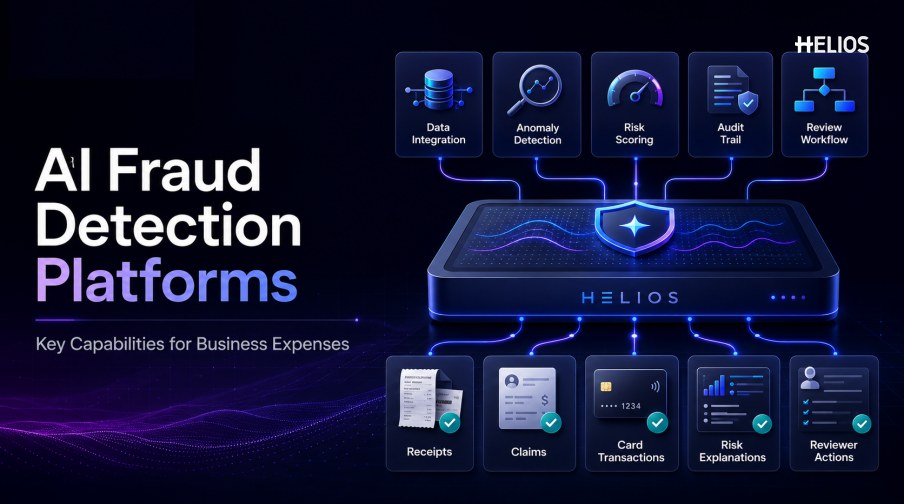
AI fraud detection for business expenses platforms should therefore be evaluated as an end-to-end control environment. Core capabilities include data integration, document recognition, duplicate and anomaly detection, risk prioritization, explanations, audit history, authorized workflows, and continuous monitoring.
This guide summarizes those capabilities and explains how Helios and Spark AI can support the expense-review foundation while organizations validate any fraud-specific requirements.
1. Data Integration and Identity Resolution
The platform must create a reliable view of each expense and its relationships.
- Claims and reports. Connect line items, descriptions, categories, dates, amounts, currencies, attendees, projects, and approvals.
- Documents. Link original receipts and invoices with OCR fields, metadata, confidence, corrections, and document identifiers.
- Card and payment data. Associate corporate card transactions, payment references, reversals, refunds, and reimbursement status where in scope.
- People and organization. Resolve employees, roles, managers, entities, departments, cost centers, projects, locations, and policy groups.
- Merchants and master data. Normalize merchant descriptors, supplier identities, categories, tax data, currencies, and accounting mappings.
- Policies and workflows. Retain limits, evidence rules, exceptions, approver roles, effective dates, and version history.
- Review outcomes. Connect alerts with corrections, valid exceptions, confirmed issues, recoveries, and final decisions.
2. Detection and Risk-Prioritization Capabilities
A strong platform combines complementary methods.
- Policy rules. Test explicit evidence, amount, category, merchant, date, role, approval, and coding requirements.
- Duplicate detection. Compare documents and normalized fields across reports, users, entities, card records, and reimbursement history.
- Document consistency. Check whether receipt or invoice content aligns with the submitted merchant, date, currency, tax, and total.
- Anomaly detection. Identify unusual amount, timing, frequency, merchant, category, splitting, approval, or behavior patterns.
- Relationship analysis. Surface relevant links among employees, approvers, merchants, transactions, trips, and repeated exceptions.
- Risk scoring. Combine materiality, severity, confidence, signal diversity, and business context into a review priority.
- Explainable alerts. Show the source evidence, comparison, policy, threshold, and factors behind each signal.
3. Review Workflow and Case Management
Detection has little value unless an authorized team can resolve the alert efficiently.
- Prioritized queues. Sort by materiality, risk components, age, entity, category, or reviewer responsibility.
- Evidence workspace. Display documents, entered and recognized values, related records, policies, explanations, and history together.
- Information requests. Allow reviewers to obtain receipts, business context, attendees, approvals, or corrections from the submitter.
- Routing and escalation. Assign records according to role, department, entity, cost center, severity, and exception type.
- Neutral outcome categories. Separate error, incomplete evidence, valid exception, policy violation, suspected fraud, and confirmed fraud.
- Segregation of duties. Control who can submit, approve, investigate, change rules, close cases, and post accounting results.
- Service-level monitoring. Track queue age, handling time, unresolved evidence, escalation, and closure.
4. Audit Trail and Governance
AI fraud detection for business expenses platforms must preserve defensible evidence and controlled change.
- Source lineage. Identify where every field, document, policy, comparison record, and model input originated.
- Version history. Retain the rule, threshold, model, policy, and configuration that applied at decision time.
- Decision records. Store explanations, reviewer notes, information requests, corrections, approvals, escalations, timestamps, and outcomes.
- Model and rule governance. Define who can design, test, approve, publish, monitor, and retire detection logic.
- Data protection. Control access, encryption, retention, deletion, exports, card data, employee information, and investigation notes.
- Feedback controls. Use verified outcomes for improvement and prevent unreviewed user actions from becoming automatic training labels.
- Assurance boundary. Document that automated risk signals support review and do not independently prove fraud or replace formal investigative procedures.
5. Accounting, Reporting, and Continuous Monitoring
The platform should connect risk review with financial outcomes.
- Accounting continuity. Carry approved accounts, dimensions, taxes, currencies, references, and corrections into finance systems.
- Payment and reimbursement status. Know whether a flagged record is pending, paid, rejected, recovered, reversed, or adjusted.
- Management reporting. Analyze alerts, policy exceptions, duplicate amounts, merchants, categories, approvers, entities, and trends.
- Control performance. Monitor useful-alert rate, missed issues, overrides, reviewer time, queue backlog, recoveries, and repeat patterns.
- Drift monitoring. Review changes in documents, merchants, policies, entities, currencies, card programs, user behavior, and model performance.
- Change management. Test updates against a baseline, document approval, monitor rollout, and retain rollback capability.
A Practical Platform Selection Process
A controlled pilot should answer whether the platform works with the organization’s data and reviewers.
- Define risks and boundaries. List the fraud schemes, errors, policy violations, entities, decisions, and excluded uses in scope.
- Map required data. Identify claims, documents, cards, users, merchants, policies, approvals, accounting, and outcome data.
- Prepare representative cases. Include known issues, clean records, legitimate anomalies, weak documents, multiple currencies, and difficult workflows.
- Measure each capability. Evaluate duplicates, anomalies, rules, scoring, explanations, review steps, audit history, and integration separately.
- Test end-to-end failures. Cover missing data, delayed feeds, duplicate messages, unavailable connectors, corrections, retries, and reconciliation.
- Approve governance. Assign owners for data, rules, models, access, investigations, monitoring, incidents, and deployments.
- Compare total operating effort. Include configuration, data cleanup, false alerts, reviewer workload, integrations, support, and ongoing improvement.
How Helios and Spark AI Fit a Business Expense Control Platform
Helios combines OCR capture, Built-In Policy Compliance, Automated Policy Control, flexible approvals, accounting-entry generation, and reporting in an expense-management workflow. Spark AI adds conversational assistance and policy-aware auditing. This provides five relevant platform layers:
- Document and expense data capture. OCR structures receipt and invoice information for user confirmation and downstream checks.
- Automated policy enforcement. Configured rules evaluate reimbursement requests against company spending requirements.
- AI-assisted expense review. Spark AI states that it audits expenses against policies and identifies risks and violations.
- Governed workflow and escalation. Flexible approval routes help preserve roles and exception handling.
- Accounting and analytical continuity. Journal-entry generation, integration, dashboards, and customizable reports connect review with finance outcomes.
Helios also presents itself as an enterprise-grade provider with global experience and information-security credentials. Buyers should validate fraud-specific data sources, duplicate and anomaly methods, risk scoring, explanations, investigation workflow, outcome taxonomy, card integration, audit evidence, governance, monitoring, and service scope directly.
FAQs About AI Fraud Detection Platforms for Business Expenses
What is the most important platform capability?
Reliable integration and data linkage come first. Detection, scoring, and explanations cannot be trusted if claims, documents, users, policies, payments, and outcomes are incomplete or mismatched.
Should a platform use rules or machine learning?
Use both where appropriate. Rules express explicit requirements, while models help identify variable or unexpected patterns. The combined result should remain explainable and reviewable.
How should platform accuracy be measured?
Measure useful alerts, missed known issues, results by risk type, reviewer overrides, handling time, recoveries, false-alert cost, and performance across entities and time—not one average score.
What audit history is required?
Retain source records, documents, policies, rule and model versions, signals, explanations, reviewer actions, corrections, timestamps, accounting outcomes, and final classifications.
Is Helios a dedicated fraud investigation platform?
Helios publicly focuses on expense control, policy compliance, OCR, approvals, accounting, reporting, and Spark AI-assisted auditing. Organizations should validate dedicated fraud-case and investigation requirements directly.
Finance teams can evaluate Helios and Spark AI as part of a broader expense-control architecture using representative data, known risk cases, reviewer workflows, accounting interfaces, and clear governance.