
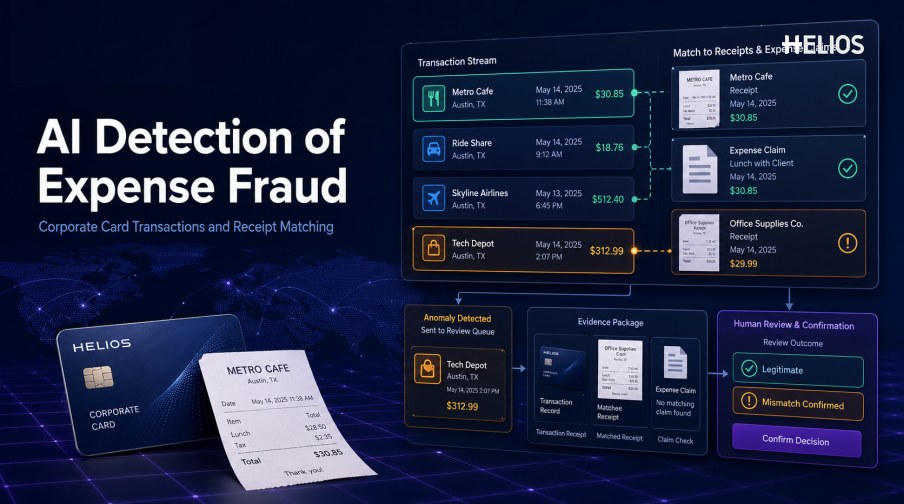
Corporate cards give organizations timely transaction data, but the transaction alone does not prove business purpose or policy compliance. A merchant name may be ambiguous, a card charge may include personal items, the receipt may not match the transaction, or an employee may assign an incorrect category.
AI detection of expense fraud corporate cards can connect card feeds with receipts, claims, employee context, policies, and prior behavior. It can identify unusual merchants, amounts, times, categories, and evidence mismatches, then prioritize records for review. These are risk signals, not automatic findings of fraud.
This guide explains the main detection methods and controls and shows how Helios receipt capture, policy enforcement, and Spark AI-assisted review can support a corporate-card expense process.
Corporate Card Risk Scenarios
Organizations should translate their card policy into specific data and review scenarios.
- Personal purchase. A card is used for a non-business item or for a mixed purchase without separating the personal portion.
- Receipt mismatch. The submitted receipt differs from the transaction in merchant, date, amount, currency, tax, or line items.
- Missing evidence. A transaction lacks a receipt, invoice, business purpose, attendee list, or required approval.
- Merchant-category mismatch. The claimed category or purpose conflicts with the merchant type or receipt content.
- Unusual time or location. The charge occurs outside the trip, at an unexpected location, or at a time inconsistent with business activity.
- Split or threshold avoidance. Multiple charges remain just below a limit or divide one purchase across transactions.
- Duplicate reimbursement. A card-funded expense is also submitted for cash reimbursement or appears in another claim.
- Approval or card-use abuse. Transactions bypass expected review, use another employee’s card, or persist after a card should be inactive.
How AI Reviews Merchant, Amount, Time, and Category
Each dimension requires normalization and business context.
- Merchant. Normalize processor descriptors and parent companies, compare merchant type with purpose, and identify new or restricted merchants.
- Amount. Compare with receipt totals, policy limits, typical ranges, prior purchases, exchange rates, taxes, tips, and refunds.
- Time. Evaluate transaction date and time against trip dates, working patterns, card status, submission timing, and related purchases.
- Category. Compare card codes, receipt line items, submitted category, policy group, role, project, and accounting mapping.
- Location. Assess merchant location against travel itinerary, employee base, project site, and cross-border requirements.
- Frequency. Identify repeated merchants, rapid sequences, recurring threshold-adjacent charges, and sudden changes in usage.
- Relationship patterns. Consider employee, approver, merchant, device, trip, and reimbursement links where permitted and relevant.
A Simple Corporate Card Review Workflow
A card transaction can move through the following controlled sequence:
- Ingest the transaction. Receive merchant descriptor, timestamp, amount, currency, card token, status, and other permitted feed data.
- Match the employee and context. Link the cardholder, entity, policy, trip, project, role, and approval requirements.
- Collect the receipt and claim. Prompt the user to attach evidence, confirm the transaction, and add business purpose and coding.
- Extract receipt data. OCR proposes merchant, date, amount, currency, tax, tip, and line details for confirmation.
- Reconcile transaction and evidence. Compare card, receipt, and submitted fields using tolerances and currency logic.
- Run policy and anomaly checks. Evaluate limits, merchants, categories, timing, duplicates, missing evidence, and unusual patterns.
- Prioritize and review. Show the mismatch, policy, related records, materiality, confidence, and employee explanation to an authorized reviewer.
- Post and monitor. Carry approved coding into accounting and retain the decision, correction, exception, and status for reporting.
Transaction-to-Receipt Matching Controls
Matching should account for legitimate differences while making conflicts visible.
- Merchant normalization. Map processor descriptions, locations, franchise names, and parent companies before comparison.
- Amount tolerances. Define how tips, deposits, preauthorizations, taxes, partial refunds, currency conversion, and rounding are handled.
- Date windows. Allow documented settlement delays while flagging dates outside the expected transaction or trip period.
- Partial and multiple matches. Support one receipt to several card charges or one charge to several documents when the business process permits.
- Line-item evidence. Use receipt details to identify personal items, prohibited categories, or missing business portions when reliable line extraction is available.
- Unmatched queues. Track missing receipts, orphaned transactions, duplicate claims, credits, reversals, and unresolved differences.
- Correction history. Retain the original feed, submitted values, recognized values, reviewer changes, and final reconciliation.
Policy and Human Review Controls
AI detection of expense fraud corporate cards should support—not bypass—accountable review.
- Policy enforcement. Apply merchant, category, amount, evidence, timing, role, and approval requirements consistently.
- Risk-based routing. Use materiality, signal strength, policy severity, card status, and evidence confidence to determine the review path.
- Employee response. Allow the cardholder to explain legitimate exceptions and provide missing evidence within a documented process.
- Independent review. Higher-risk or sensitive cases should route to authorized finance, compliance, or investigation roles.
- Neutral conclusions. Distinguish mismatch, error, incomplete evidence, policy violation, suspected fraud, and confirmed fraud.
- Audit trail. Retain transaction data, documents, policies, signals, explanations, decisions, timestamps, and accounting outcome.
Implementation Metrics and Safeguards
A pilot should measure matching quality, risk value, and user impact.
- Match rate. Percentage of card transactions linked to the correct receipt and expense claim.
- Mismatch precision. Percentage of flagged merchant, amount, time, category, or evidence conflicts that require action.
- Unmatched aging. Time that card transactions remain without evidence, coding, explanation, or approval.
- Duplicate prevention. Card-funded expenses stopped from receiving additional reimbursement.
- Reviewer and employee effort. Time to attach evidence, correct fields, explain exceptions, and close records.
- Data protection. Tokenize card identifiers, restrict access, control retention, and avoid exposing sensitive payment data.
- Drift and change. Monitor new merchant descriptors, policy updates, card programs, currencies, regions, and threshold performance.
How Helios Supports Corporate Card Expense Review
Helios combines mobile expense submission, OCR receipt capture, Built-In Policy Compliance, Automated Policy Control, flexible approvals, accounting integration, and reporting. Spark AI adds policy-aware claim and approval assistance. Together, these capabilities support five review needs:
- Collect receipt evidence promptly. Mobile capture and upload reduce the delay between a transaction and its supporting document.
- Structure receipt fields with OCR. Recognized merchant, date, currency, tax, and amount data can be confirmed before review.
- Apply spending policies. Configured controls evaluate expense requirements and surface exceptions.
- Assist authorized review. Approval Copilot checks claims against company policy while reviewers retain decision authority.
- Connect approved records with finance. Accounting-entry generation, dashboards, and reporting support downstream processing and visibility.
Helios also presents itself as an enterprise-grade provider with global experience and information-security credentials. Organizations requiring corporate-card fraud detection should validate card-feed support, transaction matching, merchant normalization, amount and date tolerances, duplicate reimbursement checks, anomaly logic, card-data security, and reconciliation workflows.
FAQs About AI Detection of Corporate Card Expense Fraud
What corporate card data is most useful?
Merchant descriptor, timestamp, amount, currency, cardholder token, status, location where available, receipt, claim, policy, trip, approval, and accounting outcome can support review.
Why might a receipt total differ from the card charge?
Tips, deposits, taxes, currency conversion, preauthorizations, partial refunds, split settlements, and rounding may create legitimate differences that require configured tolerances.
Can merchant category codes prove personal spending?
No. A code is a useful signal but can be broad or inaccurate. Review the receipt, business purpose, employee context, policy, and other evidence.
How can duplicate card reimbursement be detected?
Match card transactions with claims and documents using normalized employee, merchant, date, amount, currency, payment reference, and receipt similarity.
Does Helios publicly describe corporate-card fraud detection?
Helios publicly describes OCR capture, policy enforcement, approvals, accounting, reporting, and Spark AI expense review. Buyers should validate specific card-feed, matching, and fraud-risk requirements directly.
Organizations can evaluate Helios and Spark AI expense review alongside their card feeds, receipt types, matching tolerances, policy exceptions, reviewer roles, security requirements, and accounting processes.