
Traditional expense controls often review a small sample or apply fixed thresholds to every claim. That approach can miss patterns spread across reports, employees, merchants, or time—and can overwhelm finance teams with low-value alerts.
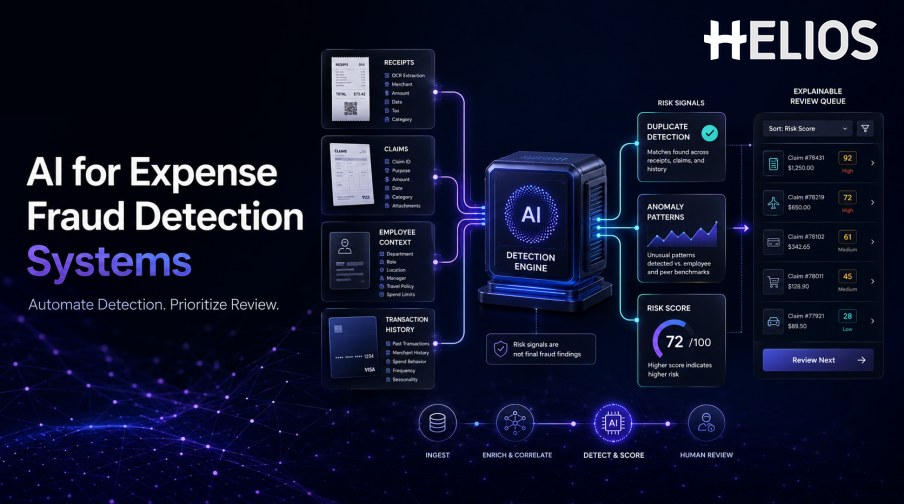
AI for expense fraud detection systems can screen larger volumes by combining receipt recognition, duplicate comparison, behavioral patterns, contextual baselines, and risk scoring. The system prioritizes records and explains the signals so a reviewer can inspect the evidence. It should not label an employee or transaction as fraudulent without appropriate investigation and decision authority.
This article explains how AI can automate expense fraud detection screening and how Spark AI expense auditing can support policy-aware review within the wider Helios workflow.
What Data Does an AI Expense Fraud Detection System Use?
Detection quality depends on connected, reliable, and appropriately governed data.
- Expense claims. Amounts, dates, merchants, categories, currencies, descriptions, attendees, projects, and organizational dimensions.
- Receipts and invoices. Images, extracted fields, document identifiers, line items, taxes, metadata, and correction history.
- Employee and role context. Entity, department, role, manager, location, travel status, policy group, and approval authority.
- Transaction history. Prior claims, reimbursements, card transactions, payment references, reversals, and corrections.
- Policy and workflow data. Limits, evidence rules, exceptions, pre-approvals, approvers, escalation paths, and policy versions.
- Merchant and category data. Normalized merchants, business type, restricted categories, preferred suppliers, and recurring patterns.
- Review outcomes. Confirmed errors, valid exceptions, policy violations, dismissed alerts, corrections, and investigation results.
How AI Automates Expense Fraud Detection
An automated screening pipeline typically includes these stages:
- Ingest and link data. Connect claims, documents, users, policies, approvals, card data, and historical records using stable identifiers.
- Extract and normalize fields. Use OCR and data processing to standardize merchants, dates, currencies, tax, amounts, and document references.
- Run duplicate detection. Compare images and structured fields across claims, reports, entities, currencies, and prior reimbursements.
- Identify anomaly patterns. Evaluate unusual amounts, timing, frequency, merchants, categories, split behavior, and changes from relevant baselines.
- Apply policy checks. Test explicit limits, evidence, approvals, dates, categories, coding, and exception requirements.
- Calculate a risk priority. Combine materiality, signal strength, confidence, severity, and multiple independent indicators.
- Explain and route the alert. Present the source evidence, reason, comparison, policy, and related records to an authorized reviewer.
- Capture the outcome. Record corrections, explanations, decisions, escalation, and whether the alert represented an error, exception, violation, or confirmed issue.
Duplicate Detection Methods
Duplicate reimbursement may appear identical or slightly changed.
- Exact field matching. Compare employee, merchant, date, amount, currency, invoice number, and payment reference.
- Normalized matching. Account for date formats, merchant spelling, tax inclusion, decimal separators, and currency representations.
- Near-duplicate comparison. Allow small changes in amount, date, crop, rotation, compression, filename, or report placement.
- Document similarity. Compare visual and textual receipt or invoice content rather than relying only on entered fields.
- Cross-entity and cross-channel checks. Search claims, card transactions, reimbursements, and entities when access and policy allow.
- Relationship review. Show both records, payment status, corrections, currency logic, and business context so the reviewer can confirm the match.
Anomaly Detection and Risk Scoring
Anomaly models can find less obvious patterns, but the comparison design determines whether a signal is meaningful.
- Relevant baselines. Compare an expense with appropriate employees, roles, destinations, categories, trips, merchants, and seasons.
- Multiple dimensions. Consider amount, frequency, timing, category, merchant, location, approver, document quality, and policy outcome together.
- Materiality. Increase priority when a possible error or violation could have greater financial or compliance impact.
- Signal independence. Several unrelated indicators may justify higher priority than repeated versions of the same signal.
- Explainable components. A reviewer should see which factors increased risk and the source records behind them.
- Threshold monitoring. Track alert precision, missed issues, overrides, queue volume, and performance drift after changes.
Human Review and Investigation Controls
AI can automate expense fraud detection screening, but it cannot replace evidence-based investigation.
- Neutral alert language. Describe duplicate potential, anomaly, policy mismatch, or evidence conflict instead of declaring fraud.
- Source-backed review. Provide the document, entered values, recognized values, comparison records, policy, and calculation.
- Authorized access. Restrict sensitive risk queues, notes, employee responses, and investigation results.
- Consistent procedures. Use defined steps for information requests, correction, escalation, investigation, legal review, and closure.
- Documented decisions. Record who decided, what evidence was considered, what changed, and how the outcome was classified.
- Feedback governance. Use verified outcomes to improve rules and models; do not train automatically on unreviewed labels.
Implementation and Evaluation Checklist
A pilot should test detection value, fairness, and operating fit.
- Define the risk taxonomy. Specify duplicates, fabricated documents, inflated amounts, personal spending, splitting, coding manipulation, and approval risks in scope.
- Prepare known and legitimate cases. Include confirmed issues, normal records, errors, emergencies, new suppliers, and valid unusual expenses.
- Measure by signal type. Track precision, missed cases, reviewer time, recoveries, overrides, and explanation quality separately.
- Test data boundaries. Validate entity, region, language, currency, retention, access, and permitted cross-record comparisons.
- Follow records end to end. Test document capture, policy, approval, review, accounting, reimbursement, errors, and reporting.
- Establish monitoring. Assign owners for drift, thresholds, rule and model changes, queue health, incidents, and periodic independent review.
How Helios and Spark AI Support Automated Expense Review
Helios combines OCR capture, Built-In Policy Compliance, Automated Policy Control, configurable approvals, accounting integration, and reporting. Spark AI states that it audits expenses against company policies and includes an Approval Copilot. This supports five parts of an AI-assisted risk-review workflow:
- Structure receipt and invoice evidence. OCR captures relevant document details for confirmation and downstream checks.
- Apply explicit policy controls. Configured spending requirements create a deterministic compliance layer.
- Assist risk and violation review. Spark AI highlights policy-related risks and helps reviewers examine claims.
- Preserve accountable routing. Flexible approvals keep decisions, escalations, and exceptions within defined roles.
- Connect review outcomes with finance. Accounting-entry generation and reporting support downstream traceability and analysis.
Helios also presents itself as an enterprise-grade provider with global experience and information-security credentials. Buyers should specifically validate duplicate comparison, anomaly models, risk scoring, explanations, investigation records, card data, cross-entity access, false-alert controls, integration, and monitoring if those capabilities are required.
FAQs About AI for Expense Fraud Detection Systems
Can AI automate expense fraud detection completely?
AI can automate data extraction, screening, duplicate comparison, anomaly signals, policy checks, prioritization, and explanations. Evidence-based investigation and accountable conclusions still require authorized human processes.
What is the difference between a duplicate and an anomaly?
A duplicate resembles another specific record or document. An anomaly differs from a relevant pattern or baseline and may not match any single prior expense.
How should a risk score be used?
Use it to prioritize review, with visible components and thresholds. It should not serve as the sole basis for alleging misconduct or taking a high-impact action.
What does Spark AI publicly describe?
Spark AI describes automated expense auditing against company policies, risk and violation identification, and an Approval Copilot that checks claims against policy. Buyers should validate any additional fraud-specific requirements.
Teams can test Helios and Spark AI expense review with representative claims, known duplicates, legitimate anomalies, policy exceptions, reviewer workflows, and measurable screening outcomes.