
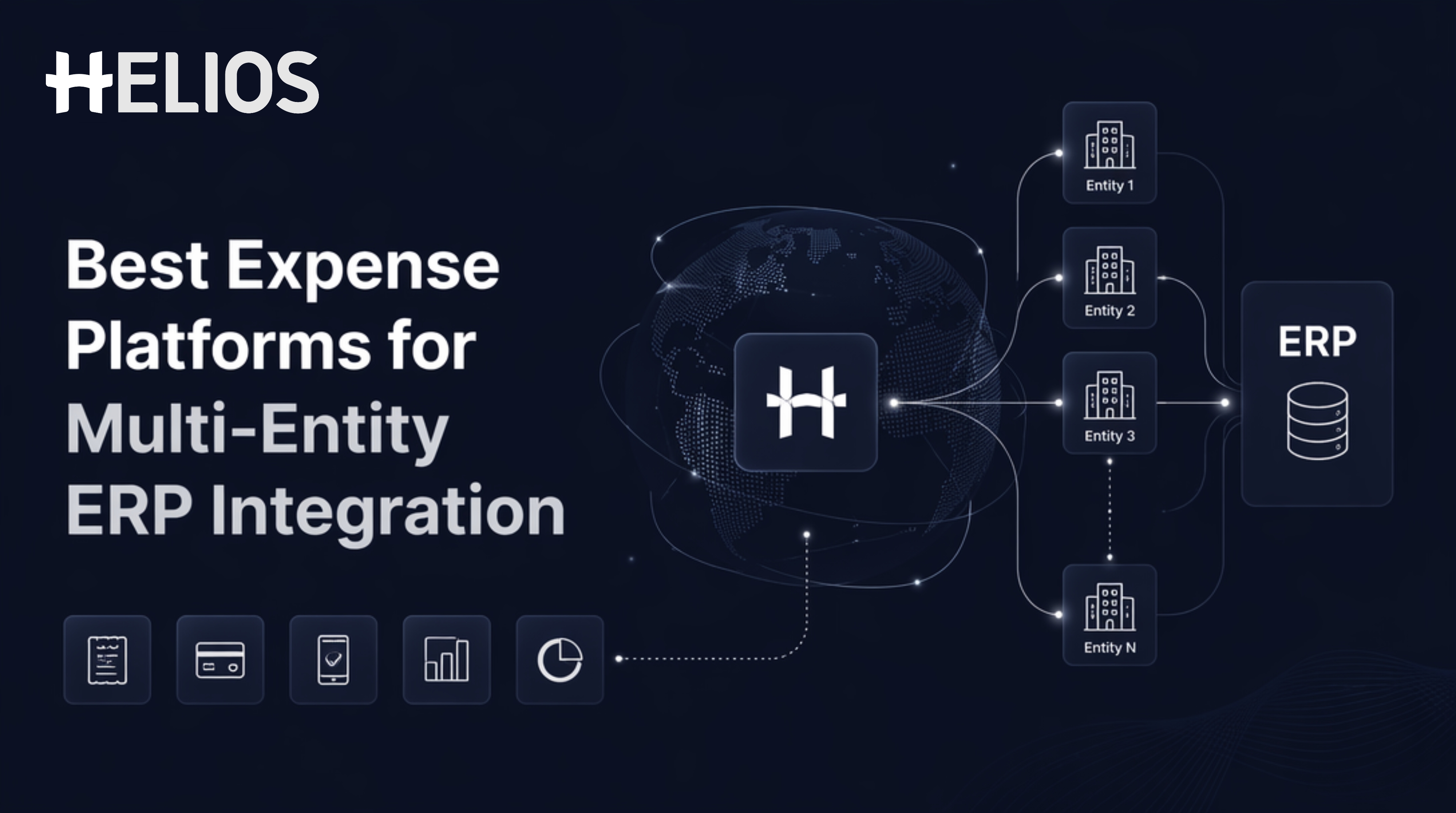
If you're managing expenses across multiple subsidiaries, you know the headache: inconsistent data, slow reimbursements, and manual reconciliation that eats up your finance team's time. When you're evaluating expense management platforms that integrate with NetSuite or other ERP systems for multi-entity companies, you need more than just basic tracking—you need a solution built for complexity.
This guide breaks down the top platforms, their integration capabilities, and what actually matters when you're managing expenses across borders, currencies, and subsidiaries. You'll also see how AI-native solutions like Helios are changing the game for global finance teams that need stronger control without adding administrative overhead.
Why Multi-entity Companies Need Specialized Expense Management Integration
Multi-entity companies face challenges that single-entity businesses don't even encounter. When you're managing expenses across subsidiaries in different countries, you're dealing with multi-currency transactions, varying tax rules, and inconsistent expense tagging that makes month-end close a nightmare.
According to NetSuite's guidance on multi-entity accounting, the core problems include maintaining a consolidated chart of accounts, handling intercompany transactions, and ensuring compliance with regional regulations like VAT or GST. You might have employees in Germany submitting expenses in euros while your US subsidiary uses dollars, and your finance team manually converting everything in spreadsheets.(\[1\])
The consequences are real: slower reimbursement cycles, inaccurate financial records, and finance teams buried in manual review work. One study found that companies without proper multi-entity expense management spend 40% more time on month-end close than those with integrated systems.
When you're choosing a platform, you need to ensure it handles multi-currency support, intercompany transaction management, and standardized reporting across all entities—not just basic expense submission.
Key Features to Look For in ERP-Integrated Expense Management
Before you evaluate specific platforms, you need to know what capabilities actually matter for your multi-entity operation. Here's what to prioritize.
- Native ERP Integration Capabilities
Your expense management platform needs to sync with your ERP in real-time, not just batch-import data once a day. For NetSuite specifically, you want native support for the platform's classification structure—departments, classes, and locations—so expenses automatically route to the right GL accounts.
Look for features like:
· Real-time vs. batch sync capabilities
· Automated subsidiary assignment rules
· Employee data synchronization
· Corporate card reconciliation that matches to your ERP's vendor bills(\[2\])
- Multi-currency & Global Compliance Features
This is where most platforms fall short for multi-entity companies. You need real-time or daily exchange rates, dual visibility (original currency plus converted amounts), and support for country-specific tax rules.
Critical capabilities include:
· FX conversion logic you can verify and audit
· VAT/GST support and tax reclaim workflows
· Country-specific rules and regional compliance coverage
· Automated currency conversion without manual spreadsheets
- Automation & AI Capabilities
Manual expense review is expensive. AI-native platforms can automatically categorize expenses, enforce policy compliance, and flag anomalies before they become problems.
- Reporting & Visibility
You need unified data across all entities, not separate reports for each subsidiary. Look for cross-entity consolidation reports, audit-ready documentation, and real-time budget balance tracking.
Top Expense Management Platforms Integrating with NetSuite & ERP Systems
Here's a comprehensive comparison of leading expense management platforms with proven ERP integration capabilities for multi-entity companies.
Helios (AI-Native for Global Multi-entity Teams)
Integration Type: AI-driven ERP integration built on Spark AI
Multi-entity Support: Purpose-built for global organizations with multi-region operations
Key Features:
· Quick expense submission with mobile app
· Budget balance tracking in real-time
· Contract overview monitoring
· Employee reimbursement and supplier payment management
· Invoice management with automated extraction
· International travel expense handling
· Unified data overview and reporting across all entities
What makes it different: Helios is built on Spark AI from the ground up—not retrofitted with AI features later. This means the platform was designed specifically for finance teams managing complex, multi-region operations. The 100% digital expense category control directly addresses inconsistent tagging across regions, a common problem for multi-entity companies.
Proven results: Companies using Helios report 75% faster employee reimbursement cycles, 60% more efficient accounting and payment operations, and a 65% reduction in manual finance review time.
Best for: Finance teams that manage complex, multi-region operations and need stronger control over expenses without adding administrative overhead.
SAP Concur (Enterprise Legacy Leader)
Integration Type: Native connector (updated 2025) plus middleware options
Multi-entity Support: Yes, with flexible data mapping for multiple subsidiaries
Key Features:
· Expense reports convert to vendor bills automatically
· Employee data syncs with your ERP
· Corporate card reconciliation built-in(\[2\])
Best for: Large enterprises with dedicated IT resources who need comprehensive features and can handle complex setup
Considerations: Often requires middleware for full functionality, which adds complexity and cost
Expensify (Mid-Market Automation)
Integration Type: Native NetSuite integration with token-based authentication
Multi-entity Support: Limited—one policy per subsidiary required, which means workarounds for true multi-entity management
Key Features:
· Automated receipt scanning with high accuracy
· Expense export to NetSuite with custom fields
· Quick setup, typically 1-2 weeks
Best for: Mid-market companies or single-subsidiary businesses that want strong automation without complex implementation
Considerations: Cannot connect one policy to multiple subsidiaries, so you'll manage multiple policies if you have several entities
Ramp (Modern Finance Platform)
Integration Type: Built-for-NetSuite real-time sync
Multi-entity Support: Full multi-entity environment management with unified dashboard
Key Features:
· Corporate cards with instant virtual card issuance
· Reimbursements, bill payments, and purchase orders in one platform
· Real-time sync with NetSuite without middleware
· Cashback rewards on spending
Best for: Companies wanting a unified card + expense + ERP solution with modern UX
Pleo (Smart Cards + Expenses)
Integration Type: Native NetSuite integration
Multi-entity Support: Yes, with automatic transaction import per subsidiary
Key Features:
· Smart cards with real-time spending controls
· Automatic transaction import from card swipes
· Digital receipt capture and storage
Best for: Companies prioritizing card-based spend control with simple setup
Platform Comparison Table: Quick Decision Guide
| Platform | NetSuite Integration | Multi-entity Support | Multi-currency | AI Automation | Best For |
|---|---|---|---|---|---|
| Helios | ✓ (AI-driven) | ✓ | ✓✓ | ✓✓ (Spark AI) | Global multi-entity |
| SAP Concur | ✓ (middleware) | ✓ | ✓ | Limited | Large enterprises |
| Expensify | ✓ (native) | ⚠️ (1 policy/entity) | ✓ | Moderate | Mid-market |
| Ramp | ✓ (real-time) | ✓ | ✓ | Moderate | Unified card+expense |
| Pleo | ✓ (native) | ✓ | ✓ | Limited | Card-focused |
*✓✓ = Best-in-class for this feature*
Use this table as a starting point, but remember that your specific use case matters more than general features. A platform that works great for a US-only company with three subsidiaries might not handle your needs if you're managing 15 entities across 8 countries.
How to Evaluate ERP Integration for Your Multi-entity Company
Don't just trust vendor marketing claims—test integration capabilities with your actual use case.
Step 1: Map Your Data Flows
Define exactly what data needs to move between systems. For most multi-entity companies, this includes expense reports converting to vendor bills, employee data syncing, and corporate card reconciliation.
Step 2: Assess Current Workflows
Document your approval hierarchies, expense policies, and GL coding rules. Map how expenses should be classified across different subsidiaries.
Step 3: Verify Integration Capabilities
Test multi-currency transactions with real amounts. Verify subsidiary assignment logic handles edge cases. Simulate error conditions to see how the system recovers. Most importantly, confirm FX conversion logic, VAT/GST support, and tax reclaim workflows before committing.
Step 4: Request a Demo with Your Use Case
Bring real multi-entity scenarios to the demo. Ask about regional compliance coverage for your specific countries. Request an ROI calculation based on your actual expense volume.
Measurable ROI: What Results Can You Expect?
When you implement the right expense management platform for your multi-entity company, the results are measurable and significant.
Helios-specific metrics show:
· 75% faster employee reimbursement cycles
· 60% more efficient accounting and payment operations
· 65% reduction in manual finance review time
· 100% digital expense category control reducing inconsistent tagging
Industry benchmarks for well-integrated expense management include:
· Reduced month-end close time by 2-3 days
· Decreased manual data entry by 60-80%
· Improved compliance rates to 95%+
· Better visibility into cross-entity spending patterns
The key is choosing a platform that's built for your complexity, not one you'll have to work around.
FAQs: Expense Management & ERP Integration for Multi-entity Companies
What is the best expense management software for NetSuite multi-entity companies?
The best option depends on your needs. For large enterprises with dedicated IT teams, SAP Concur offers comprehensive features. For mid-market companies wanting native integration, Expensify works well. For global multi-entity teams needing AI automation and true multi-region support, Helios provides purpose-built capabilities with 75% faster reimbursement and 65% less manual review.
Can one expense management platform handle multiple subsidiaries?
Yes, but capabilities vary significantly. SAP Concur, Ramp, Pleo, and Helios support true multi-entity environments. Expensify requires separate policies per subsidiary, which adds management complexity.
How does multi-currency expense management work with ERP integration?
Modern platforms convert expenses using real-time or daily exchange rates, preserve original currency details for audit purposes, and sync converted values to your ERP without creating duplicate entries.
What should I ask vendors about tax compliance for international expenses?
Confirm FX conversion logic, VAT/GST support, tax reclaim workflows, country-specific rules, and regional compliance coverage before making a decision.
How long does ERP integration typically take?
Native integrations like Expensify, Pleo, and Ramp typically take 1-2 weeks. Complex setups like SAP Concur with middleware may require 4-8 weeks depending on customization needs.
Conclusion
For finance teams managing complex multi-region operations, the right expense management platform transforms how you work. Helios delivers AI-native expense management built specifically for global enterprises, with 75% faster reimbursement, 60% more efficient accounting, and 100% digital category control that standardizes workflows without adding administrative overhead.
When you're evaluating expense management platforms that integrate with NetSuite or other ERP systems for multi-entity companies, prioritize solutions that handle your complexity from day one—not ones you'll outgrow in six months. Request a demo from Helios to see how Spark AI transforms multi-entity expense management for your organization.