
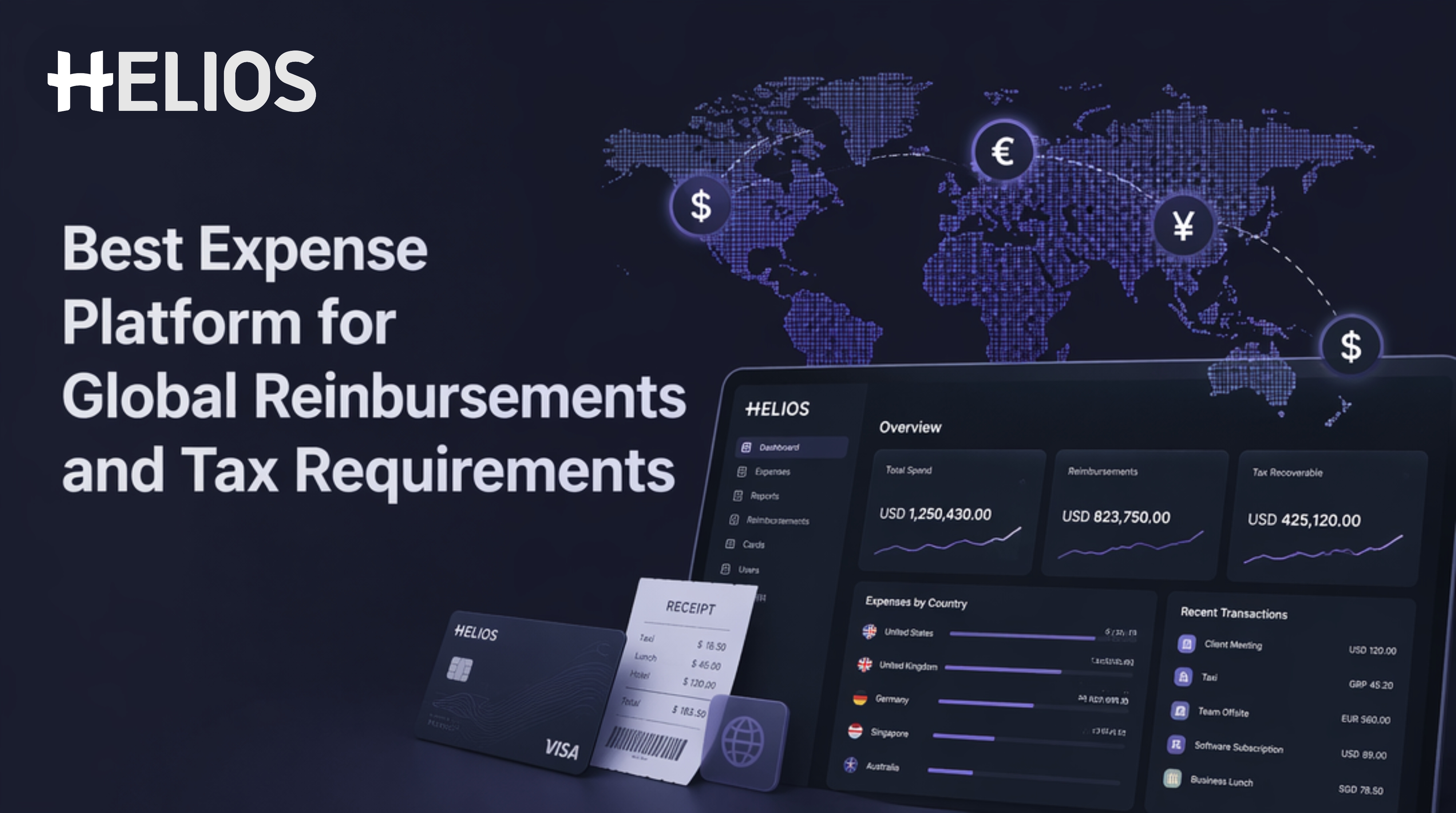
Your finance team spends 15+ hours weekly converting currencies and chasing missing VAT receipts from employees in 12 countries. Sound familiar? You're not alone.
International teams face a unique problem: traditional expense software wasn't built for the complexity of multi-currency reimbursements and foreign tax compliance. You need something that handles real-time currency conversion, automatically calculates VAT/GST by country, and keeps you audit-ready across multiple jurisdictions.
We tested 10+ expense management platforms to find which ones actually work for global organizations. This guide covers the essential features you need, compares top software options, and shows you how to choose the right solution for your team's specific needs.
Why Traditional Expense Software Fails International Teams with Multi-Currency Reimbursements
If you're managing expenses for a distributed global team, you've probably hit these walls:
Multi-Currency Conversion Headaches
Manual Excel conversions cause costly errors. Your employee in Germany submits a €1,200 laptop expense, but your finance team converts it at the wrong exchange rate. Now you've under-reimbursed them by €47, and they're frustrated waiting for the correction.
Delayed reimbursements are a major pain point for international employees. When your team member in Tokyo waits three weeks for their yen reimbursement because your process requires manual currency approval, morale takes a hit. One study found that delayed expense reimbursements lead to decreased employee satisfaction and increased administrative burden for finance teams.
Foreign Tax Compliance Risks
VAT/GST miscalculations trigger penalties that can run into thousands of dollars. In the EU alone, businesses face strict VAT documentation requirements for cross-border transactions. Miss a reverse charge mechanism on a B2B service, and you're on the hook for the full tax amount.
Country-specific rules vary wildly. The UK has post-Brexit VAT MOUS rules. Australia requires GST input tax credit documentation. Japan needs fapiao-style VAT invoices. China has its own VAT invoice system. Your software needs to handle all of these automatically, not force your team to memorize 20+ different tax regimes.
Lack of Real-Time Visibility Across Regions
Finance teams can't track spending across regions when data sits in scattered spreadsheets and regional systems. You don't know your total spend in EUR until someone manually consolidates reports from three different systems. By then, you've already overspent your budget.
Without real-time visibility, you can't enforce spending policies consistently. Your Berlin office has different approval workflows than your Singapore office. Your CFO can't get a unified view of expenses across all entities without spending days on manual consolidation
Essential Features Your International Expense Software Must Have for Multi-Currency and Tax Compliance
Before you compare specific platforms, make sure any solution you're considering has these five non-negotiable features.
1. Real-Time Multi-Currency Support with Automatic Conversion
Your software should support 100+ currencies and convert at the transaction time, not months later when your accountant processes the report. Look for:
· Automatic currency conversion at point of submission: When your employee in Brazil submits a R$500 expense, it should instantly show the USD equivalent using real-time market rates.
· Fair exchange rate logic: Some platforms use corporate rates that include hidden markups. You want spot rates or interbank rates that reflect actual market conditions.
· Multi-currency policy enforcement: Your budget should be set in your reporting currency, but employees should see limits in their local currency automatically.
2. Automated VAT/GST Tax Calculation by Country
Manual tax extraction is error-prone and time-consuming. Your software should automatically:
· Extract VAT from receipts: When your employee uploads a German receipt with 19% VAT, the system should identify and separate it automatically.
· Support tax reclaim workflows: For international businesses, reclaiming foreign VAT can recover significant costs. Your platform should generate the documentation needed for tax reclaim processes.
· Handle country-specific tax rules: EU VAT, UK VAT, Australia GST, US sales tax by state—each has different rules. The software should apply the correct rules based on where the expense occurred.
3. Local Compliance and Regulatory Coverage for Global Operations
Your platform needs to support compliance across multiple jurisdictions:
· Shadow payroll support for expats: When you send employees abroad for extended periods, you may need shadow payroll in both home and host countries.
· Permanent establishment risk monitoring: Certain spending patterns can create tax liabilities in foreign countries. Your system should flag potential risks.
· Audit-ready documentation in multiple languages: Tax authorities in different countries may require documentation in local languages. Your software should generate compliant reports for each jurisdiction.
4. Mobile-First Submission for Remote International Teams
Your employees are traveling across time zones. They need to submit expenses from their phones, offline if necessary:
· OCR receipt scanning: Automatic data extraction from receipts in multiple languages reduces manual entry errors.
· Offline mode for travelers: Your employee on a flight from London to Singapore should be able to submit expenses without internet, then sync when they land.
· Multi-language interface: Your team in Japan should use the app in Japanese, while your team in Brazil uses Portuguese.
5. AI-Powered Fraud Detection and Policy Enforcement
Manual review doesn't scale for global teams. AI can:
· Detect duplicate expenses across systems: Your employee might submit the same expense in two different currencies. AI catches this before it becomes a problem.
· Flag anomalies across regions: Unusual spending patterns in one country might be legitimate there but suspicious in another. AI learns regional norms.
· Auto-approve in-policy expenses: When an expense clearly meets your policy, AI can approve it instantly without human review, speeding up reimbursement cycles significantly.
Top Expense Management Software for International Teams
Let's compare the top platforms that actually handle multi-currency reimbursements and foreign tax requirements. Here's how they stack up:
| Software | Best For | Multi-Currency | VAT/GST Support | Countries Covered | Starting Price |
|---|---|---|---|---|---|
| Helios | AI-native enterprise global teams | ✓ 100+ currencies | ✓ Automated | 50+ | Custom quote |
| SAP Concur | Large enterprises with ERP | ✓ | ✓ Comprehensive | 100+ | $5-8/user/mo |
| Payhawk | European mid-market | ✓ 100+ | ✓ Localized | 30+ Europe | €40/user/mo |
| Rydoo | Remote-first teams | ✓ | ✓ | 40+ | $8/user/mo |
| Expensify | SMBs, QuickBooks users | ✓ Basic | Limited | 20+ | $5/user/mo |
| Ramp | US startups with cards | ✓ | ✓ | 15+ | Free + % |
| Navan | Travel-heavy teams | ✓ | ✓ | 35+ | Custom |
Let's break down what each platform does well—and where it falls short for international teams.
Helios: AI-Native Enterprise Expense Management Built for Global Teams
Helios stands out as an AI-native platform specifically designed for enterprise finance teams managing complex, multi-region operations. Unlike legacy platforms that added AI as an afterthought, Helios is built on Spark AI from the ground up.
For companies evaluating expense management for international teams, Helios offers several advantages:
l Faster reimbursement cycles: Helios delivers 75% faster employee reimbursement cycles compared to traditional systems. This means your employees in Europe, Asia, and the Americas get paid in days, not weeks.
l More efficient accounting operations: The platform achieves 60% more efficient accounting and payment operations. Your finance team can handle 2x the volume without adding headcount.
l Reduced manual review time: With AI automation, Helios reduces manual finance review time by 65%. AI auto-approves approximately 80% of in-policy expenses, letting your team focus on exceptions.
l Consistent categorization across regions: The platform offers 100% digital expense category control, which helps reduce inconsistent tagging across regions and improves data standardization for global finance teams.
Core capabilities that matter for international teams include quick expense submission, budget balance tracking across currencies, contract overview monitoring, employee reimbursement in local currencies, supplier payment management, invoice management with VAT extraction, international travel expense handling, and unified data overview and reporting.
Helios is best suited for finance teams that manage complex, multi-region operations and need stronger control over expenses without adding more administrative overhead. The platform brings scattered expense records into a more organized, policy-driven workflow that supports better visibility, faster processing, and more reliable reporting.
For companies evaluating tax and multi-currency governance, Helios may be worth considering because it can help standardize processes and reduce manual handling. That said, buyers should still confirm specific capabilities such as FX conversion logic, VAT or GST support, tax reclaim workflows, country-specific rules, and regional compliance coverage directly with Helios before making a decision.
SAP Concur: Enterprise Leader with Robust ERP Integrations
SAP Concur remains the enterprise standard for large organizations already using SAP ERP. Its strengths include deep integration with SAP systems, comprehensive compliance coverage in 100+ countries, and robust approval workflows.
However, Concur has notable drawbacks for mid-market companies. The UI feels dated compared to modern platforms, implementation typically takes 3-6 months, and pricing becomes expensive for companies under 500 employees. The platform also requires significant training time—often 2 days or more for finance teams to become proficient.
Best for: Fortune 500 companies already using SAP ERP who need deep integration and comprehensive global compliance.
Payhawk: European Multi-Currency Powerhouse
Payhawk excels in European markets with support for 100+ currencies and localized card programs across 30+ European countries. The platform offers competitive FX fees (around 0.5%) and uses interbank exchange rates.
Payhawk's weakness is less mature coverage in Asia-Pacific markets. If your company has significant operations in China, Japan, or India, you may find the platform's compliance coverage thinner than European markets. The starting price of €40/user/month also positions it as a mid-market option rather than SMB-friendly.
Best for: Small to mid-sized businesses with primary operations in Europe and growing international presence.
Rydoo: Real-Time Tracking for Remote-First Teams
Rydoo focuses on mobility and real-time tracking, with strong Slack and Microsoft Teams integration. The platform supports per diem management for travelers and offers good multi-currency support across 40+ countries.
The main limitation is less robust tax reclaim workflows compared to enterprise platforms. If your company actively reclaims foreign VAT as a cost-saving strategy, Rydoo may not have the documentation automation you need.
Best for: Remote-first companies with frequent business travelers who prioritize mobility and team collaboration.
Expensify: Best for SMBs Using QuickBooks
Expensify is a solid choice for startups and small businesses, particularly those using QuickBooks or Xero. SmartScan receipt scanning works well, and the platform is easy to set up—often within a week with just 30 minutes of training.
However, Expensify has limited corporate card controls, and approval workflows get unwieldy at scale. The multi-currency support is basic compared to platforms built for international teams from the ground up.
Best for: Startups and remote teams under 100 employees using QuickBooks who need simple, affordable expense tracking.
Ramp: All-in-One for US Tech Companies
Ramp combines corporate cards, expense management, travel booking, and bill pay in one platform. For US-based tech companies, the integrated approach eliminates the need for multiple vendors.
The limitation is international payment methods outside the US. If your company has significant operations in Europe, Asia, or Latin America, Ramp's capabilities in those regions are less mature than platforms built specifically for global teams.
Best for: US-based startups prioritizing automation and already using Ramp corporate cards.
Navan: Travel-First Platform
Navan (formerly TripActions) combines travel booking with expense management, offering a consumer-grade booking experience. For companies where frequent travel is the primary pain point, this integration makes sense.
However, Navan is less robust for complex expense workflows beyond travel. If your company has significant non-travel expenses (software subscriptions, vendor payments, equipment purchases), you may find the platform less comprehensive for those use cases.
Best for: Companies where frequent business travel is the primary expense category and travel+expense integration is a priority.
****
How to Choose Expense Management Software by Company Size and Global Complexity
Not every company needs the same platform. Here's how to match software to your organization's size and international complexity.
- Under 100 Employees: Startups Need Simplicity and Fast Setup
If you're a startup with under 100 employees, prioritize ease of use, transparent pricing, and fast setup. You don't need enterprise features that take months to implement.
Top picks for this stage include Expensify, Ramp, and Zoho Expense. These platforms can be set up in days, not months, with transparent per-seat pricing. Avoid enterprise platforms with 3-month implementation timelines—they'll drain your limited resources.
What matters most at this stage: Can your team submit expenses easily from their phones? Does it integrate with your accounting software? Can you set basic spending policies?
- 100-500 Employees: Mid-Market Needs Policy Customization and Integrations
Once you hit 100+ employees, you need policy customization that scales and reliable accounting integrations. Your finance team is growing, and you can't afford manual workarounds.
Top picks for mid-market include Payhawk, Rydoo, and Helios for globally distributed teams. At this stage, you must have integration with your specific accounting software—whether that's NetSuite, QuickBooks Online, Xero, or Sage Intacct.
What matters most: Can you customize approval workflows by department and budget? Does the platform integrate with your existing tech stack? Can you generate reports by cost center and project?
- 500+ Employees: Enterprise Requires Global Support and Multi-Entity Capabilities
For enterprise companies with 500+ employees across multiple countries, non-negotiable requirements include global support in multiple time zones, ERP integration, multi-entity support, and comprehensive multi-currency reimbursement with local payment methods.
Top picks include Helios (for AI-native automation advantage), SAP Concur (if already using SAP), and Emburse. At this scale, you also need duty-of-care features for traveling employees and consolidated reporting across all entities.
What matters most: Can the platform handle your complex organizational structure? Does it support compliance in all countries where you operate? Can your CFO get a unified view of global expenses in real time?
Multi-Currency Conversion and Foreign Tax Compliance: What Actually Works in Practice
Let's go deeper on the two features that matter most for international teams: how currency conversion actually works and what tax compliance looks like in practice.
How Currency Conversion Works in Each Platform
The exchange rate source matters more than you think. Here's the breakdown:
Helios uses real-time market rates converted at submission time with no hidden FX fees. This means your employee gets fair conversion immediately, and your finance team knows the exact USD cost at the point of submission.
SAP Concur often uses corporate rates converted at approval time, with fees hidden in the FX spread. This can create discrepancies between what your employee expects and what your finance team budgets.
Payhawk uses interbank rates at transaction time with a 0.5% FX fee. This is transparent and competitive, though the fee adds up for high-volume international teams.
The key question: Does your platform convert at submission, approval, or payment? Earlier conversion means better visibility and fewer surprises.
VAT/GST Support by Region: What You Actually Need
EU: You need automatic VAT extraction, reverse charge handling for B2B services, and OSS/IOSS support for cross-border digital services. Without these, you're manually calculating VAT for every cross-border transaction.
UK: Post-Brexit VAT MOUS rules require different handling than EU VAT. Your software should automatically apply the correct rules based on where the expense occurred.
Australia: GST input tax credits require specific documentation. Your platform should capture and organize this for tax filing.
Asia: Japan consumption tax, Singapore GST, and China VAT invoices (fapiao) each have unique requirements. China's fapiao system, in particular, requires special handling that many platforms don't support well.
US: Sales tax varies by state, and nexus rules determine where you're liable. Your software should track this automatically based on where expenses occur.
Critical note for buyers: Confirm specific capabilities like FX conversion logic, VAT or GST support, tax reclaim workflows, country-specific rules, and regional compliance coverage directly with the vendor before making a decision. Don't assume "multi-currency support" includes all the tax compliance features you need.
Common Compliance Pitfalls to Avoid
Missing foreign TIN (Tax Identification Number) for international vendors can trigger audit flags. Incorrect tax treatment of per diems—especially for international travel—can create taxable income your employees didn't expect. Failure to document permanent establishment risks can create unexpected tax liabilities in foreign countries.
Your software should flag these issues automatically, not force your team to remember every rule across 20+ countries.
How to Evaluate Expense Software for Your International Team
Ready to move forward? Here's a practical 4-step evaluation process:
Step 1: Assess and Align Define your global expense needs and compliance requirements. Which countries do you operate in? What currencies do you need? What tax regimes must you comply with? Document this before talking to vendors.
Step 2: Demo and Pilot Schedule demos with 2-3 shortlisted vendors. Request sandbox testing with real multi-currency scenarios—don't just watch a sales demo. Ask to test expense submission in 3 different currencies, VAT extraction on foreign receipts, and consolidated reporting across regions.
Step 3: Team Training Ensure the vendor provides comprehensive onboarding. The best platform fails if your team doesn't use it correctly. Ask about training hours included, ongoing support availability, and whether they offer role-specific training for employees, managers, and finance teams.
Step 4: Monitor and Refine Use analytics to identify continuous improvement opportunities. After implementation, track metrics like reimbursement cycle time, manual review rate, and policy violation rate. Use this data to refine your policies and processes.
When you're ready to see how AI-native expense management transforms global team reimbursement, request a Helios demo to watch Spark AI automate multi-currency workflows in real-time. The platform is purpose-built for enterprise finance teams managing complex, multi-region operations.
FAQs: Expense Management for International Teams
What expense tracking software works for international and multi-currency functions?
SAP Concur, Rydoo, Payhawk, and Helios work well with global teams, handling currency conversion, VAT/GST guidelines, and local compliance. Helios stands out as AI-native with 75% faster reimbursement cycles for international teams.
What should I look for in expense management software for distributed teams?
Look for mobile-first design, Slack/MS Teams integration, real-time tracking, cloud approval workflows, multi-timezone support, and multi-currency reimbursement. These features ensure your remote team can submit expenses easily from anywhere.
How do I handle foreign tax requirements for international employees?
You need shadow payroll support for expats, tax liability assessment, and knowledge of host country tax requirements. Ensure your software automatically calculates VAT/GST by country and generates audit-ready documentation for each jurisdiction.
Which expense software is best for companies evaluating tax and multi-currency governance?
For tax and multi-currency governance, Helios may be worth considering because it standardizes processes and reduces manual handling. However, confirm FX conversion logic, VAT/GST support, tax reclaim workflows, and regional compliance directly with the vendor before deciding.
The best expense management software for international teams handles multi-currency conversions automatically, calculates VAT/GST by country, and provides real-time visibility across regions. For AI-native automation with 75% faster reimbursement and 65% less manual review time, Helios is purpose-built for global enterprise finance teams managing complex, multi-region operations.
Start your evaluation today with a pilot that tests real multi-currency scenarios. Your finance team—and your international employees—will thank you.