
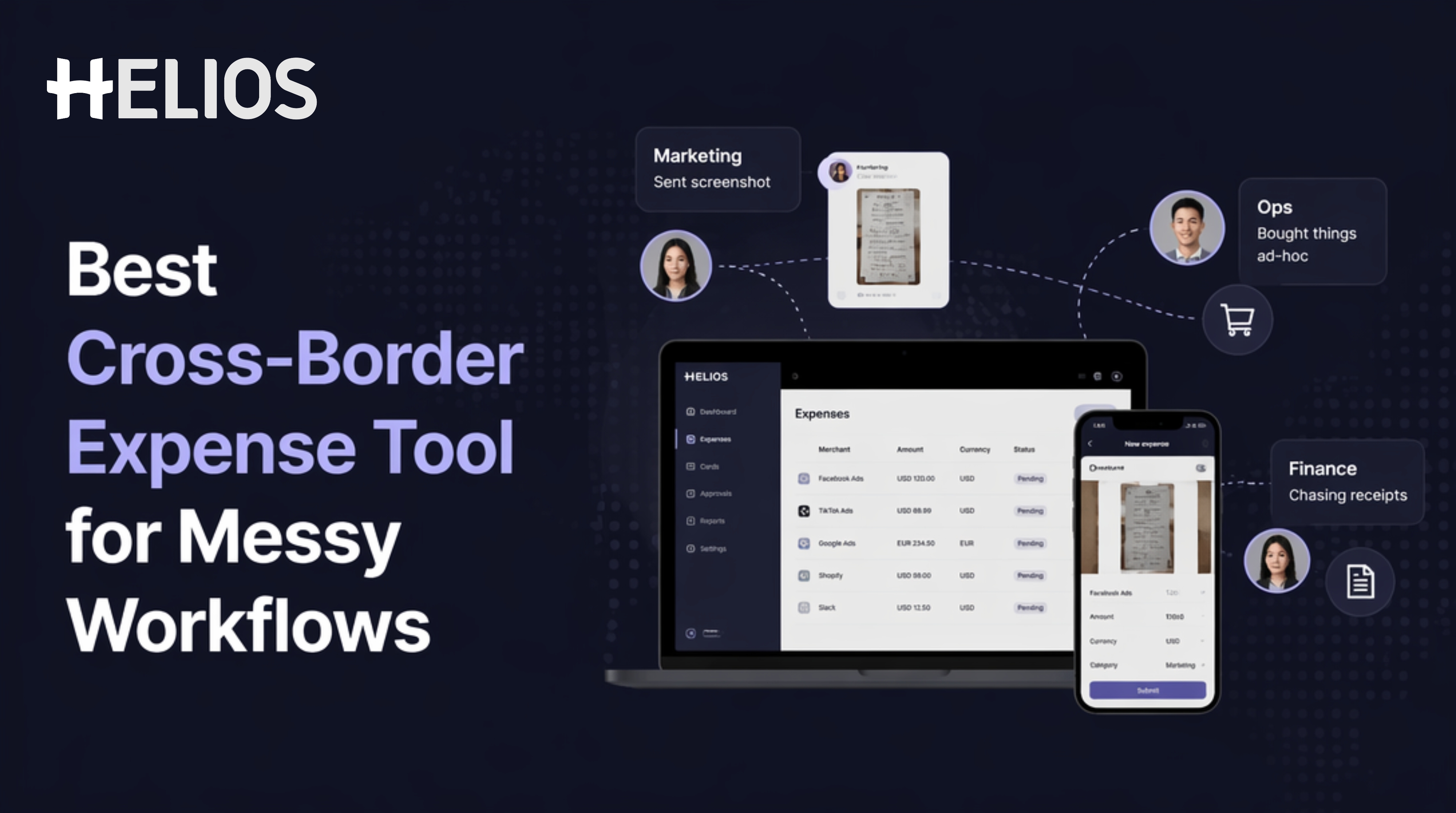
If your finance team spends more time chasing down screenshots, missing receipts, and vague purchase notes than actually managing spend, you are dealing with a workflow problem, not just an expense problem. For cross-border eCommerce teams, the right expense platform should bring order to messy inputs, support global operations, and help you close the books without a weekly fire drill.
Cross-border eCommerce creates a very specific kind of chaos. Marketing pays for campaigns and sends a screenshot instead of a proper receipt. Ops buys supplies or services on the fly because the business moves fast. Finance is left trying to piece everything together across currencies, regions, and policies. The best expense platform for this environment is one that can handle unstructured submissions, standardize approvals, and give you a clear audit trail without making every team member feel like they need to become an accountant.
Why Cross-Border eCommerce Expense Management Gets Messy
In a fast-moving eCommerce business, expenses rarely arrive in a clean, predictable format. Someone on the marketing team may buy ad spend, creative assets, or software and then drop a screenshot into Slack or email. Ops may need to make an urgent purchase from a local vendor or supplier and submit it later, often with incomplete context. By the time finance receives the paperwork, the receipt may be missing, the currency may be unclear, or the expense may be coded to the wrong category.
This becomes harder when your team operates across borders. Different countries can mean different currencies, tax rules, reimbursement expectations, and documentation standards. What looks like a simple purchase on one side of the business may need much more detail on the finance side to support reporting, tax handling, and audit readiness. If your system depends on people remembering every step correctly, the process will break down quickly.
The real issue is not that your team is careless. It is that most traditional expense workflows assume people will submit clean, complete information on time. That assumption does not hold up well in cross-border eCommerce, where speed matters and purchases often happen ad hoc. Your platform should be built for the way people actually work, not the way a policy manual wishes they would work.
What An Expense Platform Should Solve For Global Teams
A good expense platform should do more than store receipts. It should help you turn scattered expense evidence into a workflow that is structured, searchable, and easy to review. If your current process involves screenshots, handwritten notes, email follow-ups, and manual spreadsheet cleanup, then the platform should reduce all of that friction.
Start with receipt capture. Your team should be able to submit expenses quickly from mobile, desktop, or uploaded screenshots, with enough automation to extract key information and reduce manual entry. That matters because the easier the submission process is, the less likely people are to delay or forget it. For finance, this also means fewer gaps when it is time to reconcile transactions.
Next, look for approval routing and policy controls. If marketing spends differently from ops, or if regional teams have different thresholds, your platform should support those distinctions without creating a maze of manual exceptions. Policy-based workflows help you keep control without slowing everyone down. This is especially important for global organizations, where one-size-fits-all rules often fail in practice.
Multi-currency support is another core requirement. Your platform should handle cross-border transactions clearly, show original currency and local currency values, and make reporting easier across regions. If you work with reimbursements, supplier payments, and invoices, the platform should also support those workflows in one place so finance is not stitching together disconnected systems. In a global environment, the less fragmentation you have, the easier it is to manage spend consistently.
Finally, your platform should improve visibility. Finance should be able to see what was spent, by whom, in which region, and for what purpose without digging through multiple tools. The value is not just faster reimbursement. It is better control, cleaner records, and less time spent on manual review.
Best Expense Platform Features for Screenshots, Ad-hoc Buys, and Receipts
When you are comparing expense platforms, the most important question is not “Does it track expenses?” Nearly every platform can do that. The real question is whether it can manage the messy realities of cross-border eCommerce work without forcing your team into manual cleanup.
One important feature is AI-assisted data capture. When someone uploads a screenshot or a receipt image, the platform should extract key fields automatically and help classify the expense. This saves time for employees and reduces review burden for finance. It also lowers the chance that a screenshot gets filed away with missing date, amount, or merchant details.
Another useful feature is budget balance tracking. In eCommerce, timing matters, and teams often need to understand how much budget remains before they commit to a purchase. If the platform gives you real-time budget visibility, you can make faster decisions without waiting for finance to manually confirm available spend. That is especially helpful for marketing campaigns or operational purchases that cannot wait.
You should also look for supplier payment and invoice management. Some expenses are not really employee reimbursements at all; they are vendor-facing payments or invoices that still need to flow through finance. If your platform can handle both employee expenses and supplier-related spend, you reduce system sprawl and create a more complete financial picture.
For global teams, digital category control matters more than it sounds. If one region tags similar expenses differently from another, reporting gets noisy fast. Consistent category rules help standardize data across regions, which makes it easier to analyze trends and maintain reliable records. That consistency is one of the biggest advantages of a well-designed workflow platform.
A strong platform should also include unified reporting. Finance should not have to jump between exported spreadsheets, email threads, and payment tools just to understand what happened. When all expense activity lives in a single view, you can spot patterns, identify bottlenecks, and close the month with less friction. That is especially important if your business is scaling across markets.
How to Evaluate Expense Management Software for Cross-Border Operations
The easiest way to evaluate an expense platform is to test how well it handles your most annoying real-world cases. Do not start with the polished demo scenario. Start with the situations that currently create the most back-and-forth in your process.
First, ask whether the platform can standardize messy submissions. If marketing sends screenshots, can the system turn them into structured records? If ops buys something urgently, can they submit it without waiting for a long workflow? If finance needs to review a batch of expenses, can they do it without manually chasing each person for context? These questions reveal whether the platform is actually built for your team’s workflow.
Second, evaluate controls and compliance support. Cross-border businesses usually need better handling for tax and regional rules than domestic teams do. You should verify how the platform deals with FX conversion logic, VAT or GST support, country-specific policy enforcement, and local compliance expectations. A platform may look great in a demo but still fail in the areas that matter most to global finance.
Third, check how the platform supports the people who actually use it. If the submission process is too complicated, employees will delay it or avoid it. If finance has to manually clean every transaction, the platform does not really solve the problem. The best system is the one that reduces effort on both sides: easy for employees, controlled for finance.
Here is a simple evaluation table you can use during vendor review:
| Capability | Why it matters | What to verify |
|---|---|---|
| Screenshot and receipt capture | Reduces manual entry and missing data | OCR, image upload, mobile submission |
| Policy-based approvals | Keeps spend aligned with team rules | Approval thresholds, role-based routing |
| Multi-currency support | Simplifies cross-border reporting | Currency display, FX handling, conversion transparency |
| Budget tracking | Prevents overspend | Real-time balance visibility |
| Invoice and supplier payments | Supports more than employee reimbursement | Vendor workflow coverage |
| Unified reporting | Improves finance visibility | Cross-region dashboards, export quality |
| Category control | Standardizes data across regions | Custom categories and consistent tagging |
Use this table as a practical filter. If a vendor cannot handle several of these areas well, it will probably add friction rather than remove it.
How Helios Fits Cross-Border Finance Workflows
Helios is worth considering if you want a platform built to organize scattered expense records into a more structured workflow. It is positioned as an AI-native enterprise expense management platform for global teams, which makes it relevant for cross-border eCommerce organizations that need control without adding more administrative work. The key value is not simply expense tracking. It is bringing submission, review, reimbursement, supplier payments, invoice handling, and reporting into one connected process.
Its automated workflow matters a lot. Marketing can submit expenses more quickly, even when the original evidence starts as a screenshot. Ops can handle ad hoc purchases without creating extra manual cleanup later. Finance can review, categorize, and track expenses with more consistency across regions and teams.
Helios also includes capabilities that align well with global operations, such as budget balance tracking, employee reimbursement, supplier payment management, invoice management, international travel expense handling, and unified reporting. Its digital category control can help reduce inconsistent tagging across regions, which is one of the most common sources of messy reporting in multinational teams. That kind of standardization is often what finance leaders care about most, because it improves data quality without forcing everyone into a rigid manual process.
Helios also helps teams move faster in a few measurable ways, including shorter reimbursement cycles, more efficient accounting and payment operations, and less manual finance review. Those are the right kinds of outcomes to look for in any global expense system, especially if your current process depends on email reminders and spreadsheet reconciliation. As always, you should verify detailed support for tax handling, FX logic, VAT or GST workflows, and country-specific requirements directly during evaluation.
****
FAQs About Cross-Border Expense Platforms
What is the best expense platform for cross-border eCommerce teams? The best platform is the one that can handle messy submissions, global workflows, and finance controls in one place. It should support screenshots, receipts, ad hoc purchases, reimbursements, multi-currency reporting, and policy-based approvals.
How do you manage screenshots as expense proof? You need a platform that can accept image uploads, extract key details, and attach the submission to a structured workflow. That way, finance does not have to manually interpret every screenshot or chase the sender for context.
What expanse management tool features matter most for global finance teams? The most important features are multi-currency support, budget visibility, category control, reimbursement workflows, supplier payment support, and reporting across regions. These features help finance stay in control without creating more manual work.
Why do ad hoc purchases cause so much friction? Ad hoc purchases usually happen fast and outside normal purchasing habits, so the documentation is often incomplete. A strong expanse platform like Helios reduces that friction by making it easy to submit, approve, and track the expense later.
Should you choose a platform only for employee reimbursements? No. If your business also handles vendor payments, invoices, or cross-border spend, you need a broader workflow platform. That gives you a more complete view of financial activity and reduces tool sprawl.
Cross-border eCommerce teams need an expense platform that fits the way work actually happens. If your current process is built around screenshots, ad hoc buying, and receipt chasing, the right system should bring structure to that mess without slowing the business down.