
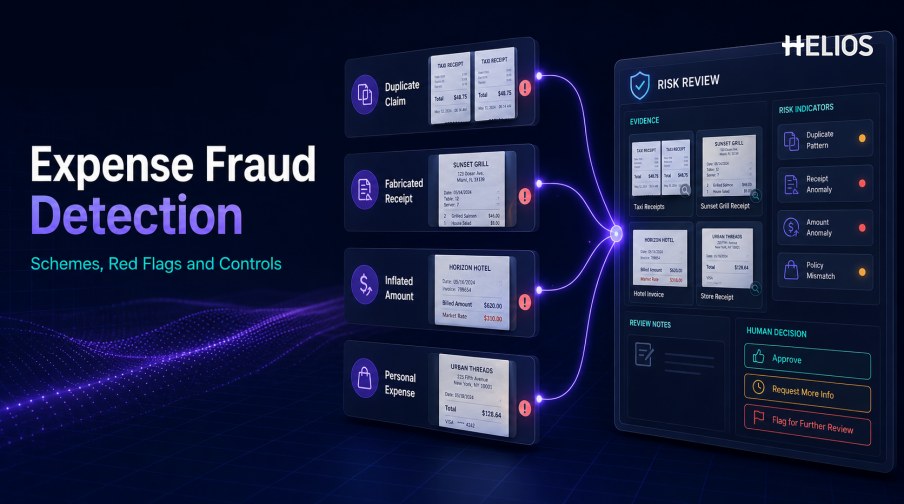
Expense fraud can arise when an employee intentionally seeks reimbursement for a duplicate, altered, fabricated, inflated, or personal expense. Similar records can also result from mistakes, delayed submissions, currency confusion, or weak documentation. A reliable control process must therefore detect risk signals without treating every anomaly as proof of misconduct.
Expense fraud detection combines clear policies, receipt and invoice evidence, duplicate comparison, transaction analysis, approval controls, and human investigation. The objective is to identify records that deserve attention, preserve the evidence, and reach a documented decision based on context.
This guide explains common schemes, practical red flags, and layered controls, then shows how Helios expense review and policy capabilities can strengthen the process.
Common Expense Fraud Schemes
Organizations should define their risk taxonomy before choosing detection methods.
- Duplicate reimbursement. The same receipt or expense is submitted more than once, possibly in different reports, formats, currencies, or entities.
- Fabricated receipt or invoice. A document is created, materially altered, or obtained for a transaction that did not occur as claimed.
- Inflated amount. The submitted amount is increased, a tip is overstated, a receipt is edited, or a personal portion is included.
- Personal expense. A non-business purchase is categorized or described as a legitimate company expense.
- Mischaracterized category. A restricted expense is assigned to a permitted category to avoid a limit or approval requirement.
- Split transaction. One expense is divided across claims or payment methods to remain below a threshold.
- Collusion or approval abuse. A submitter and approver coordinate, ignore evidence, or bypass expected segregation of duties.
- Mileage or per diem manipulation. Distance, dates, trip duration, attendees, or eligibility are overstated or duplicated.
Red Flags That Help Detect Expense Fraud
A red flag is a reason to review—not a finding by itself.
- Duplicate images or key fields. The same merchant, date, amount, currency, invoice number, or visual receipt appears in another record.
- Document inconsistencies. Fonts, totals, taxes, dates, line items, metadata, or image areas appear altered or internally inconsistent.
- Round or threshold-adjacent amounts. Claims repeatedly fall just below receipt, approval, or category limits.
- Unusual merchant or category. The merchant differs from the claimed purpose or from normal spending for the role or trip.
- Timing anomalies. Expenses occur outside the trip, at unusual hours, on non-working days, or after employment or project dates.
- Frequency changes. A sudden increase in claims, repeated merchants, recurring lost-receipt statements, or many manual adjustments appears.
- Approval irregularities. The same approver repeatedly accepts exceptions, approvals occur unusually quickly, or required escalations are missing.
- Accounting conflicts. The claim, card transaction, reimbursement, and posted record do not reconcile.
A Simple Expense Fraud Detection Process
A defensible process separates automated screening from investigation and final conclusions.
- Collect complete evidence. Bring together the claim, receipt or invoice, employee context, trip, card transaction, approvals, policy, and related history.
- Normalize the data. Standardize dates, currencies, merchants, tax, amounts, document identifiers, and organizational dimensions.
- Run deterministic checks. Evaluate policy limits, required evidence, duplicates, arithmetic, dates, categories, and approval requirements.
- Analyze patterns. Compare the record with relevant employee, peer, merchant, category, trip, and historical behavior.
- Prioritize risk. Combine materiality, signal strength, confidence, rule severity, and the number of independent indicators.
- Review the evidence. An authorized reviewer examines the original documents, source data, explanation, related records, and employee response.
- Document the outcome. Record whether the issue was an error, valid exception, policy breach, suspected misconduct, or confirmed matter under the organization’s process.
- Improve controls. Use validated cases to refine policies, training, thresholds, data, approval design, and monitoring.
Controls for Duplicate, Fabricated, Inflated, and Personal Expenses
Layered controls are more reliable than one risk score.
- Duplicate controls. Compare document images and normalized merchant, date, amount, currency, employee, invoice number, and payment reference.
- Document integrity review. Retain original uploads, OCR output, metadata where appropriate, correction history, and links to related transactions.
- Amount validation. Reconcile subtotal, tax, tip, total, currency, card transaction, and reimbursable portion.
- Business-purpose controls. Require meaningful descriptions, attendees, project or client context, and supporting evidence for higher-risk categories.
- Merchant and category rules. Restrict personal or prohibited merchants and flag category descriptions that conflict with the evidence.
- Approval segregation. Route exceptions to independent reviewers and prevent self-approval or incompatible permissions.
- Post-payment review. Analyze reimbursed records, corrections, chargebacks, card data, and recurring patterns that were not visible before payment.
How to Investigate Without Treating Alerts as Proof
Expense fraud detection should protect evidence, fairness, and decision quality.
- Validate the alert first. Confirm data quality, document links, currency conversion, merchant normalization, and comparison logic.
- Consider legitimate explanations. Duplicates may be split payments, amount differences may be tips or taxes, and unusual merchants may fit a new assignment.
- Preserve source records. Keep the original documents, system values, policy version, alert reason, related claims, and access history.
- Limit access. Only authorized reviewers should see sensitive allegations, employee data, investigation notes, and outcomes.
- Follow organizational procedures. Escalation, employee response, disciplinary decisions, legal review, and reporting should follow approved policies and local requirements.
- Record neutral outcomes. Distinguish error, incomplete evidence, legitimate exception, policy violation, suspected fraud, and confirmed fraud.
Metrics for Expense Fraud Controls
Measure both detection value and operational cost.
- Useful-alert rate. The proportion of reviewed alerts that reveal a real error, policy issue, control weakness, or investigation-worthy condition.
- Missed-issue rate. Material problems found through sampling, employee reports, chargebacks, or later review that screening did not surface.
- Duplicate prevention and recovery. Confirmed duplicate amounts stopped before payment or recovered afterward.
- Reviewer effort. Time to gather evidence, communicate, decide, correct, and close a case.
- Repeat pattern rate. Recurring issues by employee, merchant, approver, entity, category, or control.
- Cycle time and backlog. Age of risk queues and time from alert to documented outcome.
- Control drift. Changes in alert volume, precision, overrides, data quality, and performance after policy or system updates.
How Helios Supports Expense Risk Review and Policy Control
Helios combines OCR receipt capture, Built-In Policy Compliance, Automated Policy Control, flexible approvals, accounting integration, and reporting. Spark AI adds policy-aware claim and approval assistance. These capabilities support five layers of expense fraud detection and review:
- Capture source evidence. OCR populates relevant receipt and invoice fields while keeping documents available for confirmation.
- Apply policy checks consistently. Automated Policy Control evaluates configured spending requirements for each reimbursement request.
- Assist higher-risk review. Spark AI states that it audits expenses against company policies and identifies risks and violations for review.
- Keep decisions in accountable workflows. Configurable approval paths support authorized review, escalation, and exception handling.
- Connect outcomes with finance visibility. Accounting-entry generation and reporting help preserve downstream status and analysis.
Helios also presents itself as an enterprise-grade provider with global experience and information-security credentials. Organizations should validate any required duplicate, anomaly, document-integrity, risk-scoring, investigation, card-data, audit-trail, integration, and monitoring capabilities rather than assuming a policy-control feature proves fraud.
FAQs About Expense Fraud Detection
What is the most common expense fraud risk?
Duplicate reimbursement is a common and measurable risk, but exposure varies by organization. Fabricated documents, inflated amounts, personal spending, category manipulation, and approval abuse also require controls.
How can companies detect expense fraud without AI?
Clear policies, required evidence, duplicate field matching, reconciliations, approval segregation, sampling, exception reports, employee reporting channels, and post-payment review remain important.
Does an unusual expense mean fraud?
No. It is a reason to review the data and business context. New assignments, emergencies, taxes, tips, supplier changes, or data errors can create legitimate anomalies.
What evidence should a reviewer examine?
Review the original receipt or invoice, submitted values, card or payment record, trip and employee context, policy, approvals, related claims, correction history, and explanation.
Can Helios automatically confirm expense fraud?
Helios provides policy enforcement, OCR, approvals, accounting, reporting, and Spark AI-assisted review. Fraud confirmation still requires the organization’s evidence, investigation, authority, and procedures.
Teams can evaluate Helios expense controls and Spark AI review with known risk cases, legitimate exceptions, representative documents, reviewer procedures, accounting records, and measurable outcomes.