
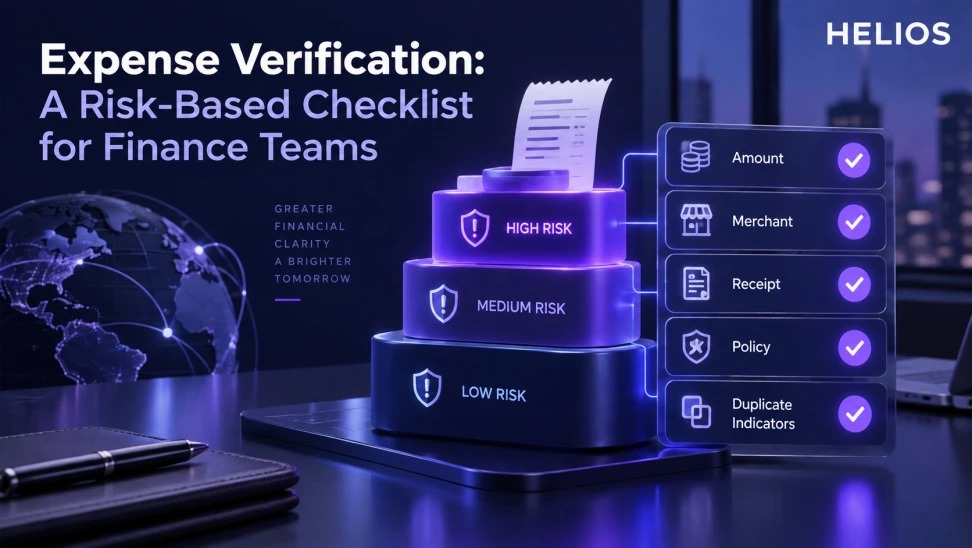
A risk-based expense verification checklist covering amount, merchant, receipt, policy, duplicates, and the human–automation boundary.
A practical framework for finance teams
A risk-based expense verification checklist covering amount, merchant, receipt, policy, duplicates, and the human–automation boundary.
Automated checks can structure evidence and identify conditions for review, but they do not prove business legitimacy or misconduct. Specific risk models and automatic decisions must be validated.
For related guidance, see AI compliance software.
A useful design starts with the decision, then specifies the data, owner, control, timing, and next action. This keeps dashboards, forms, queues, verification, and approvals connected to the work finance must complete.
Expense Verification at a glance
| Risk tier | Example trigger | Verification depth | Decision |
| Low | Routine, complete, within policy | Automated fields plus sampling | Release or sample |
| Medium | Unusual value or incomplete context | Targeted finance review | Resolve or escalate |
| High | Duplicate, prohibited, sensitive, conflicting | Specialist evidence review | Hold and investigate |
| Unknown | Missing or unreliable data | Obtain evidence first | Do not infer low risk |
For related guidance, see travel expense policy template.
A clear workflow connects the trigger, evidence, owner, decision, and follow-up.
Verify identity, amount, and context
Confirm employee, entity, payment method, merchant, date, amount, currency, exchange rate, category, business purpose, project or client, attendees, route, and approval.
Match the claim with receipt, card transaction, itinerary, request, and other evidence. Preserve original values and corrections.
For related guidance, see duplicate payment detection.
Check receipt and merchant evidence
Verify readability, completeness, itemization, total, taxes, tip, date, merchant identity, currency, and connection to the claim. Treat OCR as extracted data that may require correction.
Review unusual merchant-category combinations, altered-looking evidence, credits, refunds, and missing-receipt declarations according to policy.
Apply policy and duplicate checks
Deterministic checks suit limits, required fields, restricted categories, approval thresholds, and timing. Duplicate indicators may compare amount, date, merchant, employee, receipt image, card transaction, and linked invoice.
A similar transaction is a review signal. Account for legitimate recurring subscriptions, shared meals, installments, and resubmissions before concluding it is duplicate.
Set risk tiers and review depth
Low-risk complete claims may receive automated checks and sampling. Medium-risk claims receive targeted verification. High-risk or sensitive claims need experienced review and escalation. Missing data should remain unknown rather than defaulting to low risk.
Document triggers, overrides, evidence, reviewer, decision, and reason. Calibrate thresholds by entity, category, country, and loss severity.
For related guidance, see expense fraud detection.
Keep human judgment for context
Humans should assess business necessity, plausible explanation, sensitive relationships, novel exceptions, conflicting evidence, legal or tax questions, and potential misconduct.
Automation can prioritize work and present evidence. It should not hide uncertainty or make an irreversible high-impact decision without governed authority.
Measure verification quality
Track coverage, confirmed issue rate, false-positive rate, override rate, unresolved age, time per review, recoveries, repeat problems, and employee impact.
Use test sets and sampled cleared claims to detect missed issues. Review drift after policy, merchant, currency, or employee behavior changes.
How Helios supports this workflow
Helios can connect mobile expense capture, multilingual OCR, configurable policy controls, role-based approvals, accounting preparation, integration, and multidimensional reporting. Spark AI can assist in confirmed conversational and policy-review scenarios. Exact delegation, reminder, transfer, risk-scoring, conflict detection, algorithm, and integration behavior should be validated during implementation.
For related guidance, see AI audit best practices.
- Use OCR to extract receipt and invoice fields.
- Apply configurable policy checks and approval routing.
- Connect claim, receipt, card, purpose, and accounting context.
- Support reviewer decisions and exception evidence.
- Report verification outcomes across multiple dimensions.
- Use Spark AI only within confirmed assistance scenarios.
A practical conclusion
Design around the decision and the accountable person. Make evidence easy to find, exceptions visible, and next actions explicit. Measure whether the workflow improves control, speed, and employee experience.
See how Helios can support this workflow. Request a Helios demo.
FAQ
What is expense verification?
It is the controlled review of expense identity, context, evidence, policy, duplicates, accounting data, and approval before release.
Which checks can be automated?
Explicit field, limit, timing, category, workflow, and similarity checks are candidates when logic and data are reliable.
Which checks require people?
Business legitimacy, novel exceptions, sensitive relationships, conflicting evidence, and legal or tax questions require judgment.
Does a duplicate indicator prove duplication?
No. It identifies similar records for review and may reflect legitimate recurring or shared transactions.
How should risk tiers work?
Define triggers, review depth, owner, evidence, decision authority, override, and follow-up for each tier.
How can Helios help?
Helios supports OCR, policy controls, approvals, structured evidence, reporting, and confirmed AI assistance scenarios.