
AI can review more expense records than a finance team can inspect manually, but coverage alone does not create a reliable control. Poor data, vague objectives, unexplained scores, excessive alerts, weak human oversight, and ungoverned changes can turn automation into additional risk and workload.
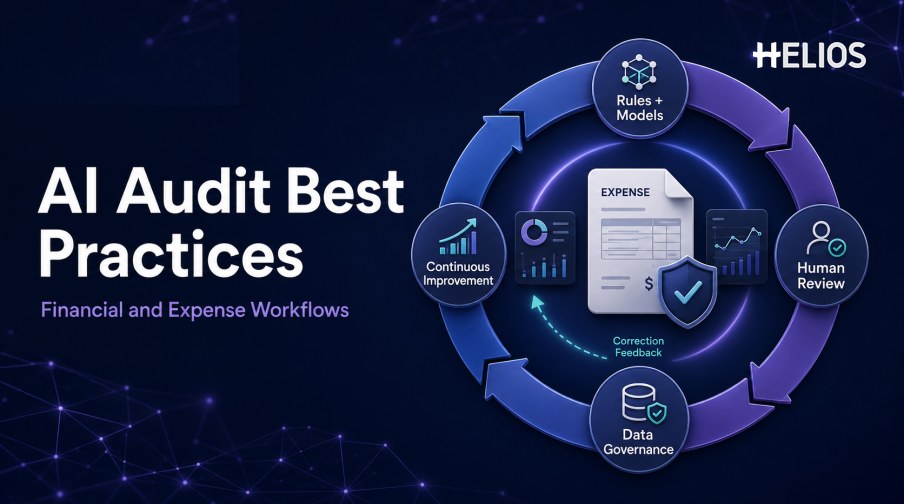
AI audit best practices therefore treat technology as part of a controlled financial and expense workflow. Rules define known requirements, models identify less obvious patterns, reviewers evaluate material exceptions, governance protects data and decisions, and monitoring improves the system over time.
This guide presents practical AI audit best practices for internal expense review and explains how Helios automated controls and Spark AI can support a governed implementation. It does not describe statutory audit procedures or replace professional audit judgment.
1. Define the Review Scope and Decision Boundary
A responsible program begins with a precise statement of what the AI system will and will not do.
- Name the process. Identify the expense types, entities, regions, users, documents, approval stages, and accounting outputs in scope.
- Define the objective. Examples include checking required evidence, applying policy limits, detecting duplicate signals, prioritizing anomalies, or improving coding quality.
- Separate recommendations from decisions. Document whether the system can pass, flag, prioritize, summarize, request information, or take any automated action.
- Set human-review triggers. Require authorized review for material amounts, low confidence, adverse outcomes, policy exceptions, sensitive categories, and conflicting evidence.
- State excluded uses. Make clear that operational AI review does not produce a statutory audit opinion, legal finding, or proof of fraud.
- Assign accountable owners. Finance, policy, data, security, technology, and operational owners should approve the design and changes.
2. Combine Rules and Models
One of the most useful AI audit best practices is to match each control with the method best suited to it.
- Use rules for explicit requirements. Receipt thresholds, category limits, required approvals, dates, merchants, and evidence can be expressed deterministically.
- Use models for variable patterns. Anomaly detection can surface unusual amounts, timing, frequency, suppliers, categories, or combinations that fixed rules may not anticipate.
- Use OCR for document data. Receipt and invoice recognition provides structured fields, confidence, and source locations for downstream checks.
- Use materiality in every method. Thresholds and routing should reflect the possible impact of an error or exception.
- Combine signals transparently. A risk priority should show the contributing rule, anomaly, missing data, confidence, and business context.
- Avoid protected-characteristic shortcuts. Models and rules should use legitimate business factors and be assessed for inappropriate disparate effects.
3. Design Human Review for Real Decisions
Human oversight is effective only when reviewers have evidence, authority, time, and a usable path to act.
- Present the source and result together. Show the claim, receipt or invoice, extracted values, policy, comparison basis, and confidence.
- Explain why the record was prioritized. Use specific reasons instead of a score without components.
- Support correction and inquiry. Reviewers should be able to edit data, request information, document exceptions, escalate, approve, or reject.
- Prevent automation bias. Train reviewers to question model outputs and examine legitimate explanations for unusual records.
- Capture structured outcomes. Record whether an alert was valid, what changed, why a decision was made, and whether policy or training needs improvement.
- Protect segregation of duties. Permissions and routing should prevent the same person from controlling incompatible steps.
4. Establish Data and Model Governance
AI audit best practices require controls over data, configurations, models, and evidence.
- Document data lineage. Identify where documents, transaction fields, employee context, master data, policies, corrections, and outcomes originate.
- Control data quality. Monitor missing fields, inconsistent identifiers, late updates, duplicate records, image quality, and unreliable labels.
- Protect sensitive information. Apply role-based access, encryption, retention, deletion, residency, export controls, and incident procedures.
- Govern training and feedback. Use verified corrections and approved labels; do not allow every user edit to retrain a model automatically.
- Version rules and models. Retain who approved each change, what data and tests were used, when it took effect, and how rollback works.
- Preserve decision evidence. Store the source record, applicable policy, model or threshold version, explanation, reviewer action, and final outcome.
5. Monitor and Improve Continuously
Performance can change as suppliers, policies, travel patterns, user behavior, and document formats evolve.
- Measure alert precision. Track the proportion of alerts that reveal a real data, policy, process, or risk issue.
- Estimate missed issues. Review known cases and samples of passed records to find material conditions the system did not surface.
- Analyze overrides and corrections. Repeated reviewer disagreement may indicate weak rules, models, data, explanations, or training.
- Watch drift. Compare field accuracy, alert patterns, and outcomes across time, entities, regions, categories, and suppliers.
- Review queue health. Monitor backlog, aging, processing time, false alerts, escalations, and workload by reviewer.
- Use controlled change management. Test updates before release, compare them with a baseline, approve deployment, and retain rollback capability.
- Close the improvement loop. Use validated trends to refine policies, employee guidance, document capture, integrations, and model thresholds.
A Practical Implementation Checklist
Before moving from pilot to production, confirm the following:
- Scope and owners are approved. Use cases, excluded decisions, accountable roles, and escalation paths are documented.
- Representative data has been tested. The pilot includes normal, difficult, high-risk, multilingual, multi-entity, and legitimate unusual cases.
- Rules and models have separate metrics. Each control has coverage, precision, missed-issue, materiality, and reviewer-effort measures.
- Explanations are usable. Reviewers can verify the source, reason, comparison, confidence, and recommended next step.
- Human controls are operational. Permissions, segregation of duties, override, escalation, and documentation work under realistic volume.
- Integrations and failures are tested. Intake, documents, approvals, accounting, retries, duplicates, error queues, and reporting are covered.
- Monitoring and change control are funded. Owners have dashboards, review cadence, incident procedures, version history, and improvement capacity.
How Helios and Spark AI Support Governed Expense Review
Helios combines OCR capture, automated policy controls, configurable approvals, accounting-entry generation, and reporting. Spark AI provides conversational assistance for claims, approvals, travel, and service. These capabilities align with five AI audit best practices:
- Start with structured evidence. OCR captures relevant receipt and invoice fields while preserving the document for confirmation.
- Combine automation with explicit policy. Configured controls apply known spending requirements before or during review.
- Support explainable human review. Approval Copilot assists with policy-aware document review while the authorized user owns the decision.
- Keep decisions in governed workflows. Configurable approval paths can reflect roles, departments, cost centers, and business conditions.
- Monitor financial outcomes. Accounting-entry generation, dashboards, and customizable reports support downstream analysis and continuous improvement.
Helios also presents itself as an enterprise-grade provider with global experience and information-security credentials. Organizations should still validate data governance, document and policy coverage, model and rule behavior, reviewer controls, explanations, audit records, integrations, security, monitoring, and implementation scope.
FAQs About AI Audit Best Practices
Should finance teams start with rules or machine learning?
Start with the use case. Explicit requirements usually belong in rules, while models can help with variable patterns and prioritization. A hybrid approach often provides clearer control and broader coverage.
How much human review is necessary?
It depends on materiality, confidence, policy severity, data quality, and the consequence of a wrong decision. High-risk, uncertain, adverse, or conflicting cases should retain authorized review.
How can teams reduce false alerts?
Improve data quality, use relevant comparison groups, include business context, tune thresholds by risk, retire low-value rules, and analyze reviewer outcomes without hiding missed issues.
What should be logged for each decision?
Retain the source record and document, recognized values, policy and model versions, signals, confidence, explanation, reviewer actions, corrections, timestamps, and final outcome.
How often should AI audit controls be reviewed?
Use continuous monitoring plus a documented periodic review. Trigger additional review after policy changes, model updates, material drift, new entities, new data sources, incidents, or persistent override patterns.
Teams can apply these practices while evaluating Helios and Spark AI through a measured pilot with clear scope, representative expenses, human review, governance controls, and ongoing performance monitoring.