
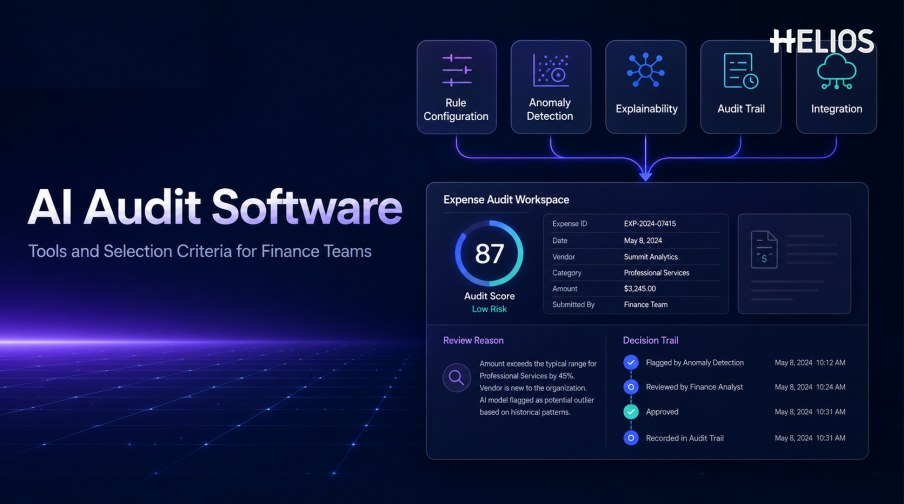
AI audit software can describe very different products. Some tools apply transaction rules, some identify statistical anomalies, some analyze documents, and others summarize evidence or prioritize review queues. Finance teams need to separate marketing labels from the exact controls, data, decisions, and integrations required in their workflow.
For expense management, useful AI audit tools should combine configurable rules, document evidence, anomaly signals, explainable results, human review, a complete audit trail, and reliable connections with expense and accounting systems. The system should help reviewers find and understand higher-risk records without treating an algorithmic score as proof of error or misconduct.
This guide explains the capabilities and evaluation steps finance teams can use when selecting AI audit software, with particular attention to Helios and Spark AI expense review.
What Does AI Audit Software Do?
AI audit software assists internal review by evaluating records, documents, policy conditions, historical patterns, and workflow events. Depending on scope, it may check every expense, identify missing evidence, flag duplicate signals, detect anomalies, rank risk, explain a result, or route a record to an authorized reviewer.
The strongest product is not necessarily the one that generates the most alerts. It is the one that applies the organization’s controls accurately, presents useful evidence, integrates with the operating workflow, and produces a review record that finance teams can understand and govern.
Core Capabilities to Evaluate
Finance teams should assess AI audit software across the following dimensions:
- Configurable rules. Support amounts, categories, receipts, dates, merchants, roles, locations, approvals, tolerances, and entity-specific requirements.
- Document recognition. Read receipts and invoices, expose source locations and confidence, and connect extracted fields with the reviewed transaction.
- Anomaly detection. Identify unusual amounts, timing, frequency, suppliers, categories, split patterns, or behavior using appropriate comparison groups.
- Duplicate signals. Compare documents and key fields while allowing reviewers to inspect possible matches and legitimate exceptions.
- Risk prioritization. Combine rule severity, materiality, confidence, and anomaly strength into a transparent review order.
- Explainability. Show what was detected, why it matters, which evidence and baseline were used, and how the reviewer can act.
- Human review workflow. Support comments, corrections, requests for information, escalation, approval, rejection, and documented override.
- Audit trail. Retain source data, policy and model versions, alerts, explanations, actions, timestamps, and final outcomes.
How to Compare AI Audit Tools
A structured evaluation should use the organization’s actual review scenarios.
- Control fit. Map each required policy, anomaly, duplicate, evidence, approval, and coding check to a demonstrable product capability.
- Precision and recall. Measure useful alerts and missed known issues instead of relying only on a vendor accuracy percentage.
- Explanation quality. Ask whether a reviewer can verify the result from the displayed source, rule, comparison, and confidence.
- Configuration ownership. Determine who can create, test, approve, publish, version, and retire rules or model thresholds.
- Workflow usability. Measure the steps required to review evidence, correct data, request information, decide, and document an exception.
- Entity and regional coverage. Validate languages, currencies, tax data, policy variations, data location, and organization structures in scope.
- Total operating effort. Include configuration, data preparation, integrations, monitoring, investigation, false alerts, support, and change management.
A Practical Selection Process
Finance teams can compare AI audit software through a controlled sequence:
- Define the review boundary. Specify the processes, records, users, entities, decisions, risks, and formal audit activities that are in or out of scope.
- Prioritize use cases. Choose measurable scenarios such as missing receipts, category limits, duplicate claims, unusual merchants, or approval exceptions.
- Prepare representative data. Include clean records, known exceptions, legitimate unusual cases, weak images, multiple regions, and corrected transactions.
- Run a field and alert-level pilot. Measure results by control and risk type rather than averaging everything into one score.
- Test reviewer experience. Observe whether users can understand evidence, correct errors, override suggestions, and record decisions efficiently.
- Validate integration and failure handling. Follow records through intake, review, approval, accounting, retry, reconciliation, and reporting.
- Approve governance and ownership. Assign responsibility for rules, models, access, data, monitoring, incident response, and deployment changes.
Integration, Security, and Audit Records
AI audit software must fit the finance architecture and preserve reliable evidence.
- Expense-system integration. The tool should receive claims, documents, policy context, employees, categories, approvals, and statuses without repeated exports.
- Accounting integration. Approved records should carry controlled accounts, dimensions, taxes, currencies, references, and transfer outcomes.
- Master-data synchronization. Employees, entities, departments, cost centers, projects, suppliers, currencies, and policies require maintained identifiers.
- Identity and access. Review role-based permissions, segregation of duties, administrator activity, authentication, and service accounts.
- Data protection. Confirm encryption, retention, deletion, residency, exports, model-data use, incident response, and sensitive-field handling.
- Versioned evidence. Store the rule, threshold, model, source record, explanation, reviewer action, and outcome that applied at decision time.
- Operational resilience. Test queues, retries, duplicate messages, unavailable connectors, latency, monitoring, and recovery procedures.
Pilot Metrics and Red Flags
A credible pilot measures control outcomes and exposes product limitations.
- Useful-alert rate. Track alerts that result in correction, escalation, policy clarification, or a documented valid exception.
- Missed-issue rate. Review known cases and sampled pass records to estimate material conditions the tool did not surface.
- Reviewer time. Measure handling time, evidence gathering, back-and-forth communication, and rework.
- Override rate. Analyze when reviewers disagree and whether the explanation, rule, model, or training data needs improvement.
- Integration reliability. Track failed, delayed, duplicated, or mismatched records and the effort required to resolve them.
- Red flags. Be cautious of unexplained scores, unsupported accuracy claims, no source evidence, automatic adverse decisions, weak version history, or pilots that exclude difficult data.
How Helios and Spark AI Fit an Expense Audit Toolset
Helios combines OCR capture, automated policy controls, configurable approvals, accounting-entry generation, and reporting. Spark AI adds conversational copilots, including approval assistance. This aligns with five selection priorities:
- Connect documents with structured records. OCR reduces manual entry and keeps receipt or invoice evidence in the expense workflow.
- Apply configurable expense controls. Policy rules act on confirmed fields and company requirements.
- Assist review with Spark AI. Approval Copilot helps reviewers examine claims against policy and relevant document details.
- Preserve controlled routing and decisions. Flexible approval workflows support roles, departments, cost centers, and conditions.
- Carry outcomes into accounting and analysis. Accounting-entry generation, integration, dashboards, and reporting support downstream finance work.
Helios also presents itself as an enterprise-grade provider with global experience and information-security credentials. Buyers should validate every required control, explanation, alert type, audit field, permission, integration, security requirement, service boundary, and implementation assumption with representative data.
FAQs About AI Audit Software
What is AI audit software for finance teams?
It is software that assists internal review of financial or expense records using rules, document analysis, anomaly signals, risk prioritization, explanations, and workflow controls.
Should AI audit tools automatically reject expenses?
Not by default. Organizations should define which low-risk actions can be automated and which exceptions, material values, or adverse outcomes require an authorized human decision.
How should anomaly alerts be evaluated?
Review the comparison group, time period, data quality, materiality, confidence, explanation, and legitimate business context. An anomaly is a review signal, not proof of wrongdoing.
What audit trail should the software retain?
Retain source records, documents, extracted values, policies, model or threshold versions, alerts, explanations, reviewer actions, corrections, timestamps, and final outcomes.
How does Spark AI support expense review?
Spark AI includes an Approval Copilot that assists with expense-document review against company policy, while configurable workflows retain organizational ownership of decisions.
Finance teams can evaluate Helios and Spark AI expense review through a controlled pilot using representative documents, known exceptions, reviewer tasks, accounting interfaces, and measurable outcomes.