
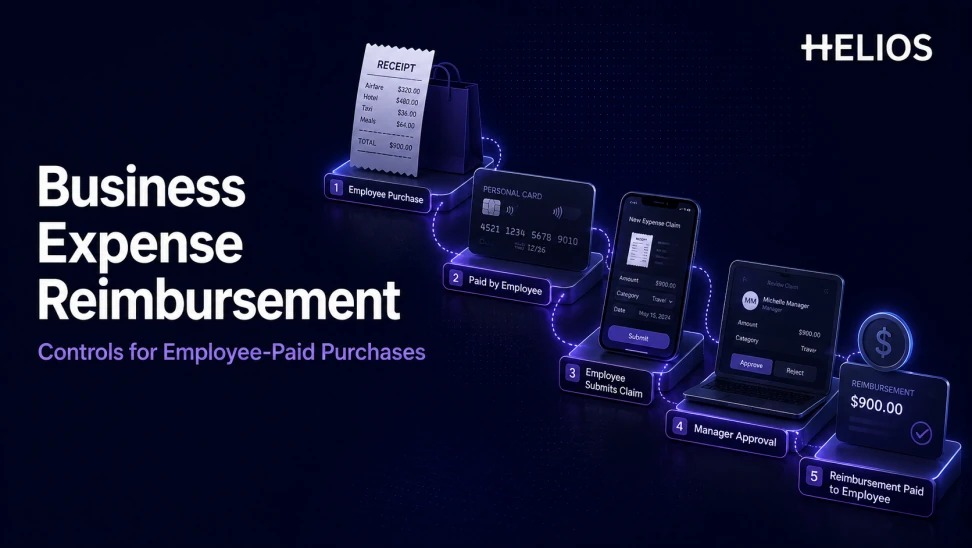
What is business expense reimbursement?
Business expense reimbursement repays an employee who used personal funds for an authorized company cost. Common examples include local transportation, emergency supplies, customer-related purchases, remote-work items, and travel costs that could not be charged through a company payment method.
The employer needs to confirm the business connection, policy eligibility, documentation, approval, amount, accounting treatment, and payment destination. The employee needs a short submission process and clear status. When those needs are not connected, finance chases receipts, employees wait for repayment, and month-end records remain incomplete.
The system view of that process is covered in What Is Expense Reimbursement Software and How Does It Work?. This article stays on the finance side of the same process: the controls that should sit around each step when an employee has already paid with personal funds.
In the United States, accountable-plan treatment generally requires a business connection, substantiation within a reasonable period, and return of excess advances. Company policy and local law may impose additional requirements. A reimbursement platform should help execute the employer’s policy without presenting tax rules as universal.
Controls across the reimbursement lifecycle
| Stage | Primary risk | Control | Evidence |
|---|---|---|---|
| Before purchase | Unnecessary or unauthorized spend | Pre-approval and preferred payment method | Request, budget owner, decision |
| At purchase | Personal items or unclear merchant detail | Itemized receipt and separate personal costs | Original receipt and transaction data |
| Submission | Wrong category, amount, currency, or purpose | Required fields and employee attestation | Claim record and attachments |
| Approval | Rubber-stamping or wrong approver | Conditional routing and exception review | Approver, comments, timestamps |
| Payment and accounting | Duplicate payment or miscoding | Payment status, duplicate checks, posting controls | Payment reference and accounting entry |
Payment operations are explored in how finance teams handle employee reimbursement payments.
Employee-paid purchases need a connected path from receipt and business purpose to approval, accounting, and repayment.
Use employee payment as an exception with a clear purpose
Corporate cards, centralized purchasing, and direct billing can reduce employee out-of-pocket exposure. Reimbursement remains necessary when those methods are unavailable, impractical, or not accepted. Define when personal payment is permitted and which categories require another channel.
Employees should not finance routine company operations because a process is slow. Repeated reimbursements for the same vendor or category may indicate a purchasing or card-program gap.
Global teams can compare international reimbursement payment methods.
Capture evidence at the time of purchase
Require an itemized receipt where available, plus merchant, date, amount, currency, category, business purpose, project or cost center, and attendees when relevant. A card statement alone may not show what was purchased.
Mobile capture reduces loss and preserves context. OCR can reduce typing, but the employee should verify every extracted field before submission.
Apply policy before finance review
Use rules to identify missing documentation, category restrictions, thresholds, dates, duplicates, and pre-approval requirements. Clear prompts allow employees to correct a claim before it reaches an approver.
Exceptions should identify the policy rule, reason, accountable approver, and any personal portion. Avoid hiding exceptions in free-text notes.
Design approval around accountability
Route the expense to someone who can confirm the business need and budget, then involve finance or specialist review where risk requires it. Amount, category, entity, project, employee, and exception status can change the route.
Set service expectations and delegation rules so claims do not remain pending when a manager is absent.
Currency controls are covered in the cross-border reimbursement exchange-rate guide.
Connect repayment with accounting
Approval is not the end of the process. The organization needs a payment instruction, status, failure handling, reconciliation, and accounting entry. Employees should see whether a claim is submitted, approved, scheduled, paid, rejected, or returned for correction.
Use duplicate controls across receipt, amount, merchant, date, employee, card feeds, and prior claims. Preserve the link between payment and the final approved expense.
Design the employee-paid purchase policy
State when personal payment is permitted, discouraged, or prohibited. Give examples for emergencies, field work, small local purchases, subscriptions, travel, gifts, and regulated categories. Explain when an employee should use a corporate card, purchase order, direct invoice, or centrally managed account instead.
Define submission deadlines, receipt thresholds, required business context, exchange-rate treatment, tax evidence, and consequences for repeat noncompliance. Policies should also explain how employees request pre-approval and what to do when a receipt is unavailable for a legitimate reason.
Measure reimbursement performance
Track time from purchase to submission, submission to approval, approval to payment, and payment failure resolution. Segment the results by entity, country, approver, category, and payment method. The total cycle shows the employee experience; each interval identifies the process owner who can improve it.
Pair speed with control measures: missing documentation, duplicate alerts, policy exceptions, returned claims, accounting corrections, and employee inquiries. A faster process that creates downstream cleanup is not a successful automation. Review both measures after policy or workflow changes.
How Helios supports employee-paid purchase controls
Helios connects mobile claim creation, receipt data, policy checks, approval workflows, accounting, reporting, and AI assistance. This helps finance control business expense reimbursement without turning every claim into a manual investigation.
To connect approval with repayment, review expense payment systems with reimbursement workflows and payout execution.
- Mobile submission captures the receipt and business context close to the transaction, which is the at-purchase control in the table above.
- Receipt OCR structures merchant, date, amount, currency, and tax fields so submission checks run on data rather than on an image.
- Claim Copilot tells the employee which supporting documents a claim needs before it is submitted, reducing returns.
- Automated policy controls apply category, limit, and evidence rules before an approver sees the claim.
- Flexible approvals route by organization, role, project, amount, and exception status, so higher-risk claims reach a finance reviewer instead of a one-tap manager approval.
- Accounting integration and reporting keep the approved claim, its evidence, and the accounting entry linked for reconciliation and audit.
A practical conclusion
A good reimbursement process protects both sides: employees recover authorized costs promptly, and finance receives the evidence, approval, accounting, and payment record needed to control company funds.
See how Helios can support this expense workflow. Request a Helios demo.
FAQ about business expense reimbursement controls
What counts as a business expense reimbursement?
It is repayment for an authorized company cost paid personally by an employee and supported according to policy.
Should employees use personal cards for business purchases?
Only where company policy permits. Routine purchases may be better handled through corporate cards, procurement, or direct billing.
Is a receipt enough for reimbursement?
Usually not. Finance may also need the business purpose, category, attendees, project, approval, currency, and explanation of any exception.
When should an employee-paid purchase require pre-approval?
When the category is restricted, the amount exceeds the policy threshold, or a corporate payment method was available. The policy should name the categories and thresholds so employees do not have to guess.
How fast should a business expense reimbursement be paid?
Set a service target from valid submission to payment and measure each interval separately: submission to approval, approval to payment instruction, and instruction to settlement. Delays usually sit in one interval, not all of them.
How is this different from how expense reimbursement software works?
The software guide explains the system steps from claim to payment. This article covers the controls finance should place around each step when the employee has already paid with personal funds. See What Is Expense Reimbursement Software and How Does It Work?.