
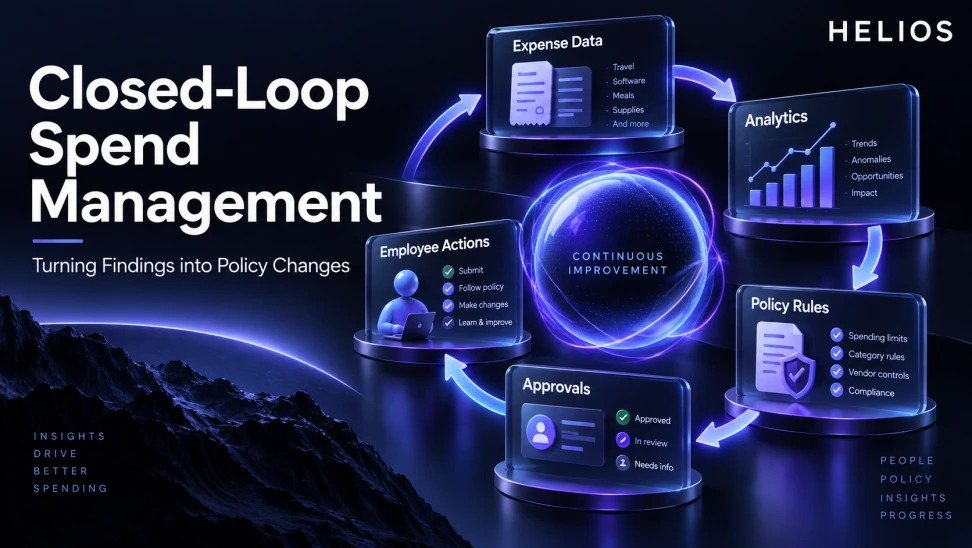
What is closed-loop spend management?
Closed-loop spend management is a repeatable cycle: capture reliable spend data, analyze behavior, select a finding, design a response, configure and communicate the change, measure the outcome, and feed the result into the next review.
Many organizations stop after publishing a dashboard or updating a policy document. The loop remains open because the finding never changes the employee workflow, the system rule, or the measure used to judge success.
For analytics and reporting, review expense automation reporting.
A closed loop assigns ownership at every stage. Finance may identify the pattern, but procurement, travel, HR, security, tax, business leaders, and system administrators may need to shape and implement the response.
Closed-Loop Spend Management at a glance
| Loop stage | Key question | Deliverable | Evidence |
|---|---|---|---|
| Capture | Can the data be trusted? | Reconciled dataset | Coverage and quality checks |
| Analyze | What pattern matters? | Finding with scope and cause | Segmented measures and examples |
| Prioritize | Is action worthwhile? | Decision and owner | Value, risk, effort, confidence |
| Change | What should people and systems do? | Policy and workflow update | Rule, exception, communication |
| Measure | Did the result improve? | Outcome review | Baseline, target, guardrails |
Policy implementation is covered in AI compliance and automated expense policy enforcement.
Closed-loop spend management connects expense capture, analysis, prioritization, policy change, communication, and outcome measurement.
Start with trustworthy expense data
Reconcile expenses to card, reimbursement, payment, and accounting records. Quantify missing receipts, uncategorized transactions, duplicate candidates, reversals, and fields that vary by entity.
Do not treat a dashboard as complete because it contains many rows. Document which spend channels and countries are included and which remain outside the view.
Human review design appears in AI expense auditing with human-in-the-loop review.
Frame a finding precisely
A useful finding names the behavior, population, time period, financial or control effect, and evidence. “Meal spend is high” is weak. “After-hours meal exceptions rose in two service teams after shift schedules changed” provides a testable starting point.
Interview employees and approvers before choosing the solution. The data shows what happened; operational context often explains why.
Prioritize value, risk, and feasibility
Score findings by potential value, compliance or fraud risk, employee impact, confidence, implementation effort, and reversibility. Select a small number of changes that owners can implement and measure.
Separate a genuine root cause from a visible symptom. Missing receipts may require better mobile capture, a merchant feed, clearer prompts, or a different payment method rather than a stricter approval.
Design the policy and workflow together
Write the policy rule in plain language, then specify the system condition, required field, approver, exception route, evidence, effective date, and owner. Test normal, borderline, urgent, and prohibited cases.
Avoid controls that merely move work downstream. A pre-approval can reduce unauthorized spend but create delay; a post-spend alert may fit low-risk categories better.
For explainability, see how finance can explain an AI policy-violation decision to auditors.
Communicate at the moment of action
Announce the change before it takes effect and explain the business reason. Put concise guidance inside the request, booking, card, or reimbursement workflow where employees make the decision.
Give managers examples and escalation routes. Support teams need the same effective date and interpretation so employees receive consistent answers.
Measure results and guardrails
Establish a baseline, target, observation period, and guardrail before launch. Measure the intended outcome along with approval time, exception volume, employee questions, accounting corrections, and business disruption.
If results differ by entity or team, investigate before expanding the rule. Keep, adjust, or reverse the change based on evidence, then record the decision for the next loop.
How Helios enables a closed expense-control loop
Helios connects structured receipt and expense data with policy rules, approvals, AI assistance, accounting integration, and analytics. This creates a practical route from observed behavior to a configured control and a measurable outcome.
A broader framework appears in finance automation for expense management.
- Capture structured transaction, receipt, policy, and approval data.
- Use analytics to identify category, entity, and exception patterns.
- Configure policy rules and required evidence around the selected finding.
- Route exceptions to accountable owners through flexible workflows.
- Use AI copilots to support employees and reviewers at the point of action.
- Measure results and accounting outcomes after the change.
A practical conclusion
Closed-loop spend management turns analysis into operational learning. The loop closes only when a finding changes a policy or workflow, employees understand the change, and outcome data shows whether the decision helped.
See how Helios can support this workflow. Request a Helios demo.
FAQ about closed-loop spend management
What makes spend management closed loop?
The process connects data, analysis, action, system configuration, communication, and measured outcomes, then feeds the result into the next review.
How do you choose which expense finding to act on?
Compare value, risk, confidence, employee impact, effort, and reversibility, and confirm the operational context with affected teams.
Should every finding result in a stricter policy?
No. The response may simplify a rule, improve data capture, change a payment method, update training, or move repeat spend into procurement.
How long should a policy-change pilot run?
Use enough time and transactions to observe the target behavior while accounting for seasonality. Define the observation period before launch.
How can Helios support closed-loop controls?
Helios connects expense data, analytics, policy rules, approvals, AI assistance, and finance integration so changes can be configured and measured.
Which guardrails should finance monitor?
Track approval delay, exceptions, employee inquiries, corrections, business disruption, and data quality alongside the target savings or control outcome.