
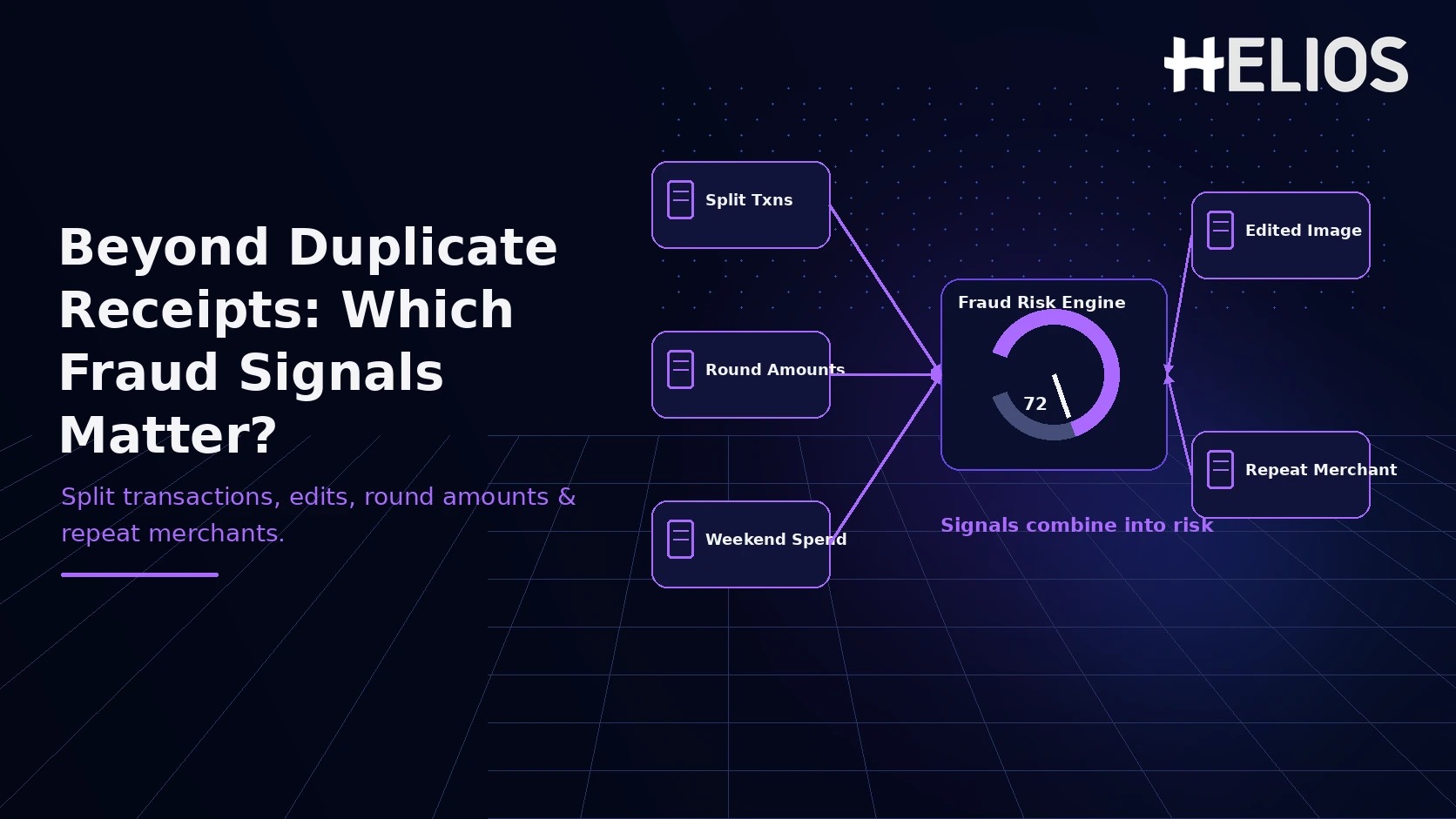
Exact duplicate receipts are easy to explain and relatively easy to flag. The same receipt appears twice, the fields match, and the review team has a clear reason to investigate. But many suspicious expense patterns are not exact duplicates. They appear as a series of individually plausible transactions that only become meaningful when you look at timing, amount, merchant history, policy thresholds, and receipt integrity together.
For finance and compliance teams, the practical question is not whether split transactions, round amounts, weekend spend, edited images, or repeat merchants are "fraud." The better question is: which signals deserve the most weight, in what context, and how should they change the review workflow?
The Short Answer
Materially edited receipt images and split transactions designed to bypass controls are usually the strongest signals in this group. Repeat-merchant anomalies become meaningful when they deviate from normal behavior. Round amounts and weekend spend are typically weak on their own, but useful as supporting context when several signals appear together.
Why Exact-Duplicate Detection Is Only the First Layer
Exact matching catches a narrow class of problems: the same evidence submitted more than once. Real-world misuse can be less literal. A person can divide a purchase into smaller claims, adjust a receipt field, choose values that sit just under an approval threshold, or repeatedly spend at a merchant in a way that looks ordinary one transaction at a time.
That is why effective expense review should move from a binary duplicate/not-duplicate rule toward contextual risk assessment. Strong controls compare each claim with policy, employee history, merchant patterns, time, amount, supporting documents, and other transactions in the same period.
Which Expense Fraud Signals Matter Most?
The five signals in this topic do not carry equal evidentiary weight. The table below is a practical ranking for triage, not a legal conclusion and not a universal scoring model.
| Signal | Typical standalone weight | Why it matters | Main false-positive risk |
| Materially edited receipt image | High | May indicate transaction evidence was altered | Cropping, compression, rotation, or legitimate annotation |
| Split transactions around a control limit | High | Can indicate deliberate circumvention of approval rules | Legitimate separate purchases made close together |
| Abnormal repeat-merchant pattern | Medium | Repetition can reveal concentration or behavior hidden at transaction level | Preferred hotels, fuel stations, office suppliers, or regular vendors |
| Round amounts | Low to medium | Fabricated or manually entered claims may cluster at convenient values | Fixed fees, deposits, allowances, and flat-rate services |
| Weekend spend | Low | Timing can be inconsistent with expected work activity | Travel, events, hospitality, shift work, or weekend operations |
1. Split Transactions: A High-Value Signal When the Pattern Tracks a Control Threshold
Split transactions occur when what is economically one purchase is divided into multiple charges or reimbursement claims. The risk rises sharply when the split appears to keep each individual transaction below a policy or approval threshold.
Imagine a company requires additional approval for expenses above $500. A single $620 purchase submitted as two $310 claims is more concerning than two unrelated purchases from the same merchant. The pattern becomes stronger when the transactions occur close together, the combined amount crosses the threshold, the employee repeats the behavior, or the descriptions are nearly identical.
Useful review questions include:
- Did multiple transactions occur at the same merchant within minutes, hours, or the same day?
- Does the combined amount cross a policy threshold that no individual transaction crosses?
- Are several transactions consistently just below an approval limit?
- Is the same splitting pattern visible across multiple expense reports or months?
- Is there a legitimate operational reason the merchant had to charge separately?
A one-off split does not prove intent. But a repeatable relationship between transaction size and a control limit is difficult to explain away as coincidence and should usually move the claim into higher-priority review.
2. Round Amounts: A Useful Supporting Feature, Rarely a Decisive Signal
Round-number expenses such as $100, $250, $500, or $1,000 are sometimes associated with fabricated or manually estimated claims because people naturally choose convenient numbers. Real purchases, by contrast, often include tax, tips, service charges, unit prices, exchange rates, or discounts that produce less tidy totals.
The problem is that many legitimate business costs are also round: conference fees, deposits, retainers, fixed-price services, per diems, or prepaid packages. For that reason, "round amount" is better treated as a weak feature than as a rule that automatically creates an exception.
Roundness matters more when it appears with other clues: a manually entered claim, missing itemization, a late submission, a new merchant, a threshold-adjacent amount, or repeated round-number claims by the same employee.
3. Weekend Spend: A Context Signal, Not a Fraud Verdict
Saturday and Sunday transactions are easy to detect, which makes them tempting as simple controls. They are also easy to over-flag. Business travel, conferences, customer entertainment, field work, retail operations, emergency purchases, and international time-zone differences can all make weekend activity normal.
A better test is whether the timing is unexpected for the employee and business context. A Sunday taxi during an approved business trip is ordinary. A large entertainment expense on a weekend with no travel record, no related business purpose, and no comparable history deserves a different level of attention.
Weekend spend becomes more informative when paired with role, location, trip dates, merchant category, employee schedule, and historical behavior. In other words, the calendar is a feature; the anomaly is the mismatch between the calendar and the expected business story.
4. Edited Receipt Images: Potentially the Strongest Signal — When the Edit Is Material
Not every edited image is suspicious. Employees routinely crop receipts, rotate photos, improve brightness, convert formats, take screenshots, or compress files before uploading. Those operations can change image metadata or pixels without changing the economic facts of the transaction.
The risk is materially different when the suspected edit affects a field that determines reimbursement or policy treatment, such as the total amount, date, merchant name, currency, item description, tax, tip, or payment method. A material change to transaction evidence is a much stronger reason for review than generic evidence that an image was processed.
A mature workflow therefore distinguishes "file modification" from "material content manipulation." Reviewers should ask whether the questionable region corresponds to a financially relevant field and whether the extracted receipt data agrees with card, travel, merchant, or other transaction records available to the organization.
5. Repeat Merchants: Patterns Matter More Than Frequency Alone
Repeated spending with the same merchant can reveal relationships that disappear when claims are reviewed one by one. The useful signal is not simply "merchant seen before." It is whether the frequency, amount, timing, or concentration is unusual for that employee, team, location, or expense category.
A salesperson using the same hotel every week may be completely normal. A field engineer buying fuel from one nearby station may also be normal. By contrast, one employee submitting many transactions to an uncommon merchant, especially at similar amounts or just below thresholds, can justify a closer look.
Repeat-merchant analysis is especially valuable for detecting patterns such as:
- High transaction frequency compared with peers in similar roles.
- Spending concentration with a merchant that is not a preferred or contracted vendor.
- Repeated purchases at unusually regular intervals or values.
- A merchant repeatedly appearing together with missing documentation, round amounts, weekend timing, or split transactions.
When Multiple Weak Signals Appear Together, the Risk Profile Changes
The biggest mistake is to treat every signal as an independent yes/no rule. A weekend transaction may be harmless. A round amount may be harmless. A repeat merchant may be harmless. But a Saturday-night claim for exactly $490 at the same unusual merchant, submitted several times in one month under a $500 approval threshold, tells a much more specific story.
Think in combinations, not isolated alerts. A strong expense-fraud review model should prioritize combinations of evidence. One high-strength signal can justify review; several low-to-medium signals can do the same when they point in a consistent direction.
This is the core difference between duplicate detection and risk-based expense review: duplicates ask whether the same evidence appeared twice; risk assessment asks whether the transaction makes sense when compared with all available context.
How Helios Supports Risk-Based Review Beyond Duplicate Receipts
Detecting these five signals well depends on structured data, consistent policy application, and the ability to spot patterns across time — not on any single feature. Three parts of Helios map directly onto that need:
- Structured receipt data, so signals are comparable in the first place. AI-Powered Receipt Capture lets employees snap a photo or upload an invoice, while OCR auto-fills the amount, date, currency, and merchant. Consistent fields also mean the platform can apply spending thresholds automatically at the point of submission — which is exactly the check a split-transaction pattern is designed to evade — instead of leaving every reviewer to remember control limits manually.
- Surfacing the exceptions that deserve a closer look. Approval Copilot, part of Spark AI, automatically checks each claim against company policy and is designed to flag subtle risks a reviewer scanning claims one at a time can miss. For finance teams, that's the natural place to surface threshold-adjacent splits or unusual patterns so review time goes to the claims that actually need it — while the authorized reviewer keeps the final call.
- Seeing repeat-merchant and behavioral patterns that only exist across time. A single claim can't reveal a repeat-merchant anomaly — that requires comparing it against history. Helios's multi-dimensional dashboards and customizable reports let reviewers examine employee spending, merchant concentration, and recurring exceptions over weeks or months rather than one reimbursement at a time.
Routing a flagged claim to the right reviewer is a separate, more general capability (configurable approval paths by department, role, or cost center) — useful here, but not specific to fraud-signal detection, so treat it as plumbing rather than a differentiator for this topic.
A Practical Workflow for Reviewing Suspicious Signals
For this topic, a workflow is more useful than a long list of rules:
- Capture and structure the claim. Employees submit receipts or invoices, and receipt data is digitized so reviewers work with consistent fields rather than free-form evidence.
- Apply company policy automatically. Check category rules, spending limits, required documentation, and approval conditions to establish the policy context for each claim.
- Review contextual anomalies. Look at threshold-adjacent splits, unusual timing, repeat merchants, round-number patterns, and any receipt-integrity concerns. If the organization uses separate image-forensics controls, treat those results as additional evidence rather than assuming every processed image is fraudulent.
- Route the exception to the appropriate reviewer. Higher-risk or ambiguous cases can be escalated through a configured approval path while routine claims continue without unnecessary delay.
- Analyze recurring behavior and tune controls. Use reporting to see whether the same employee, merchant, category, time pattern, or policy exception keeps recurring, then refine policy and review thresholds accordingly.
How to Reduce False Positives Without Weakening Controls
Fraud controls become less useful when they generate so many alerts that reviewers stop trusting them. The answer is not to remove weak signals; it is to place them in context and use them proportionally.
- Use employee and peer baselines. Compare a transaction with the employee's own history and with people in similar roles.
- Separate strong evidence from supporting context. Material receipt manipulation or threshold-evasion patterns should weigh more heavily than a weekend timestamp.
- Require combinations for weak signals. For example, a round amount alone may pass, while a round amount plus a new merchant plus weekend timing may receive additional review.
- Account for known business context. Approved travel, events, shift schedules, preferred vendors, and fixed-fee services can explain otherwise unusual patterns.
- Review patterns over time. A single odd transaction is often noise; a repeated pattern is more informative.
FAQ
How many weak signals should trigger an escalation, if none of them alone is decisive? There's no fixed count, but as a working rule: two or more low-to-medium signals pointing the same direction (for example, a round amount plus a new merchant plus weekend timing) is a reasonable bar for extra review — a single weak signal on its own usually isn't.
Should a flagged claim be auto-blocked, or just held for review? Reserve automatic blocking for the highest-confidence cases — a material edit to the amount field, or a split pattern that repeats across months. Everything else should route to a reviewer rather than be rejected outright, since most individual signals have plausible innocent explanations.
The Real Signal Is the Relationship Between Signals
Exact duplicate receipts remain a valuable control because they are objective and easy to explain. But stopping there leaves a large blind spot. Split transactions can reveal possible control avoidance; materially edited images can point to tampered evidence; repeat merchants can expose hidden patterns; and round amounts or weekend spend can add context when they appear alongside stronger anomalies.
The goal is not to label unusual expenses as fraudulent. It is to rank review effort intelligently so finance teams spend more time on combinations that are difficult to explain and less time on ordinary business activity.
To build a more contextual expense-control workflow, explore Helios for automated expense control and analytics, Spark AI for AI-assisted expense workflows, or visit the Helios Resources hub for more spend-management insights.