
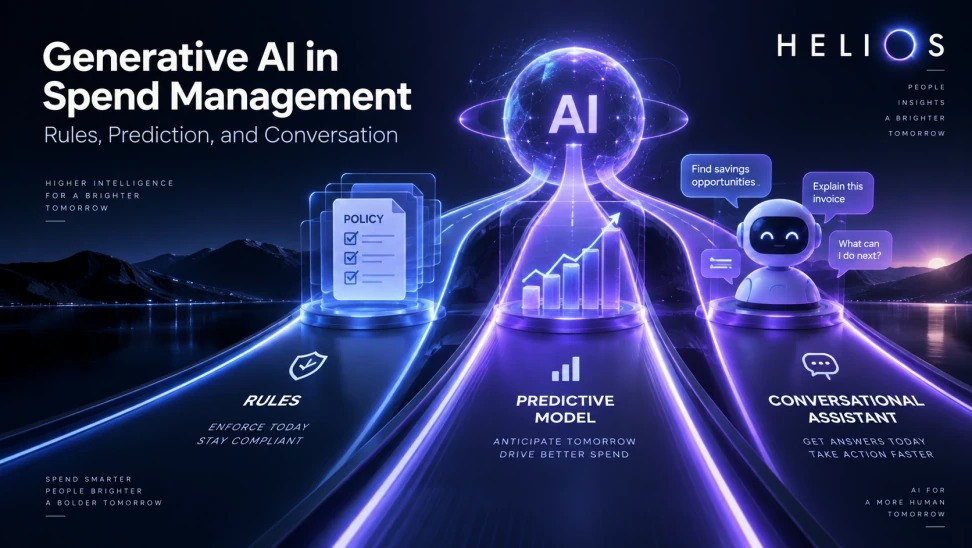
A decision guide for using deterministic rules, predictive models, and generative AI in spend management according to the task and risk.
A practical framework for finance teams
A decision guide for using deterministic rules, predictive models, and generative AI in spend management according to the task and risk.
Spark AI supports conversational assistance and policy review. This guide does not claim that Helios provides every predictive model, fully autonomous action, or unsupervised financial decision described in the broader method.
For related guidance, see Spark AI.
A useful approach starts with definitions, data boundaries, accountable owners, and measures that can change a decision. The following framework keeps the analysis comparable while connecting it to day-to-day expense operations.
Generative AI in Spend Management at a glance
| Method | Best fit | Primary input | Main control |
| Rules | Fixed thresholds and eligibility | Explicit policy and fields | Versioned logic |
| Prediction | Classification or anomaly scores | Labeled historical data | Performance monitoring |
| Conversation | Explanation and guided action | Context and approved knowledge | Grounding and review |
| Human judgment | Novel or high-impact exceptions | Evidence and accountability | Named decision owner |
For related guidance, see AI expense copilot and data protection.
A decision-ready framework turns expense data into accountable action.
Use rules for explicit decisions
Rules suit spend limits, required fields, restricted categories, approval thresholds, and deterministic routing. They are testable and repeatable when policy can be written precisely.
Version every rule, record the input and result, and provide an exception route. Generative AI should not replace simple logic that must behave identically every time.
For related guidance, see agentic finance workflows.
Use prediction for probabilistic patterns
Predictive models can rank likely categories, anomalies, or review priority when sufficient labeled data exists. A score estimates probability; it does not establish policy truth.
Measure precision, recall, calibration, coverage, drift, and performance by entity or category. Define thresholds and human review based on the cost of error.
Use conversation for explanation and guidance
Generative AI is useful for natural-language policy questions, summarizing context, drafting an explanation, or guiding an employee to the next step. Retrieval should ground answers in approved sources.
Measure answer support, task completion, escalation, correction, and user feedback. Provide citations or evidence links where the decision requires traceability.
Define tasks that should stay outside GenAI
Final payment release, irreversible posting, legal or tax conclusions, unsupported policy waivers, and high-impact disciplinary decisions need deterministic controls and accountable human authority.
A conversational response can assist the user, but authorization must remain in the governed workflow.
For related guidance, see AI finance operations use cases.
Design the human–AI split
Specify what AI observes, suggests, explains, or prepares; what a rule enforces; and what a person approves. Show uncertainty and route low-confidence or conflicting cases.
Log the source, model or rule version, output, user change, final decision, and reason at a level appropriate to risk and privacy.
Evaluate value and failure boundaries
Baseline time, touches, accuracy, return rate, and resolution quality. Compare against a non-AI workflow and review errors by severity, not only average accuracy.
Test missing receipts, multilingual inputs, conflicting policies, prompt attacks, sensitive data, outdated sources, and service outages before scale.
How Helios supports this workflow
Helios can connect mobile expense capture, multilingual OCR, configurable policy controls, role-based approvals, accounting preparation, integration, and multidimensional reporting. Spark AI can support conversational assistance and policy review within the confirmed product scope. Predictive modeling, autonomous execution, specific logs, and retention periods should be validated during solution design.
For related guidance, see finance AI agent capabilities and limitations.
- Use deterministic policies and approval routing for explicit controls.
- Use Spark AI for confirmed conversational assistance and policy review.
- Connect AI guidance to receipt, claim, and workflow context.
- Escalate exceptions to accountable employees, managers, or finance reviewers.
- Preserve supporting information for governed review.
- Measure adoption, correction, escalation, and operational outcomes.
A practical conclusion
The best result is a repeatable operating model: define the question, preserve the evidence, assign the decision, measure the outcome, and improve the policy or workflow when the data supports a change.
See how Helios can support this workflow. Request a Helios demo.
FAQ
What is generative AI in spend management?
It uses language models to interpret context, answer questions, summarize evidence, or guide users in spend workflows.
When are deterministic rules better?
Use rules when a policy or threshold must produce the same auditable result for the same inputs.
When is prediction useful?
Use it for probabilistic classification or prioritization when labeled data and monitoring are available.
Which tasks should not rely on GenAI alone?
Irreversible payments, unsupported waivers, legal or tax conclusions, and high-impact decisions require governed controls and human authority.
How should teams evaluate GenAI?
Measure grounded answer quality, completion, correction, escalation, latency, risk severity, and operational impact.
What does Helios confirm?
Helios confirms Spark AI conversational and policy-review capabilities; other predictive or autonomous functions should be validated.