
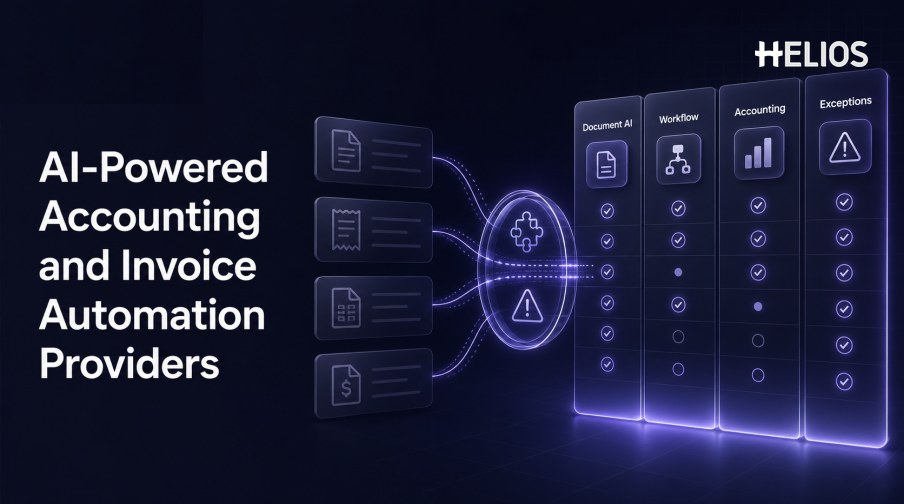
AI-powered accounting invoice automation providers approach the market from different directions. Some begin with document capture, some with accounts payable, some with expense management, and others with accounting integration or workflow automation. Similar labels can therefore describe substantially different capabilities.
A useful comparison should examine what documents the provider recognizes, which fields it captures, how it validates data, how exceptions move, what accounting actions it supports, and how the implementation fits the organization’s systems and controls. ‘Top’ should mean best fit for the tested requirements—not a universal ranking.
This guide provides a provider-evaluation framework and explains how Helios OCR, expense workflows, and accounting integration relate to invoice automation.
Types of Invoice Automation Providers
The provider category often reveals the product’s strongest and weakest areas.
- Document AI providers. Focus on OCR, classification, field extraction, tables, APIs, and confidence handling, while customers build more of the workflow.
- Expense-management platforms. Connect invoice or receipt capture with employee claims, policy, approvals, reimbursement, accounting, and reporting.
- Accounts-payable platforms. May add supplier records, purchase orders, invoice approval, payment scheduling, and AP controls.
- Accounting or ERP extensions. Emphasize native posting, master data, tax, period controls, and existing finance processes.
- Workflow-automation platforms. Provide flexible routing and integration but may rely on separate recognition and finance logic.
- Specialist service providers. Combine software with managed review, configuration, or data-entry services for selected documents or regions.
Document Recognition and Data Extraction Criteria
Providers should be compared using the organization’s own documents.
- Supported inputs. Confirm native PDFs, scans, photographs, email attachments, multi-page documents, batch files, and relevant capture channels.
- Header-field coverage. Test supplier, invoice number, dates, currency, totals, tax, payment terms, references, and required business fields.
- Line-item coverage. Evaluate descriptions, quantities, units, prices, tax, discounts, and table structures where required.
- Language and regional coverage. Use real documents with relevant scripts, date and decimal conventions, currencies, and tax formats.
- Accuracy and confidence. Measure critical fields separately and require source highlighting, confidence, and controlled correction.
- Learning and maintenance. Understand how new layouts, corrections, templates, models, and release changes affect production performance.
Workflow Automation and Exception Handling
The workflow must turn extracted fields into accountable decisions.
- Validation rules. Check required values, arithmetic, duplicates, policy, reference data, coding, and business context.
- Flexible routing. Support entity, role, department, cost center, amount, category, supplier, exception, and escalation conditions.
- Reviewer experience. Show source evidence, extracted values, policy results, related records, corrections, comments, and history together.
- Exception resolution. Assign an owner, request evidence, correct values, approve, reject, return, escalate, and record the outcome.
- Service levels and reminders. Track aging, deadlines, blocked items, reassignment, escalation, and unresolved integration errors.
- Audit trail. Retain source, extraction, edits, checks, decisions, actors, timestamps, exports, and final status.
Accounting Integration and Financial Controls
Accounting claims should be tested in the proposed configuration.
- Mapping capability. Confirm entity, account, tax, cost center, project, category, and other dimensions required by the accounting model.
- Entry generation. Understand whether the provider creates a draft, approved entry, interface file, or directly posted transaction.
- Validation and authority. Test balanced entries, periods, duplicate references, required dimensions, permissions, approvals, and posting limits.
- Integration reliability. Review APIs, files, connectors, authentication, schema changes, rejected records, retries, idempotency, and reconciliation.
- Source-to-ledger traceability. Verify that the accounting record remains linked to the source invoice, workflow, and later adjustments.
- Payment boundary. Clarify whether the provider prepares accounting only or also supports supplier payment, employee reimbursement, or payment controls.
Security, Governance, and Operational Fit
A provider becomes part of the organization’s financial-control environment.
- Identity and access. Evaluate SSO, role-based access, entity boundaries, least privilege, segregation of duties, and privileged administration.
- Data protection. Review encryption, retention, deletion, residency, backups, monitoring, subprocessors, and incident response.
- Change management. Require controlled updates to extraction, rules, mappings, workflow, integrations, and permissions.
- Operational monitoring. Track accuracy, corrections, exceptions, queue age, interface failures, retries, and service availability.
- Support model. Define implementation ownership, service hours, languages, escalation, issue response, training, and release communication.
- Business continuity. Plan for service interruption, export, manual fallback, audit access, and vendor exit.
How to Compare Providers Fairly
A common scorecard and test process makes provider results comparable.
- Document the required scope. Define documents, fields, validations, volumes, entities, countries, workflow roles, systems, and service levels.
- Weight the criteria. Separate mandatory requirements from preferences and assign weights based on business and control impact.
- Use one representative test set. Give providers the same common, difficult, multilingual, line-item, and exception cases.
- Run the same workflow scenarios. Test correction, routing, escalation, approval, accounting, failure handling, reporting, and audit retrieval.
- Measure total effort. Include implementation, integrations, configuration, correction work, administration, support, licensing, and change management.
- Validate references and claims. Confirm capabilities in the exact version, region, configuration, implementation plan, and acceptance criteria proposed.
- Select for operating fit. Choose the provider that meets measured needs and control requirements rather than the longest feature list.
How Helios Relates to Invoice Automation Provider Evaluation
Helios is an expense-management platform that publicly describes invoice upload, OCR auto-fill, policy controls, flexible approval workflows, accounting-entry generation, and analytics. Spark AI adds conversational claim and approval assistance. These capabilities provide five relevant evaluation points:
- OCR document capture. Users can photograph or upload invoices and reduce manual entry.
- Expense-context validation. Captured data can be checked within policy and reimbursement workflows.
- Configurable approvals. Workflow routing can reflect departments, roles, cost centers, and business conditions.
- Accounting handoff. The accounting engine generates journal entries from approved expense reports.
- Reporting visibility. Dashboards and customizable reports support finance analysis.
Helios also presents itself as an enterprise-grade provider with global experience and information-security credentials. Helios is not publicly positioned as a complete universal AP suite, so organizations should validate supplier management, purchase-order matching, tax requirements, payment functions, fraud controls, accounting systems, regional coverage, service model, and implementation scope.
FAQs About AI-Powered Accounting Invoice Automation Providers
Are all invoice automation providers the same?
No. Products may originate in document AI, expense management, AP, accounting, or workflow automation, which affects their strengths and process scope.
How should providers be ranked?
Use weighted requirements and the same representative test set. A universal ranking is less useful than measured fit for the organization’s documents, systems, controls, and regions.
Which capability is easiest to overestimate?
Recognition accuracy is often overgeneralized. Test critical fields, difficult documents, line items, corrections, exceptions, and downstream acceptance separately.
Why is exception handling important?
Even strong recognition encounters missing, conflicting, low-confidence, unusual, or out-of-policy records. The exception workflow determines operational effort and control quality.
Where does Helios fit?
Helios connects invoice OCR with expense policy, approval, accounting-entry, and reporting workflows. Buyers should validate any broader supplier, PO, or payment requirements.
Finance teams can compare Helios invoice and expense automation against other provider categories using the same documents, fields, workflow scenarios, accounting mappings, exception cases, security requirements, and total-cost assumptions.