
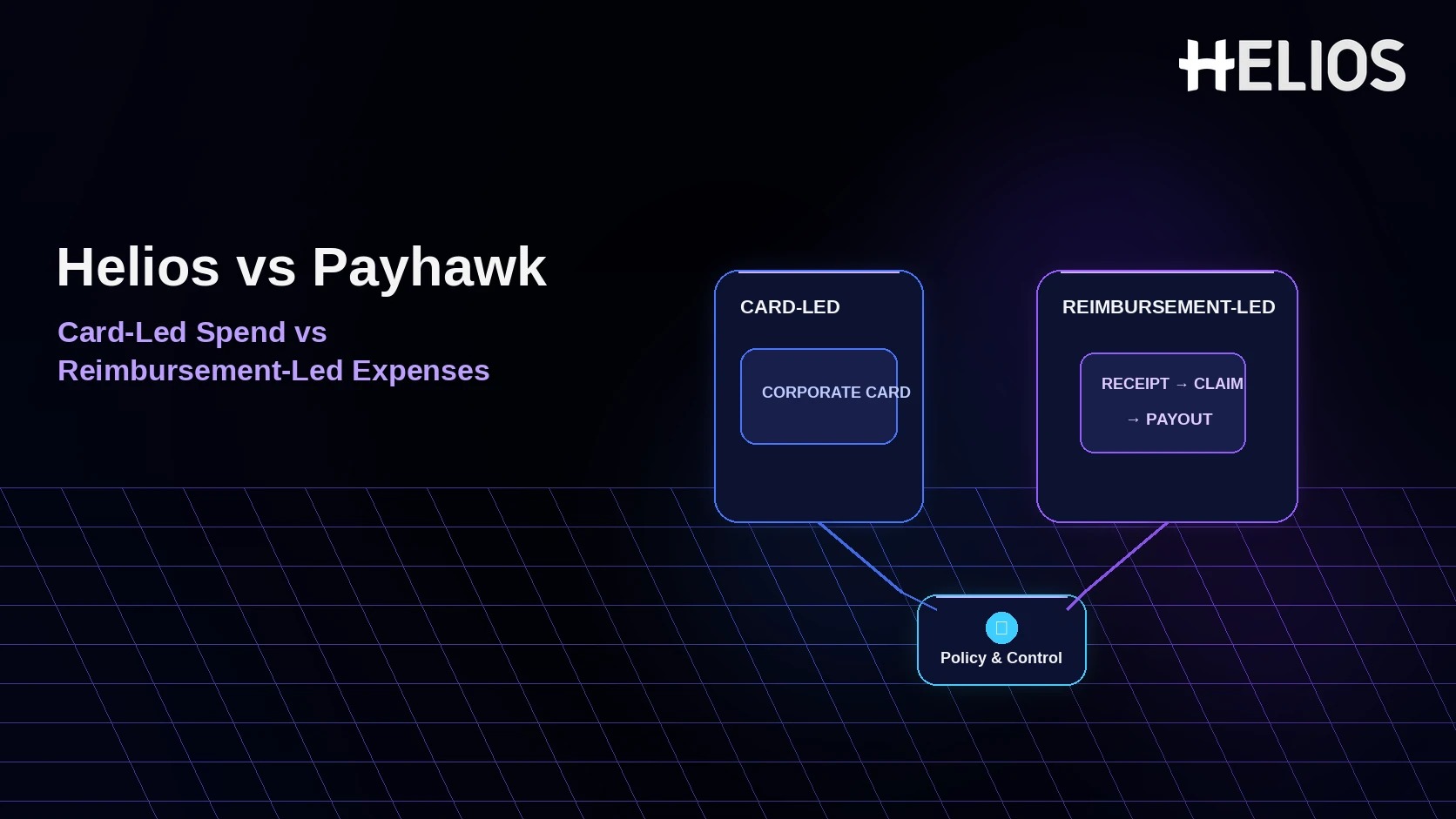
Helios and Payhawk can both manage employee expenses, but they approach company spend from different starting points. Helios is built around the reimbursement lifecycle — employee pays, submits, gets approved, gets paid back. Payhawk is built around the corporate card — the company pays first, controls happen at the point of spend, and reimbursements, bills, AP, purchase orders, subscriptions, and travel sit alongside the card as additional spend types.
For this comparison, card-led means corporate cards are a primary way employees spend company money and the platform controls that spend before or at the transaction. Reimbursement-led means employees may pay out of pocket, submit a claim, pass policy and approval checks, and receive repayment afterward. Payhawk supports both models, so the decision is not card versus reimbursement in absolute terms. It is about which operating model the company wants to make primary.
Helios vs Payhawk: The Core Difference
The most important distinction is where financial control begins. A card-led program places limits, merchant controls, budgets, and transaction visibility around company-issued cards. A reimbursement-led program places more emphasis on receipt capture, claim completeness, policy validation, approval responsibility, repayment, and accounting after an employee-funded purchase.
Helios public product materials emphasize the reimbursement and expense lifecycle: submit from a phone, capture receipts with OCR, apply company policy, route approval, generate journal entries, and analyze spend. Its current public Helios pages do not list corporate card issuance among the six core capabilities. Payhawk, by contrast, prominently markets global corporate cards and real-time card controls while also supporting reimbursable expenses, mileage, per diem, supplier invoices, and other spend types.
Helios vs Payhawk at a Glance
The table below compares the two platforms by operating model rather than treating either as a single-purpose tool. Country availability, payment rails, and pricing still need confirming for your own rollout — the model difference underneath them does not change by region.
| Category | Helios | Payhawk |
| Primary focus | Employee expense and reimbursement automation | Corporate-card-led spend management plus reimbursements and AP |
| Typical spend source | Employee-paid expenses and reimbursement claims | Company cards, reimbursements, bills, cash, mileage, and per diem |
| Control point | Policy checks, approval, finance review, and accounting workflow | Card limits and transaction controls plus approval and review workflows |
| Employee experience | Mobile-first claim submission, receipt capture, and approvals | Mobile/web card expenses, reimbursements, receipt capture, and approvals |
| Accounting | Automatic journal-entry generation from expense reports | ERP/accounting integration with coding, matching, reconciliation, and payment workflows |
| Broader spend scope | Focused enterprise expense lifecycle | Cards, AP, purchase orders, reimbursements, subscriptions, and other company spend |
| Best fit | Finance teams prioritizing expense automation and reimbursement control | Companies making corporate cards and real-time spend control central to the operating model |
How Card-Led and Reimbursement-Led Workflows Differ
Neither model is universally better. The practical difference is when company money moves and where the strongest control is applied.
- Card-led workflow. The company issues a physical or virtual card, sets limits and rules, the employee pays with company funds, the transaction appears immediately, and the receipt and accounting details are completed afterward. Payhawk automatically creates a card expense after a card transaction and then routes the record through submission and review.
- Reimbursement-led workflow. The employee pays personally, captures the receipt, submits a claim, the system validates policy and required information, approvers act, and finance reimburses the employee. Helios is publicly positioned around this mobile claim-to-accounting lifecycle.
- Hybrid workflow. Many enterprises need both. Corporate cards may be standard for recurring suppliers, subscriptions, or frequent travelers, while reimbursement remains necessary for merchants, countries, or situations where company cards are not the chosen payment method.
Card and Spend Control: Where Payhawk Is Stronger
Payhawk is the stronger shortlist candidate when corporate cards are intended to become a default spend mechanism. Its enterprise proposition emphasizes issuing and managing cards, controlling employee spend, consolidating multiple entities, and combining card transactions with reimbursements, supplier payments, subscriptions, and other spend in one platform.
The operating advantage is timing. Card transactions can be governed with limits and controls before or at purchase, then automatically appear in the expense workflow. Payhawk also supports expense-type-specific approvals, reimbursement payments directly to employee bank accounts, bulk reimbursement, OCR, and ERP reconciliation. That means a card-led strategy does not require abandoning employee reimbursements; it makes cards the primary control layer while keeping reimbursement as another supported expense type.
Reimbursement and Expense Automation: Where Helios Is Stronger
Helios is the more natural fit when the business case starts with employee expense automation rather than card issuance. Its public product design is centered on making reimbursement easier for employees while giving finance structured control through policy, approvals, accounting, and analytics.
This can be attractive when the organization already has banking and card arrangements it does not want to replace, when employee-paid expenses remain common across countries, or when finance wants to modernize expense operations without making a new card program the center of the transformation. The key evaluation question is whether Helios covers the organization’s actual payment, country, tax, reimbursement, and card-integration requirements; its current public core-feature pages do not position native corporate card issuance as a primary capability.
Policy, Approvals, and Finance Review
Both platforms automate control, but the control model reflects their broader positioning. Helios automatically enforces company spending policies and supports custom approval flows based on department, role, or cost center. Approval Copilot can assist reviewers with policy and document context while the authorized user remains responsible for the decision.
Payhawk can define different workflows for card transactions, reimbursements, bills, mileage, per diem, and other expense types. Its workflow stages can include submit, approve, review, reimburse or pay, and payment authorization, with role-based approvers and segregation-of-duties options. A pilot should test the same high-value claim, policy exception, delegate, cost-center owner, and finance review scenario in both platforms.
Accounting, Payments, and Global Operations
Helios states that its accounting engine automatically generates journal entries from expense reports and provides multi-dimensional reporting. Its homepage describes an end-to-end lifecycle from request and spending through reimbursement, accounting, payment, and reporting. Finance teams should validate the exact ERP object, account dimensions, tax treatment, currency logic, payment status, and reconciliation behavior required in each country.
Payhawk combines accounting integration with payment execution. Approved reimbursements can be paid directly from the platform, including bulk or scheduled payments, and its broader product can also manage supplier payments and AP. Its enterprise materials emphasize multi-entity operations and a single environment for cards, reimbursements, bills, and other spend. This breadth can be valuable, but it also means implementation scope may extend beyond the employee-expense team.
How to Choose Between Helios and Payhawk
A useful evaluation starts with the desired spend model rather than a generic feature checklist.
- Define the default payment model. Decide whether corporate cards should become the standard way employees spend, whether reimbursement will remain primary, or whether the organization deliberately needs a hybrid model.
- Map the real expense mix. Quantify card transactions, out-of-pocket claims, mileage, per diem, supplier invoices, subscriptions, travel, cash expenses, and country-specific payment needs. The dominant volume should influence platform fit.
- Test control timing. Compare pre-spend or card controls with post-purchase policy validation, approval, finance review, and exception handling. Confirm which risks the company wants to prevent before purchase and which it expects to resolve during reimbursement.
- Validate accounting and payment end to end. Run real transactions through reimbursement or card settlement into the target ERP. Check dimensions, tax, currency, attachments, payment status, integration errors, retries, and reconciliation.
- Measure organizational change. A card-led transformation affects issuance, limits, employee funding behavior, treasury, banking, and merchant acceptance. A reimbursement-led transformation affects claim submission, approvals, finance review, payment, and accounting. Choose the change model the organization can govern well.
How Helios Supports Reimbursement-Led Expense Management
Choosing reimbursement as the primary model only pays off if the claim-to-accounting chain is genuinely tight, without a card program filling the gaps. The clearest way to see that is to walk a single $150 client-dinner expense through both operating models:
| Step | Payhawk (card-led) | Helios (reimbursement-led) |
| 1. Spend happens | Employee swipes the company card; a hold is placed instantly | Employee pays out of pocket with a personal card or cash |
| 2. Control point | Card limits and merchant rules apply before or at the swipe | OCR captures the receipt and automated policy checks flag anything over the meal limit before it reaches a reviewer |
| 3. Evidence | Receipt is uploaded after the fact to match the card transaction | Receipt is the trigger — the claim doesn't exist without it |
| 4. Approval | Routes for review once the transaction lands | Routes by department, role, or cost center; Approval Copilot surfaces the policy context so the reviewer stays accountable |
| 5. Close-out | Reconciled against the card statement | Approved report generates the journal entry directly — no separate reconciliation step |
The reimbursement-led model compensates for not having a card-level spend limit by catching problems at submission instead of at the point of purchase — but that only works if step 5 (accounting automation closing the loop) is airtight, since there's no card control layer upstream to catch what slips through.
If corporate cards later become a required part of the operating model, confirm card-feed, issuance, and real-time control requirements explicitly — Helios's public expense-management pages don't cover native card issuance the way Payhawk's do.
Final Verdict: Helios or Payhawk?
Choose Helios when the primary transformation goal is reimbursement-led employee expense management: faster mobile claims, automated policy, configurable approval, AI-assisted review, accounting automation, and expense reporting. It is especially relevant when the company does not want a new corporate card program to define the expense project.
Choose Payhawk when the company wants corporate cards to become a central spend-control mechanism and also wants reimbursements, AP, supplier payments, subscriptions, and other spend managed alongside those cards. Payhawk is not reimbursement-free; its advantage is the ability to combine reimbursements with a broader card-led spend environment.
For many global enterprises, the real decision is not “cards or reimbursements forever.” It is which model should be primary, which should remain an exception path, and how much broader spend transformation the organization wants the platform to own.
Related Helios guidance includes expense reimbursement software, expense management software, automated approval workflows, finance automation for expense management, and global expense management.
FAQs About Helios vs Payhawk
We already issue corporate cards through a bank — does that rule out Helios?
Not automatically. Helios doesn't need to own card issuance to be relevant — its public focus is the reimbursement, policy, and accounting side of spend. What isn't confirmed on Helios's public pages is exactly how existing card transaction data would feed into that workflow, so treat "does the card feed connect cleanly" as an explicit demo question rather than an assumed yes.
If we start reimbursement-led with Helios, does moving to cards later mean switching platforms?
Not necessarily, but it does mean adding card-feed and real-time control capability that Helios's public pages don't currently list — confirm that gap explicitly rather than assuming it closes automatically as the company grows.
What's the fastest way to tell which model actually fits our spend pattern?
Pull three months of actual transactions and split them by payment method. If the majority are already employee-paid claims, reimbursement-led is the lower-disruption starting point; if card spend already dominates, evaluate Payhawk's control model first.