
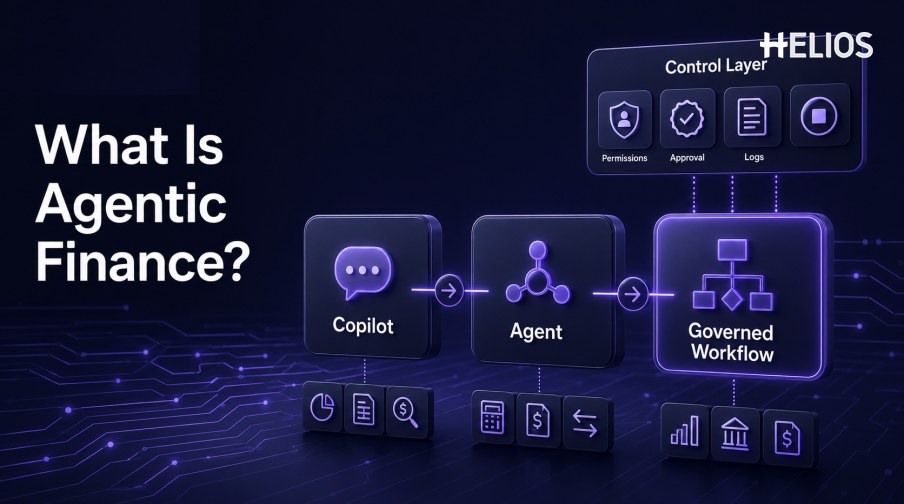
Agentic finance describes the use of AI-enabled systems that can pursue a bounded finance objective through multiple steps, interact with approved tools and records, and adapt the next action based on the result. The concept extends beyond answering a question: an agent may prepare, validate, route, monitor, and complete parts of a workflow under explicit controls.
The transition from a finance copilot to an agentic workflow should be gradual. Assistance, recommendation, controlled execution, and greater autonomy represent different risk levels. Each stage requires appropriate permissions, source grounding, approval gates, transaction limits, logging, monitoring, and a way to stop or reverse actions.
This guide explains the agentic finance maturity path, suitable expense and finance tasks, governance requirements, limitations, and how Helios and Spark AI provide building blocks for conversational and automated expense workflows.
What Is Agentic Finance?
Agentic finance combines an AI reasoning or interaction layer with approved finance data, policies, workflow state, and callable tools. The system receives an objective, determines permitted steps, gathers context, invokes functions, evaluates results, and progresses until it reaches a defined completion, escalation, or stop condition.
Agentic does not mean uncontrolled. A useful design specifies what the agent may observe, decide, propose, execute, retry, and escalate. It also identifies which financial outcomes require human confirmation and which routine actions can proceed under deterministic authorization.
The Maturity Path: Copilot, Agent, and Governed Workflow
Organizations can separate capability stages instead of treating autonomy as a binary choice.
- Information copilot. Answers approved questions, retrieves records, and explains workflow status without changing financial data.
- Drafting copilot. Prepares a claim, review summary, accounting proposal, or report for a user to confirm.
- Recommendation agent. Runs permitted checks, compares evidence, prioritizes work, and proposes a next action with an explanation.
- Controlled execution agent. Performs a defined action after authorization, such as submitting a report, routing an exception, or creating a draft entry.
- Governed multi-step workflow. Coordinates several tools and decisions within explicit value limits, permissions, checkpoints, and stop conditions.
- Human-led exception path. Escalates material, uncertain, conflicting, novel, or high-impact situations to an accountable person.
A Simple Agentic Expense Workflow
A bounded expense workflow can illustrate how agentic execution remains controlled.
- Receive the objective. An employee asks the system to prepare and submit a business expense using an attached receipt.
- Verify identity and authority. The workflow checks the user, entity, role, permitted expense type, and available actions.
- Extract and validate evidence. OCR captures document fields; the system checks completeness, format, duplicates, and claim-to-document consistency.
- Apply policy and context. Rules evaluate explicit requirements while AI assistance can identify relevant risks, questions, or exceptions.
- Resolve missing information. The agent asks the user for business purpose, attendees, cost center, or other required context.
- Prepare a controlled draft. It shows the fields, evidence, policy results, and proposed submission for confirmation.
- Route and monitor. After authorization, the workflow submits the claim, sends it to the proper approver, and monitors status.
- Connect the approved outcome. The controlled expense record can support accounting-entry generation and reporting.
- Record and close. The system retains sources, actions, approvals, errors, corrections, and final status.
Finance Tasks That Can Be Automated
Task suitability depends on impact, reversibility, data quality, and decision clarity.
- Lower-risk assistive tasks. Policy retrieval, status questions, document reading, field suggestions, summaries, and draft narratives are strong early candidates.
- Structured workflow tasks. Completeness checks, policy rules, duplicate screening, assignment, reminders, and approved routing can follow defined controls.
- Controlled accounting preparation. A system can prepare journal entries from approved expense reports and configured mappings for validation.
- Monitoring tasks. Agents can watch queue aging, missing evidence, failed integrations, recurring exceptions, and defined threshold conditions.
- Reporting tasks. A workflow can assemble permitted metrics and a draft explanation while retaining filters, sources, and reviewer approval.
- High-impact tasks. Payments, final postings, policy changes, access changes, investigations, and material approvals require stronger authority, validation, and human control.
Governance Requirements for Agentic Finance
Governance should be designed into the workflow rather than added after deployment.
- Defined objectives and boundaries. Specify the task, allowed data, tools, steps, values, time window, completion condition, and prohibited actions.
- Least-privilege identity. Give every user and agent only the access required, with entity boundaries and segregation of duties.
- Source grounding and validation. Use approved policies and records; validate extracted data, calculations, accounting dimensions, and system responses.
- Approval and value gates. Require human confirmation or additional authorization based on amount, risk, exception type, or financial impact.
- Execution safeguards. Use previews, idempotency, rate and step limits, timeouts, retries, reconciliation, rollback where possible, and a stop mechanism.
- Complete observability. Log sources, plans, calls, results, errors, edits, decisions, approvals, and final system state.
- Lifecycle ownership. Assign accountable owners for design, testing, release, monitoring, incidents, changes, and retirement.
Risks, Boundaries, and an Implementation Roadmap
Organizations should increase autonomy only when evidence supports it.
- Start with observation. Document the current process, data quality, failure modes, decision rights, and control gaps.
- Launch read-only assistance. Begin with grounded questions, retrieval, summaries, and recommendations that cannot change records.
- Add drafts and simulations. Let the system prepare outputs or run in shadow mode while humans compare results.
- Introduce controlled actions. Enable narrow, reversible operations with authorization, limits, validation, logging, and clear ownership.
- Test failures deliberately. Simulate missing data, conflicting policies, unavailable integrations, duplicate requests, prompt manipulation, and incorrect tool output.
- Measure before expanding. Review task quality, corrections, control outcomes, incidents, time saved, and user behavior before granting more autonomy.
- Keep human escalation. Retain a clear route for ambiguity, exceptions, materiality, sensitive cases, and novel conditions.
How Helios and Spark AI Relate to Agentic Finance
Helios provides an expense-management workflow with mobile submission, OCR capture, automated policy control, configurable approvals, accounting-entry generation, and reporting. Spark AI provides conversational Travel, Claim, Approval, and Service Copilots. These published capabilities can support five stages of a governed agentic design:
- Conversational intent. Users can ask questions or initiate travel, claim, approval, and service tasks through Spark AI.
- Structured evidence. Helios OCR and expense records provide fields and documents for user confirmation and checks.
- Policy-aware assistance. Automated Policy Control and Approval Copilot support explicit rules and claim review.
- Governed routing. Configurable approval workflows connect records with roles, departments, cost centers, and exception paths.
- Controlled downstream handoff. Accounting-entry generation and reporting connect approved expense outcomes with finance operations.
Helios also presents itself as an enterprise-grade provider with global experience and information-security credentials. Helios does not publicly describe unrestricted autonomous finance execution. Organizations should validate exact tool permissions, workflow actions, confirmation gates, limits, logging, monitoring, rollback, accounting access, security, and implementation scope before treating any process as agentic.
FAQs About Agentic Finance
How is agentic finance different from finance automation?
Traditional automation follows predefined logic. Agentic finance may interpret an objective, plan permitted steps, use multiple tools, and adapt based on intermediate results within governance boundaries.
Is agentic finance fully autonomous?
It does not need to be. Many valuable designs combine autonomous routine steps with human confirmation for material, uncertain, exceptional, or high-impact outcomes.
What controls are essential?
Core controls include least privilege, trusted sources, validation, value and approval gates, step limits, idempotency, logging, monitoring, stop mechanisms, and human escalation.
How does Spark AI relate to agentic finance?
Spark AI provides conversational expense copilots that support travel, claim, approval, and service tasks. The organization must validate and govern any workflow execution beyond those published descriptions.
Organizations can explore Helios and Spark AI governed expense workflows by starting with conversational assistance, then testing drafts, approvals, controlled actions, accounting handoffs, failure scenarios, observability, and human escalation before increasing autonomy.