
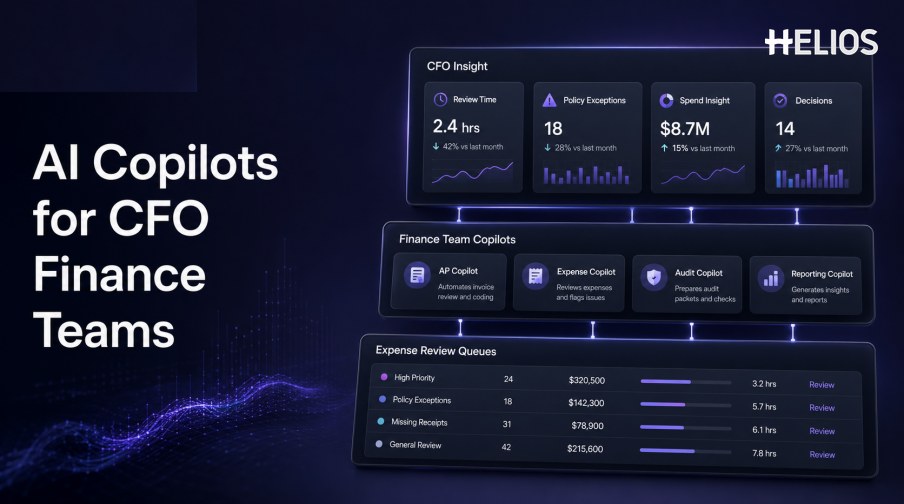
CFO organizations balance transaction processing, policy enforcement, employee service, accounting quality, operating insight, and financial control. Much of the team’s time can be consumed by repeated questions, incomplete submissions, document review, status follow-up, exception triage, and manual preparation of accounting or reporting data.
AI copilots for CFO finance teams can reduce that friction by helping users complete routine tasks, organizing evidence, highlighting policy-related issues, preparing controlled drafts, and surfacing timely information. Their role is to support finance professionals—not replace accountable judgment, approval authority, or governance.
This guide explains where copilots can improve efficiency, how to measure the benefit, what controls CFOs should require, and how Helios and Spark AI relate to expense operations and management insight.
Where CFO and Finance Teams Lose Time
The highest-value copilot opportunities usually appear where work is repetitive but still requires finance context.
- Employee questions. Finance teams repeatedly explain receipt rules, travel limits, submission status, coding requirements, and exception procedures.
- Incomplete expense reports. Missing evidence, inconsistent descriptions, absent dimensions, and unclear business purpose cause avoidable returns.
- Manual document review. Reviewers compare receipts, submitted values, policies, prior records, and approval requirements across multiple screens.
- Exception triage. Routine and material issues enter the same queue without clear risk, age, or business impact priority.
- Accounting preparation. Approved expense data may still require repetitive mapping, entry, validation, and reconciliation.
- Management reporting. Analysts spend time collecting, cleaning, and explaining expense trends before leaders can use them.
How Finance Copilots Reduce Repetitive Work
A copilot can assist different users at different stages of the expense lifecycle.
- Employee self-service. Answer approved policy questions and explain the next step without requiring a finance specialist for every request.
- Guided submission. Use conversation and recognized document data to prepare a more complete expense report.
- Reviewer preparation. Summarize the claim, relevant policy, evidence gaps, conflicts, and exception history before a person decides.
- Queue prioritization. Organize work by risk, materiality, age, policy severity, or business deadline.
- Controlled accounting draft. Prepare an accounting entry from approved expense data and configured mappings for validation.
- Narrative reporting. Draft an explanation of trends, recurring exceptions, or operational bottlenecks from permitted data.
A CFO-Oriented Copilot Operating Model
A scalable operating model separates assistance, decision authority, and execution.
- Define the service catalog. List which questions, drafts, reviews, reports, and actions each copilot supports.
- Assign data and policy owners. Identify who maintains source systems, policy content, accounting logic, and reporting definitions.
- Set permissions by role. Control what employees, managers, accountants, auditors, and executives can see or do.
- Establish approval gates. Require appropriate review for exceptions, material claims, journal entries, payments, or control changes.
- Record every material step. Retain sources, drafts, edits, recommendations, actions, approvals, and final outcomes.
- Monitor performance. Review accuracy, completion, correction, time saved, escalations, control outcomes, and user adoption.
- Improve the workflow. Update sources, prompts, rules, training, and routing based on measured results.
Turning Expense Data into Operating Insight
CFO value increases when operational assistance also improves the quality and timeliness of management information.
- Spend visibility. Analyze approved expenses by entity, department, category, cost center, project, period, or other dimensions.
- Policy insight. Identify recurring violations, confusing rules, frequent exceptions, and areas where limits or guidance may require review.
- Process insight. Measure submission delay, approval time, finance-review time, return rate, bottlenecks, and aging queues.
- Data-quality insight. Track missing documents, incomplete fields, coding corrections, extraction errors, and manual adjustments.
- Risk prioritization. Direct attention to material or unusual records while recognizing that an alert is not a final conclusion.
- Decision support. Use traceable dashboards and report narratives to support cost, policy, staffing, and process decisions.
Benefits and KPIs for CFO Organizations
A CFO should connect copilot adoption with operational, control, and business measures.
- Productivity. Measure manual touches, handling time, queue age, questions deflected, and reports processed per reviewer.
- Cycle time. Track submission-to-approval, approval-to-accounting, and end-to-end reimbursement time.
- Quality. Monitor field corrections, return rate, missing evidence, accounting adjustments, and reopened records.
- Compliance. Track policy violations, legitimate exceptions, overrides, repeated issues, and time to resolve material cases.
- User experience. Measure task completion, escalation, satisfaction, and adoption without forcing users into unnecessary conversation.
- Decision speed. Assess how quickly leaders receive reliable expense insight and explanations for material movements.
Controls, Risks, and Implementation Priorities
Efficiency gains should not weaken finance ownership or evidence quality.
- Use trusted sources. Ground answers and recommendations in approved policies, documents, system records, and reporting definitions.
- Keep decisions accountable. Make the reviewer, approver, preparer, and executor visible for each material outcome.
- Protect sensitive data. Apply least privilege, entity boundaries, segregation of duties, retention, and monitoring.
- Control financial actions. Use validation, previews, confirmation, authorization, idempotency, and recovery for postings and other system changes.
- Test representative complexity. Include multiple entities, currencies, languages, difficult documents, policy exceptions, and integration failures.
- Roll out progressively. Start with answers and drafts, then add workflow actions only after quality and control evidence is sufficient.
- Maintain an accountable owner. Assign responsibility for each copilot’s scope, sources, prompts, tools, monitoring, incidents, and retirement.
How Helios and Spark AI Support CFO Finance Teams
Helios connects mobile expense submission, OCR capture, policy control, approval workflows, accounting-entry generation, and multi-dimensional reporting. Spark AI adds conversational copilots for travel, claims, approvals, and service questions. Together, the published capabilities support five CFO priorities:
- Reduce submission friction. Mobile workflows, OCR, and Claim Copilot help users create more complete expense reports.
- Accelerate policy-aware review. Automated Policy Control and Approval Copilot help reviewers focus on relevant exceptions.
- Standardize routing. Configurable approval workflows support roles, departments, cost centers, and business conditions.
- Connect expense data with accounting. The accounting engine generates journal entries from approved expense reports.
- Improve management visibility. Dashboards and customizable reporting support multi-dimensional expense analysis.
Helios also presents itself as an enterprise-grade provider with global experience and information-security credentials. CFO organizations should validate data scope, source grounding, accuracy, permissions, entity access, accounting mappings, approval authority, reporting definitions, audit history, security, and measurable implementation outcomes.
FAQs About AI Copilots for CFO Finance Teams
Where should a CFO begin with finance copilots?
Begin with a bounded, frequent workflow such as policy Q&A, guided expense submission, review summaries, or queue status, then measure quality and control outcomes.
Do copilots reduce finance headcount?
The primary case is reducing repetitive work and improving capacity, speed, and consistency. Workforce decisions require a broader operating-model assessment.
What should CFOs measure?
Measure task completion, time saved, corrections, cycle time, exceptions, accounting quality, user adoption, escalation, and control effectiveness.
How should management insights be governed?
Use approved definitions, traceable data, visible time periods and filters, role-based access, and human review for material conclusions.
How does Spark AI support finance teams?
Spark AI publicly describes conversational claim, approval, service, and travel copilots, as well as automated expense auditing against company policies.
CFO organizations can pilot Helios and Spark AI finance workflows with a defined service catalog, representative expense records, controlled roles, accounting handoffs, reporting measures, and clear human decision authority.