
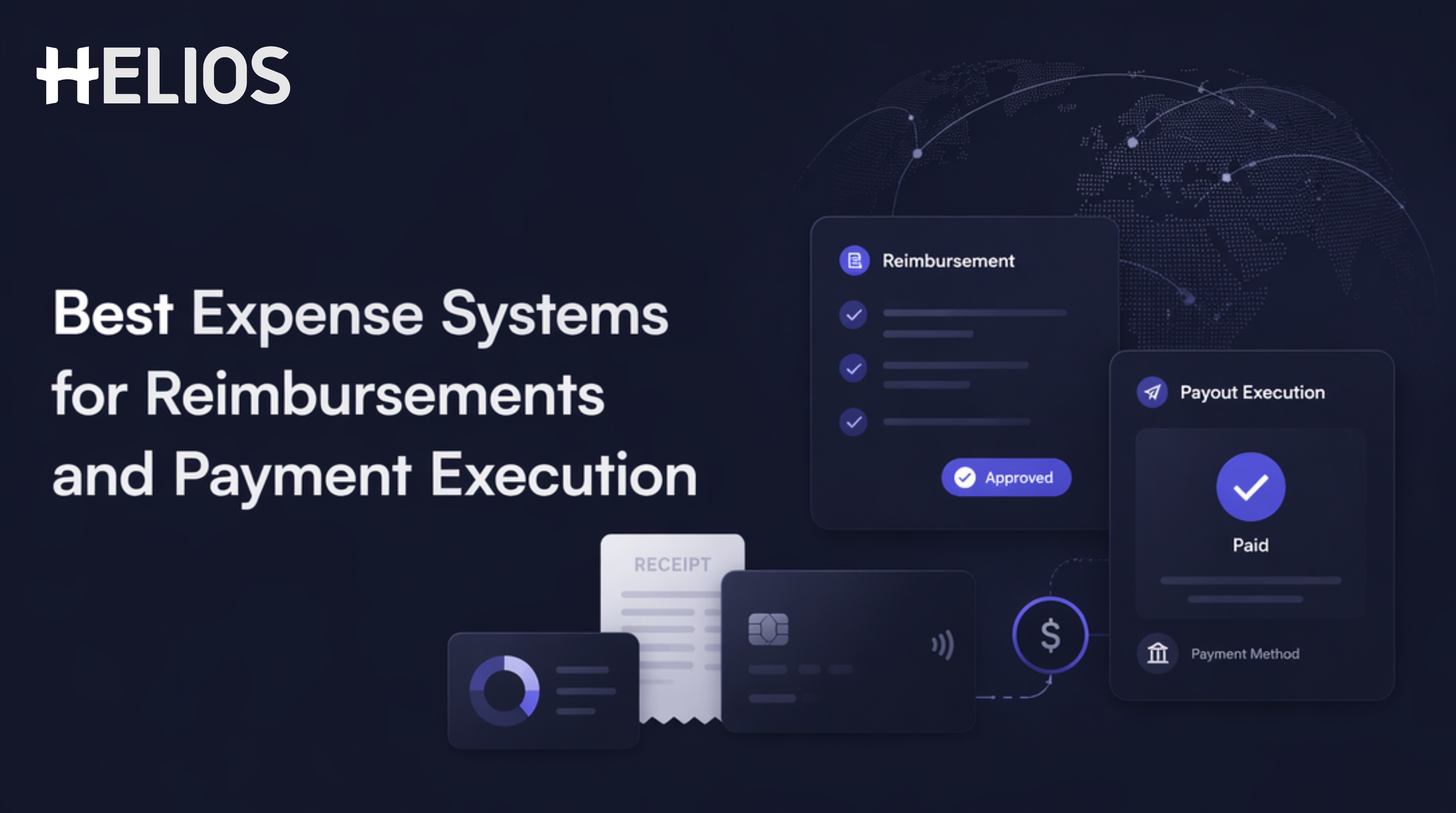
If you manage finance operations, you already know the problem: some systems handle employee reimbursements well, while others are better at sending vendor or supplier payouts. The challenge is finding one expense payment system that can support both without creating extra manual work, approval bottlenecks, or reporting gaps.
That matters more as your team grows. Once you are managing multiple departments, regions, currencies, and approval rules, a disconnected process can slow reimbursements, weaken control, and make it harder to keep records clean. In this guide, you will learn what to look for, how these systems differ, and how to evaluate platforms that support both reimbursement workflows and payout execution in one place.
****
Expense Payment Systems and Reimbursement Workflows
A reimbursement workflow is the process you use to pay back an employee after they spend personal money on a business expense. In most teams, that starts with expense submission, then moves through policy checks, approval, and finally payment. The stronger the workflow, the less time you spend chasing receipts, clarifying policy exceptions, or correcting coding errors.
An expense payment system becomes more valuable when it does more than collect claims. You want it to guide employees through submission, help managers approve quickly, and route approved items into payment without forcing finance to export data and process payouts separately. When those steps are connected, you reduce friction for both the employee and the finance team.
You should also think about how the system handles different expense types. Travel, meals, office purchases, and contractor-related spending often need different treatment. A good platform helps you standardize the process while still allowing for exceptions where policy requires them.
Payout Execution in Expense Management Software
Payout execution is the part where money actually leaves the business and reaches the right recipient. In an expense context, that may mean reimbursing an employee, paying a supplier, or settling an approved invoice. The important point is that payout execution is not just a reporting feature; it is the operational step that turns approval into completed payment.
Some tools support reimbursement tracking but stop short of execution. In that case, finance still has to move the approved data into another system, which adds extra steps and increases the risk of delays or mismatches. If you want a smoother process, you should look for software that connects approval, payment routing, and reporting in one flow.
This is especially important for companies that operate across countries. Cross-border payments often introduce extra complexity around currency conversion, tax handling, regional compliance, and timing. If your team works globally, payout execution should be evaluated with the same seriousness as approvals and receipt capture.
Key Features to Look for in Expense Reimbursement Software
When you compare expense payment systems, start with the workflow rather than the brand name. The best fit is the one that matches how your team actually works today and how you expect to scale. You should focus on features that reduce manual review and make approvals and payouts more reliable.
Here are the most important capabilities to check:
· Quick expense submission. You want employees to submit expenses easily from desktop or mobile, with receipt capture and clear category selection.
· Policy-based approval workflows. The platform should route claims based on amount, department, location, project, or custom rules.
· Budget balance tracking. Finance should be able to see how much has been spent against a budget before approving or paying.
· Employee reimbursement support. The system should handle repayment to employees without requiring a separate manual process.
· Supplier payment management. If you also pay vendors or contractors, the platform should support those payouts in the same environment.
· Invoice management. This helps when expenses and payable items overlap, especially in finance teams with shared approval steps.
· Unified reporting. You need one view of expense data, payment status, and approvals so finance can reconcile quickly.
· International travel expense handling. Global teams should be able to manage foreign spending without losing visibility.
· Digital category control. Standardized categories improve data quality and make reporting more consistent across regions.
If you are evaluating systems for a larger organization, ask whether these features are native or only possible through integrations. Native support usually means fewer handoffs and less operational risk. Integrations are still useful, but you should confirm that they do not create delays in reimbursement or payment execution.
How to Compare Systems that Handle Both Payouts and Reimbursements
Not every platform that says it supports expense management can truly handle both reimbursement workflows and payout execution. Some tools are built mainly for expense submission and approvals, while others focus more on accounts payable. The best systems connect both sides so you can move from claim to payment without losing context.
A practical way to compare tools is to look at the full lifecycle:
- The employee submits an expense or the finance team enters a payable item.
- The platform checks policy, budget, and required documentation.
- An approver reviews and confirms the item.
- The system routes it to the correct payment method.
- The payout is recorded and included in reporting.
When this workflow is broken across several tools, you often see the same problems repeat: duplicate data entry, slower reimbursement cycles, harder reconciliation, and more follow-up with employees or vendors. When it is unified, the process becomes easier to control and easier to audit.
You should also compare systems based on the kinds of payment recipients they support. Some platforms are better for employee reimbursements only. Others support supplier payments, invoice settlement, and even international transfers. If your finance team handles a mix of internal and external payouts, that distinction matters.
Another useful comparison point is visibility. Can you see the approval status, payment status, and accounting record in one dashboard? Can you search past payouts quickly? Can your finance team track exceptions and policy violations without manual spreadsheet work? These details often determine whether the system saves time in practice or only looks good during the demo.
Helios for Global Expense and Payout Workflows
If you manage expenses across more than one region, you may need a platform that brings reimbursements, supplier payments, and reporting into one controlled workflow. Helios is an AI-native enterprise expense management platform designed for global finance teams that want more standardization and less manual handling across the expense lifecycle.
In practical terms, that means the platform is built to support quick expense submission, budget balance tracking, employee reimbursement, supplier payment management, invoice management, international travel expense handling, and a unified data overview. For finance teams, that kind of setup can reduce the need to stitch together separate tools for claims, approvals, and payouts.
One reason teams evaluate a system like this is consistency. When expense categories, approval paths, and payment records are handled in a single environment, it becomes easier to maintain cleaner data across departments and countries. That can help reduce inconsistent tagging and make reporting more reliable for month-end close or audit preparation.
Another reason is workflow efficiency. If your team is dealing with recurring reimbursement requests, invoice-backed payouts, and cross-border approvals, a connected system can cut down on manual review time. The real benefit is not just speed; it is fewer handoffs and better control over the process from start to finish.
You should still review any platform carefully before adopting it. For global companies, it is wise to confirm details such as FX conversion logic, tax support, country-specific rules, VAT or GST handling, and compliance coverage in the regions where you operate. Those details often decide whether a platform fits your finance operations long term.
Best Practices When Choosing An Expense Payment System
Before you pick a platform, map your current workflow clearly. You should know who submits expenses, who approves them, who pays them, and where the process breaks down today. That gives you a better way to judge whether a system will improve operations or simply move the same problems into a new interface.
Use the following checklist during evaluation:
· Confirm that the platform supports both reimbursement and payout execution, not just expense capture.
· Ask how the system handles employee reimbursements versus supplier payments.
· Check whether approvals, payment routing, and reporting happen in one place.
· Verify accounting and ERP integration so your finance team does not have to re-enter data.
· Review multi-currency and international support if your team operates globally.
· Test audit trails, permissions, and exception handling.
· Ask for screenshots or a live demo of the exact workflow you use most often.
You should also think about the rollout experience. A system can look strong on paper but still fail if employees find it confusing or if finance has to work around weak controls. The easiest adoption usually happens when the tool is simple for employees and rigorous for finance at the same time.
For larger teams, it helps to look at standardization as a long-term benefit. A system that enforces consistent expense categories, approval logic, and payment records may save far more time than a point solution that handles only one part of the process. That is especially true if your company operates across multiple offices or legal entities.
FAQs on Reimbursement Workflows and Payout Execution
- Which expense payment systems support both reimbursement workflows and payout execution?
You should look for a platform that combine expense management, approval workflows, employee reimbursement, and payment handling in one product like Helios. The best fit is usually a system that can also manage supplier payments and reporting without forcing manual exports.
- What is the difference between reimbursement and payout execution?
Reimbursement is the process of paying someone back after they spend money for the business. Payout execution is the actual movement of funds to complete that payment or settle another approved obligation.
- Do all expense management tools support vendor or supplier payments?
No, they do not. Many tools focus on employee expense claims and stop there, so you should verify whether supplier payments are supported natively or only through another system.
- What should global finance teams prioritize?
If you work across countries, prioritize multi-currency handling, tax support, regional compliance, and strong reporting. You should also make sure the platform can standardize workflows across teams without creating extra admin work.
- How do you know if a system is right for your team?
A good sign is that it can handle your real workflow from submission to payout with minimal manual intervention. If the demo shows separate tools, repeated exports, or unclear payment routing, it may not be the right fit.
Choosing an expense payment system is less about finding the most feature-heavy product and more about finding the one that fits your workflow cleanly. If you need both reimbursement and payout execution, the strongest option is usually a platform that connects approvals, payments, and reporting in one controlled process.