
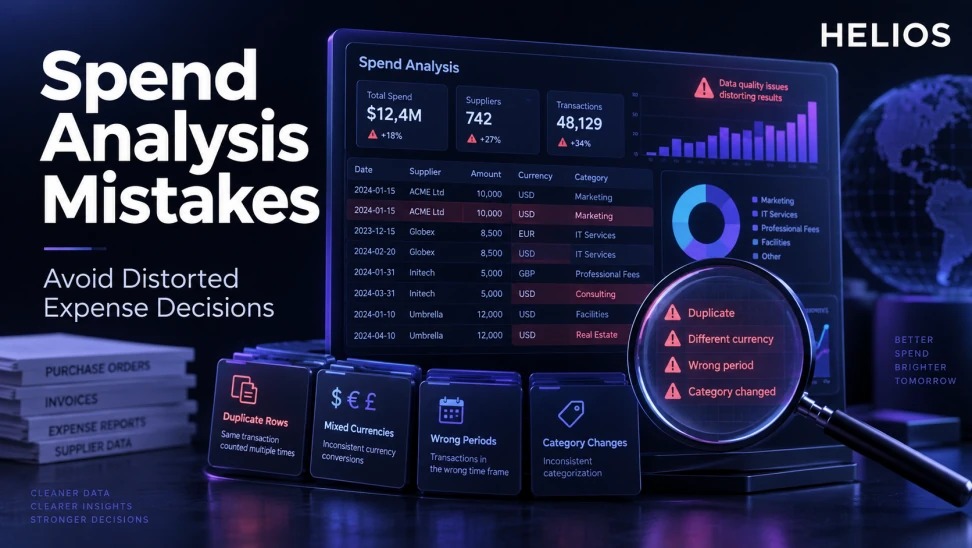
This diagnostic guide shows how duplicate rows, inconsistent periods, mixed currencies, category changes, omitted refunds, and missing channels distort employee expense conclusions.
What finance teams need to know
This diagnostic guide shows how duplicate rows, inconsistent periods, mixed currencies, category changes, omitted refunds, and missing channels distort employee expense conclusions.
Helios can provide structured reporting and integration data, but analytical methods and source-data correction require governed finance work rather than an assumption that software automatically fixes every issue.
For related guidance, see automated expense tracking.
The framework below turns the topic into defined inputs, owners, decisions, controls, and measures rather than a generic software overview.
Spend Analysis Mistakes That Distort Employee Expense Decisions at a glance
| Area | Definition | Owner | Control |
| Mistake | Distortion | Diagnostic | Correction |
| Duplicate rows | Spend overstated | Key and source comparison | Remove or flag once |
| Wrong period | False trend | Date-basis audit | Consistent calendar |
| Mixed currency | Invalid totals | Currency completeness | Documented conversion |
| Category drift | Artificial movement | Mapping version review | Controlled restatement |
| Missing refunds | Net spend overstated | Credit reconciliation | Include linked reversals |
For related guidance, see cross-border exchange-rate guide.
A practical operating model connects data, decisions, ownership, and follow-through.
Counting duplicate records
Duplicates can arise from joins, card and claim overlap, resubmissions, imports, or multiple receipt pages. They overstate spend and transaction frequency.
Define stable keys, preserve source IDs, flag uncertain matches, and reconcile totals before removing records.
For related guidance, see duplicate payment detection.
Mixing time periods
Transaction, service, submission, approval, posting, and payment dates answer different questions. Mixing them creates false trends and cutoff spikes.
Choose a date basis per measure and disclose it. Use a complete fiscal calendar and identify late submissions.
Combining currencies incorrectly
Adding CAD, USD, EUR, and other currencies without conversion is meaningless. Using inconsistent rates can create artificial savings or variance.
Preserve original currency, amount, rate, converted amount, rate source, and conversion date.
Ignoring category drift
The same expense may move between software, IT services, subscriptions, or professional fees after taxonomy changes. Trend breaks can look like real business change.
Version category mappings and restate history only under a documented rule. Report unmapped and reclassified value.
For related guidance, see expense categories and GL accounts.
Omitting refunds and channels
Ignoring credits, reversals, cash reimbursements, card transactions, or direct-paid expenses overstates net spend or hides activity.
Reconcile every included channel to control totals and disclose excluded scope.
Using averages without context
Average expense can move because route, region, role, project, or transaction mix changed. Outliers and missing values can dominate small samples.
Segment before concluding, show distributions and volumes, and test whether the finding survives alternative definitions.
Create a diagnostic checklist
Before publication, reconcile totals, inspect duplicates, test date coverage, validate currencies, review taxonomy versions, include refunds, and compare channel completeness.
Keep a data-quality log so recurring source problems receive owners and correction dates.
How Helios supports this workflow
Helios can connect mobile expense capture, OCR, configurable policy controls, role-based approvals, accounting preparation, integration, and multidimensional reporting. Capabilities outside the confirmed product scope should be validated during implementation.
For related guidance, see expense automation reporting.
- Capture structured expense and receipt fields.
- Preserve source and workflow status data.
- Report by currency, entity, category, project, and time.
- Connect approved expenses to accounting systems.
- Support reconciliation and exception analysis.
- Provide inputs for a governed data-quality process.
A practical conclusion
The strongest process uses explicit definitions, accountable owners, reliable evidence, and measures that reveal whether the intended decision actually improved.
See how Helios can support this workflow. Request a Helios demo.
FAQ about choosing an expense system for this need
What is the most common spend analysis mistake?
Using unreconciled data with duplicates, missing channels, or inconsistent definitions is a frequent root problem.
Which date should expense analysis use?
Choose the date that matches the question and disclose it; transaction, approval, posting, and payment dates are not interchangeable.
How should currencies be combined?
Preserve original values and use a documented rate, source, and date for converted reporting.
What is category drift?
It is a change in classification over time that can create artificial trends unless mappings are versioned.
Why do refunds matter?
Omitted credits and reversals overstate net spend and can distort savings or supplier conclusions.
Does Helios automatically fix analytical data?
Helios provides structured data and reporting capabilities, but finance must govern definitions, reconciliation, and corrections.