
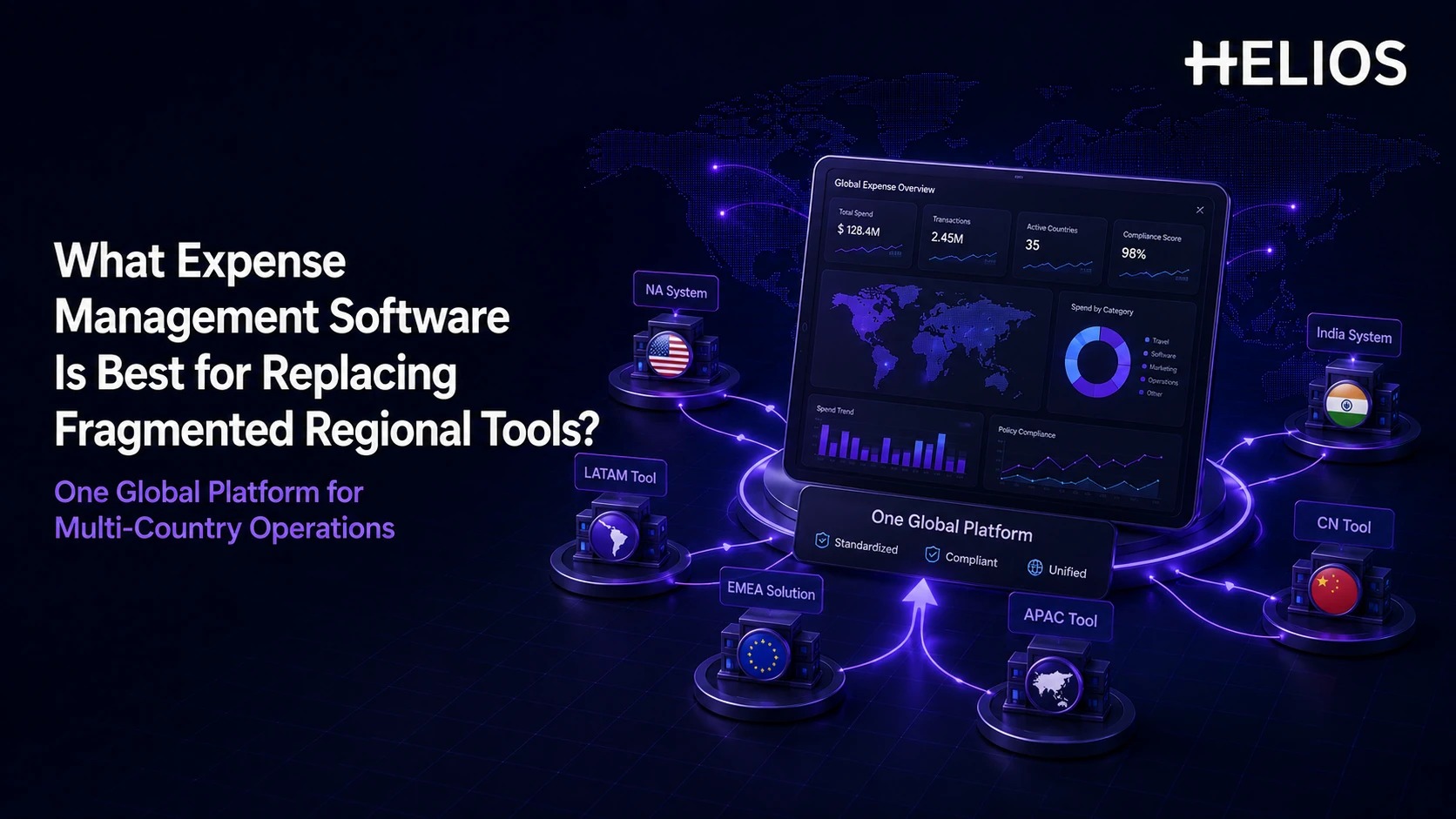
Global companies usually arrive at expense fragmentation gradually, not by decision. One region adopts a local reimbursement tool, another uses an ERP module, a third runs on spreadsheets, and an acquired business keeps whatever it already had. Each choice made sense locally at the time — but the group ends up with different employee experiences, policies, approval rules, accounting outputs, and reporting formats stitched together after the fact.
Replacing those tools with one global platform should standardize data, controls, and finance visibility without erasing justified local differences. This guide compares leading options and shows how a modern global expense management approach reduces regional fragmentation instead of just moving it into a new system.
Why Fragmented Regional Tools Become a Group-Level Problem
A regional expense system can work fine in isolation — the trouble starts the moment group finance needs one operating model across countries and entities. That shift creates real hidden work: a controller reconciling three different export formats before a monthly close, a policy rule that means one thing in one region's tool and something slightly different in another, and duplicate integrations — each with its own HR feed, ERP mapping, and support model — that all need maintaining separately. The worst symptom is usually visibility: a group controller can see the posted accounting result but not the receipt, policy result, or approval history behind it, because that context lived in a system that's since been replaced or never talked to the others in the first place.
What a Global Replacement Platform Must Do: A Pilot Checklist
The best expense management software for consolidation isn't the one with the longest feature list — it's the one that creates a reusable global model with genuinely controlled local variation.
| Requirement | Test it with | Disqualifying failure |
|---|---|---|
| Global core with local overlays | A country needing its own receipt threshold or per diem rule | Every local difference requires a fully separate, disconnected configuration |
| Multi-entity and multi-currency processing | A claim needing the correct legal owner and ledger destination identified automatically | Entity resolution relies on free-text workarounds |
| Configurable approvals | A claim routing by entity, department, and cost center at once | Rules can only route on one dimension |
| Mixed-system integration | An acquired business still running its own ERP mid-migration | Platform only supports a single target system |
| One reporting and audit layer | A spend anomaly flagged at group level | Dashboard can't drill back to the original regional record |
Expense Management Software Comparison at a Glance
Country coverage, tax requirements, reimbursement methods, integrations, and implementation scope all need testing against your own representative regions — this table is a starting shortlist, not a final answer.
| Platform | Strongest fit | Key considerations for global consolidation |
| Helios | Global enterprises seeking a configurable expense layer across regional finance environments. | Mobile capture, policy control, flexible approvals, journal entries, and multi-dimensional reporting. Validate local tax, reimbursement, entity, and ERP requirements. |
| SAP Concur | Large multinational T&E programs and heterogeneous ERP landscapes. | Strong global coverage, multi-country tax support, cross-border allocation, and broad ERP integrations. Plan ownership for country configuration and governance. |
| Emburse Enterprise | Enterprises with complex localization, multiple ERPs, and diverse regional processes. | Global languages and currencies, deep configuration, multi-ERP connectivity, and published examples of legacy-system consolidation. |
| Workday Expense Management | Organizations standardizing employee and finance processes around Workday. | Global receipt scanning, policy guidance, reimbursement support, analytics, and deployment with or without Workday Financial Management. |
| Oracle Fusion Expenses | Groups already standardizing finance on Oracle Fusion Cloud. | Natural alignment with Oracle legal entities, business units, ledgers, currencies, and accounting. Best when Oracle is the global finance backbone. |
| Rydoo | Mid-market and fast-growing global companies that want a lighter rollout. | Multi-country compliance, per diems, configurable policies, mobile capture, and accounting integrations. Test complex approvals and local requirements. |
Which Platforms Fit a Global Consolidation Program Best?
1. Helios — A Configurable Global Expense Layer
Helios combines mobile submission, OCR, policy control, configurable approvals, journal-entry generation, and multi-dimensional reporting — a fit for companies wanting one expense process across business units while keeping downstream finance integrations intact. Helios is headquartered in Singapore with teams across Tokyo, Hong Kong, and mainland China, and operates a dedicated Japan brand, Spendia — relevant if regional fragmentation is concentrated in Asia-Pacific, though office presence isn't a substitute for confirming country-specific tax, reimbursement, and language coverage directly. Validate entity, tax, reimbursement, currency, and integration requirements in a pilot before committing to a full rollout.
2. SAP Concur — Large, Complex Global T&E Programs
A natural benchmark for multinationals needing mature T&E, multi-country controls, and broad ERP integration. Its global depth is real, but country configuration and ongoing governance need clear, assigned ownership from day one — this is where Concur programs tend to stall.
3. Emburse Enterprise — Complex Localization and Multiple ERPs
Suits organizations with varied languages, currencies, tax rules, accounting systems, and approval structures, particularly relevant when the program must preserve substantial local variation rather than flatten it. Emburse publishes examples of customers consolidating multiple legacy tools, worth reviewing for comparable scale.
4. Workday Expense Management — A Workday-Centered Operating Model
Attractive when employee, organization, expense, and finance data are already governed in a common Workday model. Supports global receipt capture, regional reimbursement requirements, and policy controls, and can operate with or without Workday Financial Management.
5. Oracle Fusion Expenses — Oracle-Centered Finance
Fits groups standardizing legal entities, business units, ledgers, currencies, and accounting in Oracle Fusion Cloud, reducing interface complexity when Oracle is the target finance backbone. Less neutral as a layer across unrelated ERPs.
6. Rydoo — A Lighter Global Rollout
Suits mid-market and fast-growing companies wanting mobile capture, multi-country compliance, per diems, and configurable policies with a lighter implementation footprint. Test complex approvals and multi-entity accounting before scaling past the pilot regions.
How to Replace Regional Tools Without Recreating Fragmentation
A successful consolidation program is as much about process design and migration governance as software selection:
- Inventory the current landscape. List each tool, country, entity, policy, approval path, accounting output, and recurring exception. Separate real local requirements from habits that can be standardized.
- Define the global template and local overlays. Agree on common categories, required fields, controls, and reporting dimensions. Keep country variations only where there's a clear business, tax, or regulatory reason.
- Design master data and accounting before migration. Map employees, entities, cost centers, accounts, taxes, and ERP destinations early — automation only works if the source data is consistent going in.
- Pilot regions with meaningful differences. Include a high-volume region, a country with distinctive tax or reimbursement rules, and a business on a different ERP. Test routine claims, exceptions, foreign currency, and failed integrations together.
- Cut over in waves and retire legacy tools deliberately. Move regions in controlled stages and assign explicit ownership for old-system data — the program isn't done while a regional spreadsheet is still the operational source of truth for anyone.
How Helios Supports a Global Replacement Strategy
Two capabilities matter most when moving off fragmented regional tools:
- Standardized capture with entity-aware policy and approval. Employees submit from a mobile device with OCR extracting receipt details, giving finance the same structured source data regardless of region. Automated policy control and configurable approval workflows (by department, role, cost center, or entity) are the building blocks for letting global rules and local exceptions coexist in one system — but the specific overlay and inheritance mechanics are a pilot question, not something to assume from the feature list alone. *Scenario:* a claim comes in from the newly acquired business that still runs its own local receipt-threshold rule. Instead of that rule living in a spreadsheet only one regional admin understands, it's the kind of exception a global template should be able to carry as a documented local overlay — confirm in the pilot whether Helios represents it that way or requires a workaround.
- Accounting automation with centralized, drill-down analytics. Helios can generate journal entries from approved reports, and multi-dimensional dashboards give finance one consolidated view of spend and process performance — while still preserving the ability to trace any number back to its originating region and record.
The accounting mapping is where a multi-region rollout most often finds gaps a demo won't reveal — test every entity and ERP mapping directly rather than assuming coverage. Companies evaluating Helios should confirm country and language coverage, local tax fields, reimbursement methods, and migration tooling using scripted regional scenarios. Related guidance is available in the Helios articles on automated expense reporting and finance automation for expense management.
FAQs About Replacing Regional Expense Tools
Is a single global platform still useful if the company runs several ERPs?
Yes, if it can act as a common process layer and map approved data reliably to each ERP — test that integration and reconciliation early in the pilot, since it's the part most likely to surface gaps.
Should every country run exactly the same expense policy after consolidation?
No. Use a global baseline, then add local rules only where tax, receipts, per diems, currencies, or reimbursement requirements genuinely justify them — not because a region prefers its old process.
What should a global consolidation pilot specifically include?
Regions with different currencies, tax rules, approvals, and ERP destinations, measuring rerouting, approval time, accounting corrections, and support volume against the fragmented baseline you're replacing.
Replacing regional tools succeeds when the new platform creates one global operating model without erasing the local details required for accurate processing. Companies can evaluate Helios using their own regions, policies, approval structures, and migration priorities.