
What finance teams need to know
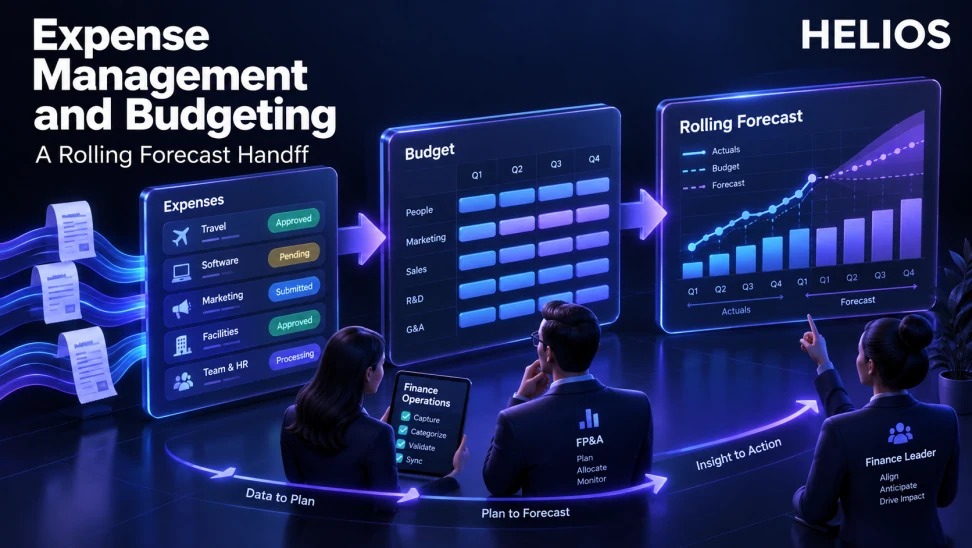
This guide defines how employee expense states should move into budget actuals, commitments, and a rolling forecast, with a clear handoff between finance operations and FP&A.
This is a data and responsibility handoff, not an assumption that Helios directly replaces a budgeting platform or provides native forecasting. Direct budget integrations and forecasting functions must be confirmed.
For related guidance, see month-end employee expense accruals.
The framework below turns the topic into defined inputs, owners, decisions, controls, and measures rather than a generic software overview.
Integrating Expense Management and Budgeting at a glance
| Area | Definition | Owner | Control |
|---|---|---|---|
| Expense status | Operational lifecycle state | Finance operations | Stable definitions |
| Budget period | Fiscal month or quarter | FP&A | Calendar mapping |
| Actuals | Posted expense | Accounting | Ledger reconciliation |
| Commitments | Approved or known future cost | Budget owner | De-duplicate at posting |
| Forecast | Expected future expense | FP&A | Documented assumptions |
For related guidance, see ERP integration test cases.
A practical operating model connects data, decisions, ownership, and follow-through.
Define expense states before mapping
Use submitted, approved, incurred but not submitted, posted, paid, returned, and rejected as distinct states. Each answers a different planning question.
Document which state represents an actual, commitment, forecast input, or excluded item. Prevent the same transaction from entering more than one bucket.
For related guidance, see automated expense tracking.
Align dates and budget periods
Choose transaction date, service date, approval date, posting date, or payment date for each measure. Map fiscal calendars, entities, currencies, and late submissions consistently.
Use a cutoff calendar and explain how post-close adjustments flow into the next forecast refresh.
Build the rolling forecast handoff
Finance operations supplies reconciled actuals, approved commitments, known unsubmitted expenses, and exception notes. FP&A maps them to forecast lines and records overrides.
The handoff file or interface needs owner, version, timestamp, source, currency basis, category mapping, and reconciliation totals.
Prevent double counting
Match card transactions, claims, accruals, postings, and payments using stable identifiers. Reverse commitments when the same expense becomes an actual.
Reconcile movement between opening forecast, new activity, actualization, cancellations, and closing forecast.
For related guidance, see expense automation reporting.
Assign ownership and cadence
Finance operations owns expense status quality; accounting owns posting and close; FP&A owns forecast treatment; budget owners explain operational changes.
Set weekly or monthly cutoffs based on materiality and volatility. Escalate missing data to the person who can resolve it.
Measure handoff quality
Track reconciliation difference, unmapped value, late expense rate, stale commitments, forecast adjustments, and time to refresh.
Review forecast error separately from data handoff error so teams fix the right problem.
How Helios supports this workflow
Helios can connect mobile expense capture, OCR, configurable policy controls, role-based approvals, accounting preparation, integration, and multidimensional reporting. Capabilities outside the confirmed product scope should be validated during implementation.
For related guidance, see finance automation for expense management.
- Provide structured expense status and reporting data.
- Capture receipts and coding through mobile workflows.
- Apply policies and role-based approvals.
- Prepare approved records for accounting.
- Support multidimensional analysis by entity, category, project, and cost center.
- Supply data for a separately governed forecast handoff.
A practical conclusion
The strongest process uses explicit definitions, accountable owners, reliable evidence, and measures that reveal whether the intended decision actually improved.
See how Helios can support this workflow. Request a Helios demo.
FAQ about connecting expense management and budgeting
What is the rolling forecast handoff?
It is the controlled transfer of expense actuals, commitments, known unsubmitted costs, assumptions, and ownership into the forecast process.
Which expense date should budgeting use?
The answer depends on the measure. Define transaction, service, approval, posting, and payment dates separately.
How do teams avoid double counting?
Use stable identifiers and reverse commitments or accruals when the underlying expense becomes an actual.
Does Helios provide budgeting forecasts?
The confirmed scope supports expense data and reporting; direct budgeting integration and native forecast functions must be validated.
Who owns the handoff?
Finance operations owns lifecycle data, accounting owns postings, FP&A owns forecast treatment, and budget owners explain business changes.
Which KPIs matter?
Track reconciliation difference, unmapped value, stale commitments, late expenses, adjustments, and refresh time.