
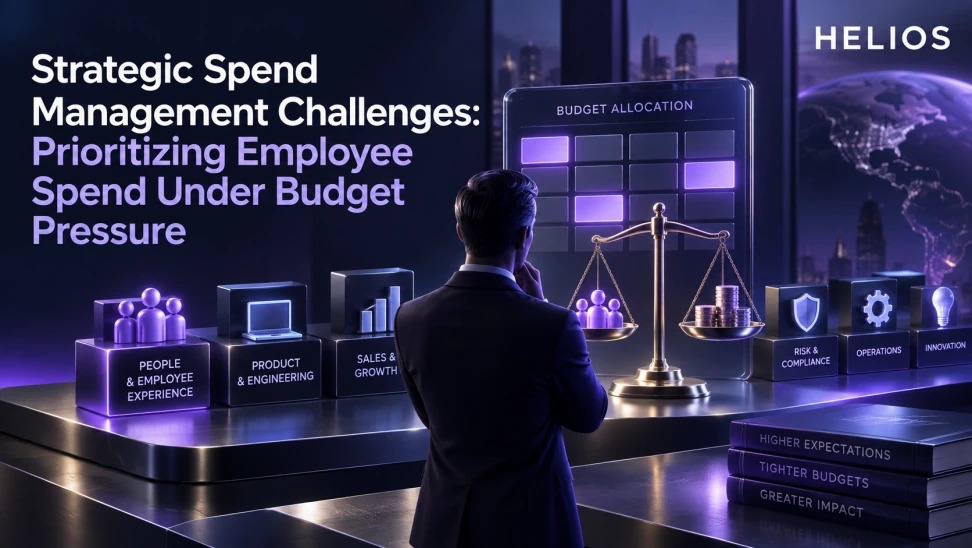
A decision framework for prioritizing employee expenses when finance must protect business continuity, controls, and growth within a tighter budget.
A practical framework for finance teams
A decision framework for prioritizing employee expenses when finance must protect business continuity, controls, and growth within a tighter budget.
This guide addresses employee spend decisions rather than procurement category strategy or a software ranking. Finance should validate legal, safety, contractual, tax, and employee-relations constraints before reducing an expense.
For related guidance, see complex reimbursement and budget control.
Start with a defined population, consistent evidence, named owners, and a decision that the analysis is meant to improve. The framework below connects each metric or workflow step to a control and a follow-up action.
Strategic Spend Management Challenges at a glance
| Criterion | Question | Score | Decision effect |
| Business necessity | What outcome fails without the spend? | 1–5 | Protect essential work |
| Risk and compliance | What exposure increases if reduced? | 1–5 | Set a minimum floor |
| Economic impact | What revenue, cost, or capacity changes? | 1–5 | Prioritize net value |
| Substitutability | Is a lower-cost route available? | 1–5 | Redesign before cutting |
| Reversibility | Can the decision be reversed quickly? | 1–5 | Sequence experiments |
For related guidance, see expense versus spend management.
A controlled handoff links evidence, ownership, decisions, and follow-through.
Define the employee-spend boundary
Include travel, local transport, meals, training, tools, home-office costs, customer work, and other employee-paid or card expenses. Separate committed, incurred, approved, posted, and forecast amounts.
Map each category to an owner and business outcome. A broad discretionary label can hide safety, customer, or operational dependencies.
For related guidance, see decentralized approval rules.
Use a transparent prioritization matrix
Score business necessity, risk, economic impact, substitutability, time sensitivity, employee impact, and reversibility. Define anchors for each score and require evidence.
Use the matrix to structure discussion, not to manufacture precision. A legal or safety floor can override the weighted total. Record who approves exceptions.
Resolve cross-department disputes
A department may save its own budget while shifting work or cost to finance, operations, another entity, or employees. Estimate transferred cost, delays, and control impact before approving a cut.
Use a cross-functional review for expenses with shared beneficiaries. Assign one decision owner and record dissent or dependencies.
Choose redesign before blunt reduction
Replace lower-value trips with remote meetings, consolidate visits, change booking windows, simplify low-risk approvals, negotiate service options, or focus training on critical roles.
Track employee burden and business outcomes. A nominal cut that creates manual work, delayed reimbursement, or lost sales may reduce enterprise value.
For related guidance, see split allocation across dimensions.
Create an exception and escalation path
An exception should state the rule, business purpose, alternatives considered, incremental amount, beneficiary, accountable sponsor, and end date.
Review repeat exceptions as evidence that a limit is unrealistic, ownership is unclear, or the category needs redesign.
Measure whether prioritization worked
Track actual versus target, protected outcome, cost shifted elsewhere, exception rate, approval delay, reimbursement delay, employee impact, and reversals.
Revisit decisions when assumptions change. Separate recurring structural savings from a one-time deferral or cost avoidance.
How Helios supports this workflow
Helios can connect mobile expense capture, multilingual OCR, configurable policy controls, role-based approvals, accounting preparation, integration, and multidimensional reporting. These capabilities can provide structured records and workflow evidence. Contract interpretation, external audit opinions, customer invoicing, and capabilities outside the confirmed product scope require separate validation.
For related guidance, see automated expense approval workflows.
- Report employee spend by entity, category, department, project, and owner.
- Apply policy limits and role-based approvals.
- Capture business purpose and exception evidence.
- Support mobile submission without shifting administration to employees.
- Prepare approved records for accounting and analysis.
- Provide data for a finance-owned prioritization review.
A practical conclusion
A useful finance process makes the scope visible, preserves the evidence, assigns the decision, and verifies the result. Treat every benchmark, exception, posting, and recharge as an input to action rather than an isolated number.
See how Helios can support this workflow. Request a Helios demo.
FAQ
What is strategic employee spend management?
It links employee expense decisions to business outcomes, budget ownership, risk, controls, and measured follow-through.
Which expenses should be protected?
Protect legally required, safety-critical, customer-essential, continuity-critical, and high-value expenses according to documented evidence.
How should departments resolve competing priorities?
Use common criteria, disclose cost transfers, assign one decision owner, and document dependencies and exceptions.
What is the difference between savings and deferral?
Savings remove recurring cost while protecting outcomes; deferral moves cost or activity into a later period.
How should exceptions work?
Require the rule, reason, alternatives, amount, sponsor, duration, and evidence, then review repeated patterns.
How does Helios support prioritization?
Helios can supply policy, approval, evidence, accounting, and multidimensional reporting data for the finance decision process.