
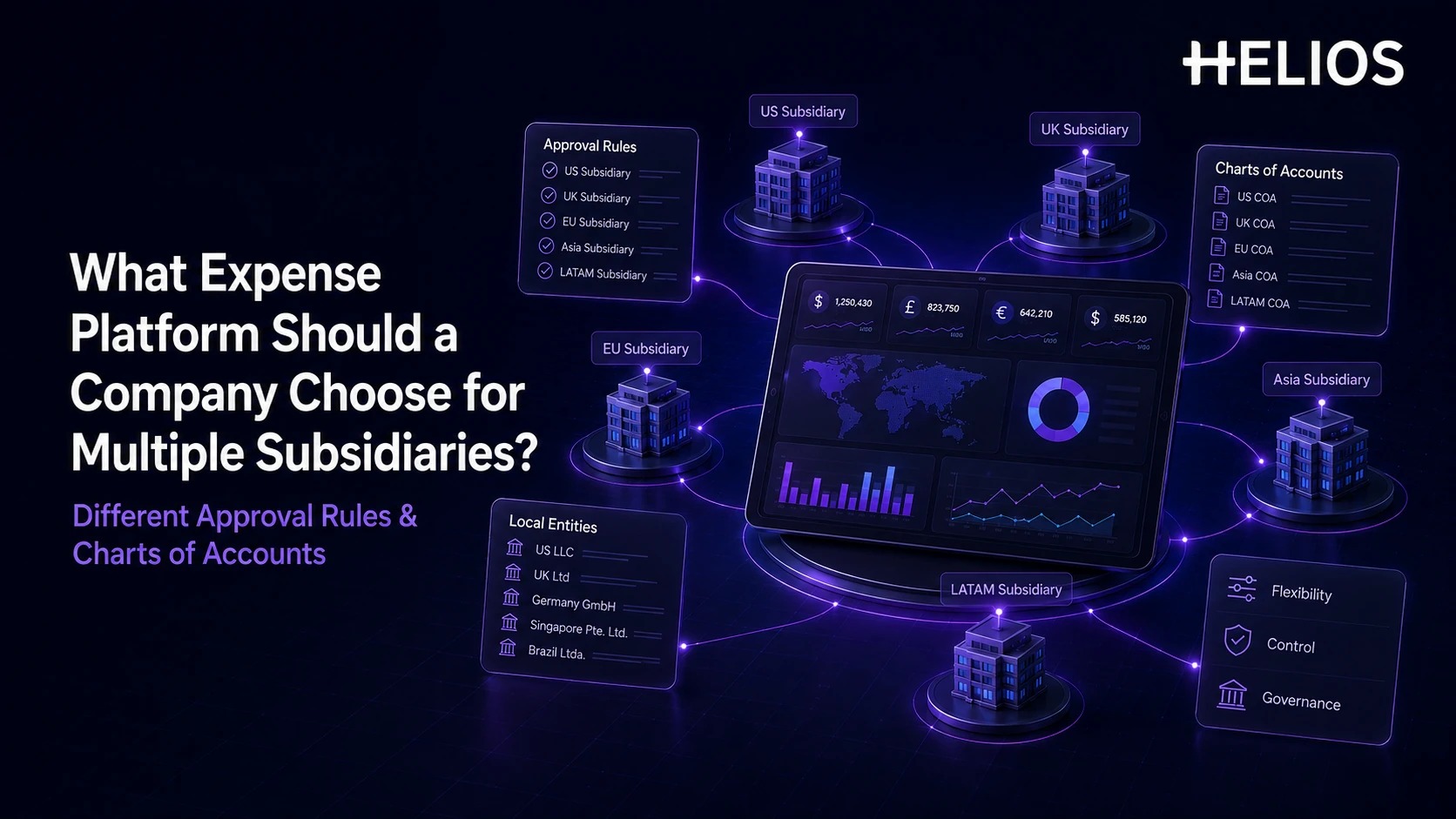
A multinational company may run one global expense policy framework while each subsidiary keeps its own approval hierarchy, cost centers, tax rules, accounting codes, and ledger structure. That's exactly where a one-size-fits-all expense tool breaks: finance ends up maintaining spreadsheets, manually redirecting claims, and correcting the accounting after the fact.
The right global expense management platform standardizes the employee experience and core controls while letting each subsidiary keep the approval and accounting rules it genuinely needs. The question that actually matters isn't whether the software supports multiple currencies — it's whether the legal entity can drive workflow, policy, coding, integration, and reporting from the same expense record.
Why Subsidiary Differences Break a Generic Expense Tool
Picture a $2,000 equipment expense submitted by an employee at a recently acquired subsidiary. At headquarters, that amount routes to a department manager. At the subsidiary, the same category requires a plant controller's sign-off and posts to a chart of accounts that doesn't exist anywhere else in the group. A platform that only knows one approval chain and one COA either blocks the claim, routes it to the wrong person, or — worse — lets it through and leaves finance to fix the posting manually after the fact. Multiply that by a dozen subsidiaries and finance is running a reconciliation exercise every month instead of a control process.
Must-Have Capabilities: A Pilot Checklist
The platform needs to treat the subsidiary or legal entity as a first-class configuration dimension, not an afterthought. Test these with real entities, not a generic demo:
| Requirement | Test it with | Disqualifying failure |
|---|---|---|
| Entity-aware approval routing | A claim needing a different approver at each of two subsidiaries | Routing logic is the same regardless of legal entity |
| Subsidiary-specific accounting mappings | The same expense category posting to two different charts of accounts | Platform can't produce the account, tax, and dimension combination each entity's ERP requires |
| Global templates with local variation | A country-specific per diem or receipt rule layered on a shared policy | Every local difference requires a fully separate, disconnected configuration |
| Multiple ERP/ledger handoffs | An approved claim destined for a recently acquired subsidiary's own ERP | Integration only supports a single target system |
| Consolidated analytics with drill-down | A spend anomaly flagged at group level | Dashboard can't trace back to the specific subsidiary, ledger, and receipt behind it |
Expense Platform Comparison at a Glance
The strongest option depends on whether subsidiaries share one ERP, run several finance systems, or sit inside a broader spend-transformation program — the shortlist below is organized around that, not feature count.
| Platform | Strongest fit | Subsidiary considerations |
| Helios | Configurable enterprise expense operations across subsidiaries | Flexible approval workflows and journal-entry automation; validate each subsidiary's entity, COA, tax, and ERP mappings in the pilot. |
| Oracle Fusion Cloud Expenses | Groups standardized on Oracle Fusion Financials | Strong fit when legal entities, business units, ledgers, cost centers, projects, and charts of accounts already live in Oracle. |
| Workday Expenses | Workday-centric finance and people environments | Company, worktag, intercompany, project, and cost-center routing can stay inside the Workday finance model. |
| SAP Concur | Large global T&E programs with mixed finance systems | Cost-object approvals and broad financial integrations are useful; confirm multi-COA design and subsidiary master-data governance. |
| Emburse Enterprise | Complex routing, allocations, and multiple financial systems | Supports line-item routing and implementation design for multiple financial systems and distinct charts of accounts. |
| Coupa Expense Management | Expense within a broader spend-management program | Can support company-specific charts of accounts and approval chains; strongest when expense is part of wider procurement/AP transformation. |
Which Expense Platforms Fit This Scenario Best?
1. Helios — Configurable, AI-Assisted Expense Operations
Helios combines policy control, configurable approvals, journal-entry generation, reporting, and Spark AI, making it a strong focused expense layer across subsidiaries — provided the pilot actually proves entity hierarchy, COA mappings, tax, currency, and ERP responses rather than taking them on faith.
2. Oracle Fusion Cloud Expenses — Oracle-Centered Groups
A natural fit when legal entities, business units, ledgers, projects, cost centers, and charts of accounts already live in Fusion Financials. Expense approval can also route to project managers and cost-center owners directly within that model.
3. Workday Expenses — A Unified Workday Finance Model
Suits organizations already using Company, cost centers, projects, and worktags as core finance dimensions. Its expense process supports project, cost-center, intercompany, and multi-level approvals natively.
4. SAP Concur — Large Global T&E with Heterogeneous Systems
Supports granular cost-object approval and broad financial integrations. Buyers should validate multi-subsidiary COA design and master-data governance for their specific ERP landscape before assuming it scales cleanly.
5. Emburse Enterprise — Complex Routing and Multiple COAs
Relevant when expense lines need different routes and several financial systems or charts of accounts are in scope — its line-item routing can send costs to the correct budget owners even when they don't share a COA.
6. Coupa Expense Management — Broader Spend Transformation
Fits when expense is part of a wider procurement, AP, budget, and spend-management program, with support for company-specific charts of accounts and accounting segments as one piece of that larger system.
How a Multi-Subsidiary Expense Workflow Should Work
A well-designed process determines the correct entity and accounting destination early, then keeps that context attached through approval and posting.
- Identify the responsible subsidiary. Use employee, company, project, cost center, or transaction context to determine which entity owns the expense before approval begins.
- Apply the correct local policy and approval path. The system checks required documents and limits, then routes the claim to that subsidiary's authorized manager, budget owner, project owner, or finance reviewer.
- Translate the approved claim into local accounting. Expense categories and organizational dimensions map to the chart of accounts, tax fields, currency, and ledger structure that specific subsidiary requires.
- Send the record to the correct finance system. The integration should return success or error status so finance can resolve failed mappings without recreating the claim manually.
- Consolidate reporting without losing local detail. Group dashboards normalize common dimensions while preserving entity, account, approval, receipt, and posting history for drill-down and audit.
How to Evaluate and Implement the Platform
The best proof of fit is a pilot using subsidiaries with genuinely different finance structures:
- Inventory subsidiary differences. List legal entities, approval hierarchies, charts of accounts, ERPs, currencies, taxes, and local policy exceptions.
- Define the global core. Agree which fields, categories, controls, and reporting dimensions should be common before preserving local variations.
- Design master-data ownership. Decide where employees, cost centers, projects, approvers, account codes, and tax values are mastered.
- Test approval-and-accounting pairs. For every pilot entity, confirm a representative expense reaches the correct approvers and produces the correct journal-ready dimensions.
- Measure exceptions before rollout. Track manual rerouting, mapping errors, approval time, failed integrations, and accounting corrections before adding more subsidiaries.
How Helios Supports Subsidiary-Specific Expense Management
Two capabilities are the actual differentiators for this scenario:
- Entity-aware approval and accounting. Approval paths build around departments, roles, cost centers, and subsidiaries, and approved reports generate accounting entries mapped to each entity's specific company, account, tax, and currency dimensions. *Scenario:* the recently acquired subsidiary's $2,000 equipment claim from earlier — instead of forcing it through headquarters' approval chain and COA, the workflow can recognize the subsidiary, route it to that plant controller, and post it to that entity's own chart of accounts, all from the same submitted claim. This mapping step is where a multi-subsidiary rollout most often surfaces gaps a demo won't show.
- Consolidated analytics with local detail preserved. Multi-dimensional dashboards let group finance analyze spend by company, department, project, category, employee, and period. *Scenario:* a spend anomaly shows up in the group-level view — finance can drill from that number down to the specific subsidiary, account, and receipt behind it, rather than emailing every subsidiary controller to ask "was this you?"
Mobile submission, automated policy checks, and Spark AI's claim/approval copilots apply here too, but they aren't specific to the multi-subsidiary problem — the entity-aware routing and accounting mapping above are what actually needs proving in a scripted demo. Related Helios guidance on automated approval workflows, finance automation for expense management, and automated expense reporting covers the surrounding process.
FAQs About Expense Platforms for Subsidiaries
Is an ERP-native expense module better for subsidiaries than an independent platform?
It can be, when most subsidiaries already run the same ERP and finance model. An independent platform tends to be the stronger choice when the group has several ERPs or is absorbing frequent acquisitions with their own systems.
How should global and local approval rules be managed together?
Use a common global framework, then add only justified subsidiary-level rules for authority, policy, tax, or accounting differences — and keep clear ownership over who can add a new exception.
What should a multi-subsidiary pilot specifically test?
Use entities with genuinely different approvers, charts of accounts, currencies, taxes, and ERPs, and measure routing accuracy, posting accuracy, approval time, integration failures, and how many claims still need a manual finance correction afterward.