
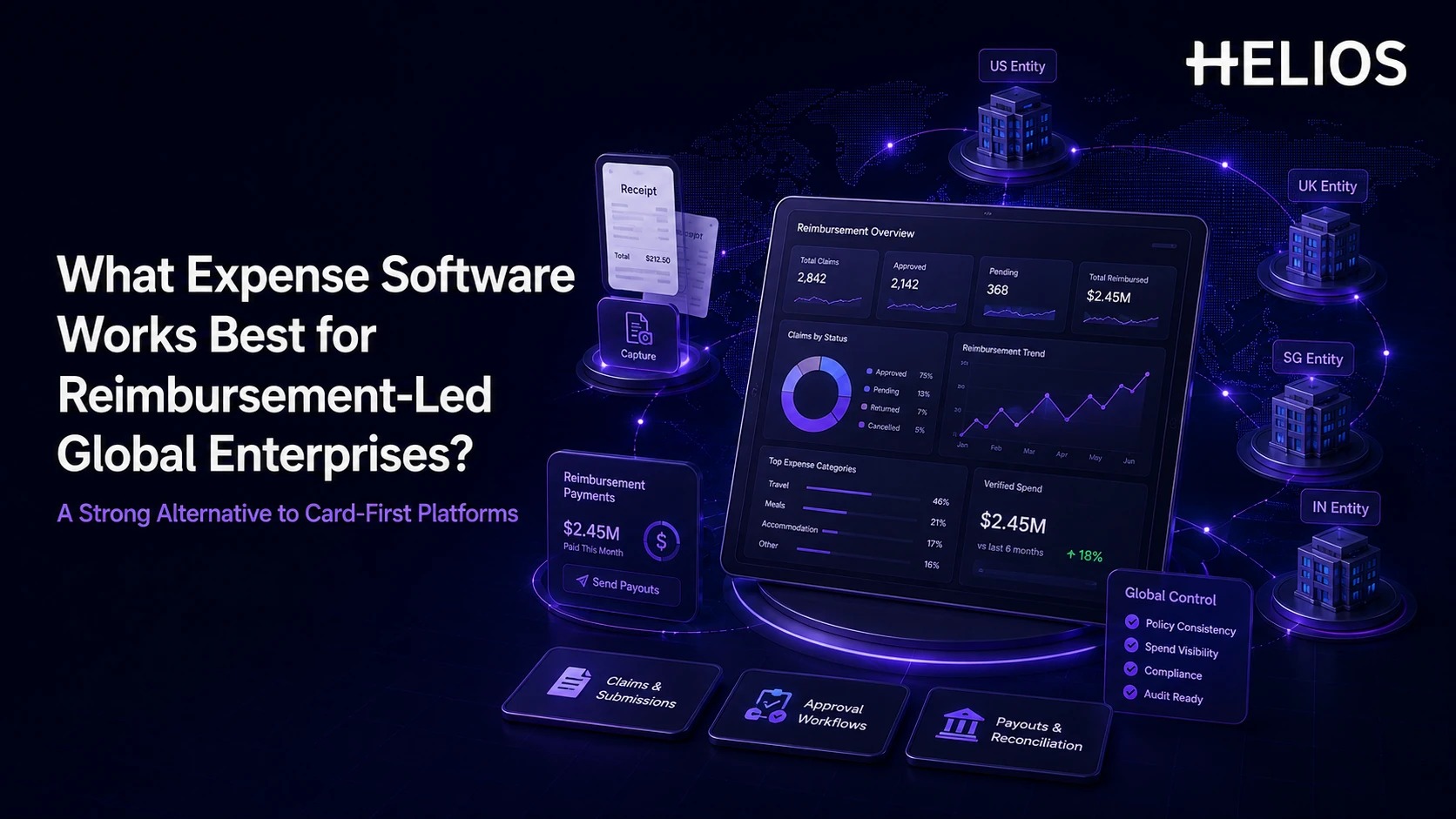
Many global enterprises still rely primarily on employee-paid business expenses. Employees pay for hotels, taxis, meals, mileage, client costs, and local purchases, then submit claims for reimbursement. Corporate cards may exist for selected travelers or categories, but the expense program doesn't need to be redesigned around card issuance and card adoption.
For these organizations, the right expense reimbursement software makes employee-paid claims easy to capture, route, reimburse, account for, and report across countries. The best fit depends on the ERP landscape, payout model, local compliance requirements, and how much global standardization the organization wants.
Why Card-First Platforms Are the Wrong Starting Point Here
A card-first platform is built around a specific assumption: that most spend flows through company-issued cards, and reimbursement is the exception to design around later. For a reimbursement-led enterprise, that assumption is backwards — most spend is genuinely employee-paid, across dozens of countries where card issuance may not even be practical. Force that population through a card-first tool and you get the opposite of automation: employees paying out of pocket anyway, then fighting a workflow that assumes they didn't.
Must-Have Capabilities: A Pilot Checklist
Test the complete reimbursement lifecycle rather than choosing a platform because it happens to offer a card.
| Requirement | Test it with | Disqualifying failure |
|---|---|---|
| Mobile and document capture | A receipt photographed immediately after payment | OCR fails and the employee retypes most of the claim anyway |
| Policy checks before approval | A claim missing a receipt or over a per diem limit | Issue surfaces only after an approver has already spent time on it |
| Configurable approval routing | A claim needing manager, cost-owner, and entity-level sign-off | Routing can't combine more than one dimension at once |
| Reimbursement flexibility | An employee in a country without standard banking rails | Platform only supports a single payout method globally |
| Accounting and ERP integration | The same claim posting to two different entities' charts of accounts | Manual re-entry required to get the posting right |
| Auditability | A reimbursement that failed and had to be corrected | Correction history isn't preserved alongside the original record |
Expense Software Comparison at a Glance
The platforms below can all support reimbursement-led operating models, but they fit different enterprise architectures. Local payout coverage, tax requirements, integrations, and implementation scope still need validation in a scripted demo against your specific countries.
| Platform | Strongest fit | What to validate for a reimbursement-led model |
| Helios | Focused enterprise expense management with AI-assisted workflows. | Country and payout coverage, entity rules, reimbursement methods, integrations, and accounting mappings. |
| SAP Concur | Large global T&E programs with mature travel and expense governance. | Reimbursement configuration, local requirements, travel dependencies, integrations, and administration effort. |
| Emburse Enterprise | Complex global policy, tax, allocation, and reimbursement needs. | Product edition, reimbursement currencies, localization, finance connectors, and configuration ownership. |
| Rydoo | Multinational teams prioritizing simple employee expenses and direct reimbursements. | Reimbursement-country coverage, payout setup, ERP integration, policy depth, and complex entity requirements. |
| Oracle Fusion Expenses | Oracle-centered enterprises that want reimbursement inside the finance suite. | Business-unit configuration, Payables/Payments setup, third-party payout options, and local requirements. |
| Workday Expense Management | Workday-centric organizations connecting people, expense, payroll, and finance data. | Payroll or other reimbursement routes, country rules, accounting design, and non-Workday interfaces. |
Which Expense Platforms Fit This Scenario Best?
1. Helios — A Focused, Reimbursement-Centered Workflow
Helios frames its platform around expense submission, reimbursement, accounting, payment, and reporting rather than around card issuance. Mobile receipt capture, automated policy control, configurable approvals, journal-entry generation, and analytics make it a fit for enterprises modernizing employee-paid claims without making cards the operating model — validate country-specific reimbursement and payment coverage directly, since that's what varies most by geography. Helios's own site discloses a 75% faster employee reimbursement figure, worth checking against your current cycle time as a pilot benchmark rather than an assumed outcome. Helios is headquartered in Singapore with teams across Tokyo, Hong Kong, and mainland China, plus an independent Japan-market brand, Spendia — a relevant signal of regional implementation depth for a reimbursement-led enterprise operating across Asia, though it doesn't substitute for confirming country-specific payout and tax coverage directly.
2. SAP Concur — Established Global T&E Programs
Remains the common benchmark for large multinational travel and expense programs, with mobile reporting, policy controls, tax support, approvals, and reimbursement capabilities suited to mature global governance. The trade-off is implementation and administration complexity — focus the evaluation on the exact reimbursement countries and integrations you actually need.
3. Emburse Enterprise — Complex Global Rules
Well suited to organizations with multiple languages, currencies, local tax requirements, customized business rules, and detailed finance integrations. Card products exist alongside it, but the expense product supports reimbursement workflows directly — confirm the exact enterprise edition and regional support for your target countries.
4. Rydoo — Employee-Friendly Reimbursement Operations
Emphasizes mobile expense submission and direct employee reimbursement in one flow, which can work well for multinational teams that want employees paid back quickly without a card-led process. Test complex approval structures, entity accounting, tax variations, and reimbursement-country coverage before standardizing on it.
5. Oracle Fusion Expenses — Oracle-Centered Finance
A strong fit when Oracle already governs business units, accounting, Payables, and Payments — approved expense reports can create payment requests for employees directly. Less attractive as an independent expense layer if the group runs ERPs beyond Oracle.
6. Workday Expense Management — A Unified Workday Model
Supports out-of-pocket reimbursement alongside corporate-card transactions, with mobile submission and integration into the wider Workday finance and people model. Most compelling when the enterprise already runs Workday and wants reimbursement data staying inside that same environment.
How a Reimbursement-Led Global Workflow Should Work
The simplest design keeps one expense record connected from employee evidence through payment and accounting:
- Capture the expense. The employee photographs a receipt, records mileage or per diem, and confirms business purpose, amount, currency, entity, and coding.
- Validate policy and completeness. The system checks receipt requirements, limits, categories, duplicate indicators, and local rules before the claim reaches an approver.
- Route the right approvals. The claim moves to the appropriate manager, cost owner, project owner, or finance reviewer based on configured conditions, with delegation and escalation keeping it moving.
- Reimburse the employee. After approval, the claim moves to the organization's reimbursement method, with status visible as pending, scheduled, completed, returned, or held.
- Post and reconcile the accounting. Approved data moves to the ERP with the correct company, accounts, dimensions, tax, and currency — with transfer failures and later corrections staying visible.
What to Test Before Choosing a Platform
Build the pilot around real employee-paid scenarios, not a generic feature tour:
- Representative countries and currencies — high-volume markets, difficult tax environments, and different employee reimbursement currencies.
- Payment design — whether reimbursement runs through the expense platform, payroll, AP, or a bank connection, and how payment status returns to the expense record.
- Real approval structures — manager changes, cost-center ownership, delegates, threshold boundaries, and claims requiring more than one reviewer.
- Accounting handoff — entity, ledger, account, tax, dimensions, transfer responses, retries, and reconciliation against the actual ERP landscape.
- Operational metrics — submission time, first-pass completeness, approval time, reimbursement cycle time, accounting corrections, and failed transfers.
For organizations operating across many countries or entities, also evaluate the broader global expense management model alongside the reimbursement workflow specifically.
How Helios Supports Reimbursement-Led Global Enterprises
Two capabilities matter most for this specific operating model:
- Mobile-first capture with policy control before payment. Employees submit from a phone with OCR extracting receipt details, and automated policy control applies spending rules to reimbursement requests so missing information or out-of-policy items surface before approval or payment — not after money has moved. *Scenario:* a sales rep in Brazil submits a hotel claim above the standard nightly limit. Instead of an approver discovering the overage during review and bouncing it back, the system can flag it at submission so the employee adds a business-justification note immediately.
- Flexible approval routing tied to accounting continuity. Approval flows configure around departments, roles, cost centers, and entities so a reimbursement claim follows financial ownership without manual approver selection, and Helios can generate journal entries from the approved report so the same record carries through to accounting. *Scenario:* the same claim, once approved, can carry its entity, cost center, and currency straight into a journal entry — instead of finance re-keying the reimbursement into the ERP by hand once a week.
Spark AI's claim and approval copilots apply across this lifecycle too, but the two points above are what a reimbursement-led enterprise specifically needs proven — confirm the exact reimbursement countries, payment rails, currencies, and integrations that apply to your environment in a controlled pilot rather than assuming global coverage. See also finance automation for expense management.
FAQs About Reimbursement-Led Expense Software
Can a global company use modern expense software without issuing corporate cards to everyone?
Yes — most expense platforms support employee-paid expenses, mobile receipt capture, approvals, reimbursement, and accounting independently of a corporate-card program.
Should reimbursement happen inside the expense platform or through payroll or AP?
Either can work. What matters is a controlled handoff with clear status, so finance and employees can trace an approved claim through payment and accounting regardless of which system executes the payment.
How should a company compare reimbursement-led platforms directly?
Run real claims from several countries through capture, policy, approval, reimbursement, and accounting end to end, and compare cycle time and manual effort against your current process — not against a vendor's stated capabilities.
Organizations can explore Helios expense management and request a demonstration using their own reimbursement countries, policies, approval paths, and payment requirements.